


Click here to follow Screen Digital on YouTube and stay updated with the latest from the world of cinema.
Premium
This is an archive article published on August 15, 2014
The memory game
Television and film actor Nikhil Ratnaparkhi, better known for his comic roles, talks about his new Marathi play Begum Memory, Aathwan Gulam
Mumbai | August 15, 2014 01:00 AM IST 3 min read
3 min read


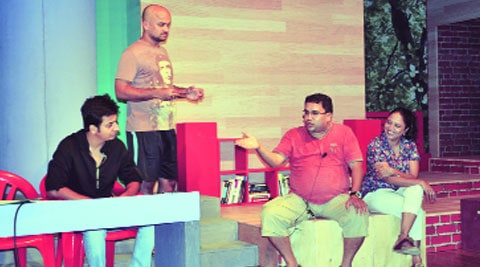 The play’s cast during rehearsals
By Aashay Khandekar
Nikhil Ratnaparkhi, the funny man filling television commercial interludes with his puns and comedy, is known more by his work than his name. The actor, who brought audience to splits with his witty punchlines in films such as Paheli (2005), Tere Bin Laden (2010) and Mod (2011), staged his Marathi play Begum Memory, Aathwan Gulam (BMAG) at Bal Gandharva Rang Mandir on August 3.
As a writer-director, BMAG is Ratnaparkhi’s second play after Tom and Jerry (2012), a light comedy that won him critical acclaim and audience praise alike, for his subtle presentation of petty fights between couples and matrimonial challenges. BMAG, he says, is a world of memories. “It is a pathbreaking trend in theatre. For many years, this topic was playing on my mind. Memories — good or bad — always make a person restless. All the things that he has done in the past, come to haunt him. The play revolves around this theme,” explains Ratnaparkhi, adding that the metaphorical presentation suggests that the brain, which is the most superior organ, is indeed like a ‘begum’ — authoritative and decisive. “But the reminders it carries enslave our mind, corresponding to the ‘gulam’ in the play,” says Ratnaparkhi.
Along with Ratnaparkhi, his wife Bhakti, Sankarshan Karhade, Sushil Inamdar and Latika Sawant have set the ball rolling for the play. Speaking about the pulse of the play, Ratnaparkhi adds, “I would sum up by saying that the story is about how a person’s brain reacts to the pressures that he faces in present-day life while adapting to the changes.”
Apart from the five key characters, the highlight of the play, according to Ratnaparkhi, is its music. Musician Gandhar Sangoram has created a character out of it, says the writer-director, who draws his inspiration from the works of legendary Marathi writer P.L. Deshpande. “His work motivates me to strive for quality and perfection, which is why I am always experimenting and working towards attaining expertise,” he adds.
Commenting on his recent shift to Marathi productions, Ratnaparkhi says, “I didn’t come here due to a lack of opportunity; it was purely out of my own interest. And people have accepted me with lot of warmth.”
Advertisement
Loading Taboola...


More Entertainment




Advertisement
PHOTOS



PHOTOS





Top Stories











Must Read







Advertisement
- 01
- 02
- 03
- 04
- 05
Advertisement
