


Click here to follow Screen Digital on YouTube and stay updated with the latest from the world of cinema.
Premium
This is an archive article published on March 28, 2014
The dancer & his dance
Pandit Birju Maharaj, whose name is synonymous with kathak, on his childhood and the art he lives for
Mumbai | March 28, 2014 01:00 AM IST 4 min read
4 min read


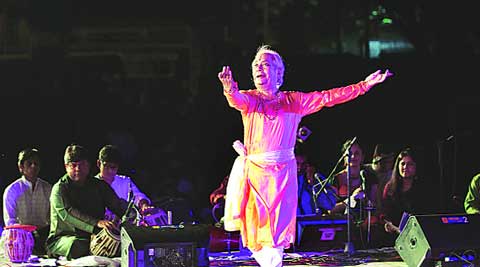 Pandit Birju Maharaj during his performance in the city
He loves flying kites and has a stack of 15 waiting to soar at the moment. He paints. He dabbles in poetry — to the effect that he manages at least one poem a day. And he sings. The venerated Padma Vibhushan-awardee Pandit Birju Maharaj, who defines kathak in the country, has many arts thriving in him. The latter is particularly a form of worship for him. Patting out some supari from a silver case and sipping on sugarless tea, Maharaj sits with unhurried ease at Kala Chaya the night before his performance in the city — now rendering some Hindustani notes, now drumming a daphli, now discussing the sequences, now posing for a picture and now revealing that he has a huge weakness for rabadi. All this is interspersed with quick one-liners and some potshots at the musicians that gets everyone cracking.
Then, as the group of over 70 kathak dancers and dance students watch in awe a scene they would have imagined in their dreams, Maharaj joins them in practise. In a flash, the 76-year-old’s eyes take on a flirtatious gleam. The eyebrows twitch, the stretched hands play gentle movements, the feet thump in quick succession and the mood is upbeat.
He smiles graciously and takes his seat; the act on the stage continues. “I can spend hours doing this. Just watching, playing and dancing,” says Maharaj, his Lucknowi heritage evident from the way he speaks. He says that just like a sculptor is in love with stone, he is in love with kathak. “I colour the beauty that God has already created. When I teach my disciples, I colour the dancers eyes, fingers and wrists,” he adds. The master dancer performed with a troupe of over 70 dancers at the Shaniwarwada dance and music festival coinciding with the festival of Holi.
The troupe included his two sons — Jaikishan and Deepak, daughter Mamta and his disciple Saswati Sen. The performance had several pieces revolving around Holi, depicting Krishna and Radha in various sequences.
Among his many accomplishments, Maharaj is also a captivating storyteller. His lineage (he is a direct descendant of the first known kathak teacher Ishwari Prasadji) afford him the stories too. He gathers some of the dancers around and shares: “Amma and my grandmother used to tell me stories of how baba (Maharaj Bindadin) would perform one move in court and the kings would be so impressed that they would shower him with gold or award an elephant. I was a little boy then, and would eagerly say: ‘I also want to perform like baba’. Amma would laugh and tell me to first stand properly.”
Another story comes out about his love for flying kites. “I must have been seven at the time. I remember asking Amma for money to buy a kite and she refused. So I headed to a store and asked the guy to lend me a kite. He said: ‘Show me some dance steps and take your kite.’ It was a crammed shop but I immediately showed some steps and took my prize, proudly declaring to Amma that I had earned my kite by dancing,” he says. Maharaj adds that he used to tell his mother that one day he would also win the praises that his grandfather and father were showered with. “With God’s grace, the dream has come true,” he says, adding, “Guru told me, make others like yourselves. That’s what my life is about — filling my colours into my disciples’ lives.”
Advertisement
Loading Taboola...


More Entertainment




Advertisement
PHOTOS

PHOTOS





Top Stories










Must Read







Advertisement
- 01
- 02
- 03
- 04
- 05
Advertisement
