


Click here to follow Screen Digital on YouTube and stay updated with the latest from the world of cinema.
Premium
This is an archive article published on March 7, 2014
Happy ending
Shattering old age mores, the Hindi play Baap ka Baap, a comedy also raises several pertinent questions about marriage
Mumbai | March 7, 2014 01:00 AM IST 4 min read
4 min read


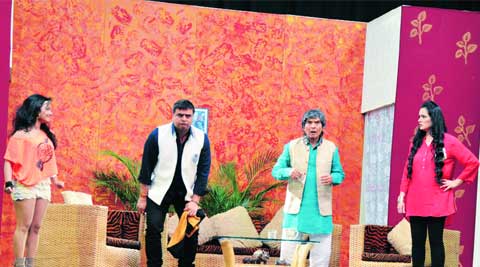 (From left) Chitrashi Rawat, Naveen Bawa, Asrani and Padmini Kolhapure
By Farida Khanzada
A play with music, dance and songs provides the necessary reprieve, breaking the monotony of prose. Writer-director-actor, Naveen Bawa, succinctly describes the various accoutrement that he has used in his latest play, Baap Ka Baap, as, “the shringar of a dulhan.” A rip-roaring comedy with a social message, the play is laced with all the ingredients that promises to not only entertain, but also provoke a healthy dialogue about several issues, that even today are intrinsically interwoven in the social fabric — like widow remarriage, accepting the person with his/her past.
The drama unfolds on stage through actors, Asrani, Padmini Kolhapure, Naveen Bawa and Chitrashi Rawat. Asrani (Jawaan), as the father who has sacrificed his youth after his wife dies during child birth, to bring up his son, Naveen Bawa (Bachcha) has only one aim in life; to see his 40- year old son, happily settled in wedlock. When Bachcha meets Mithai (Padmini Kolhapure), a young widow, her stirring tale of child marriage and subsequent widowhood, stirs up emotions and Cupid strikes his arrow. However, when he realises that she also has a teenage daughter Namkeen (Chitrashi Rawat), he steps back, not wanting to bear the onus of a young girl. This is where the twist in the tale comes and how Bachcha is ultimately coaxed into marrying Mithai becomes the highpoint of the play.
Talking about her role, Kolhapure, who had earlier worked with Bawa in the play Aasman Se Gire … Khajur Pe Atke and Abhi Toh Main Jawaan Hu, feels, “Normally the older generation has preconceived notions and there is a stigma attached to widow remarriage. They are not receptive to ideas, but in the play, it is the other way round. The father is more liberal and open-minded. Besides, we interspersed the dialogues with song and dance to break the monotony and make the play more entertaining.”
Voicing a similar sentiment, Bawa opines, “When an elderly person accepts an unconventional relationship, it creates the desired impact, as generally, they are the ones who create problems like baal vivaah. The dialogue which Asrani intones, ‘hamare sanskar hi hamari pehchan hai’, has a profound meaning. For him, instilling the right values in his son is of prime importance.”
Returning to theatre after a long time, Kolhapure feels that performing on stage before a live audience sets the adrenaline running. “The responsibility is huge and any goof up by anyone needs to be addressed immediately. A command over the language helps us as actors to improvise.”
Talking about how the story originated, Bawa, a Punjabi hailing from Dibrugarh in Assam, mentions that the germ of the idea developed when he was busy doing the theatre rounds with his play Aasman Se…. One day, while lazily lounging around with Shakti Kapoor, the hero of his play, he happened to discuss this idea. What began as a mere thought soon took shape, and in earnest, Bawa began penning his thoughts on paper. All the characters in the play have peculiar names, Jawaan, Bachcha, Mithai, Namkeen— which Bawa feels helps to create comedic situations.
While he found it difficult to cast the female leads in the play, he says, “I had scripted the father’s role keeping Asraniji in mind. Padmini’s character was a little emotional and she also had to look a little younger, somebody who could dance, do comedy, sing and someone whom one could fall in love with. I met many heroines but somewhere I could not zero in on anyone. I happened to discuss the story with Padmini, and though initially hesitant, she agreed. Casting an actor who could look 18 years old was again a task. I had acted with Chitrashi in FIR and hence knew her. So once the casting was done, we began the rehearsals in earnest, incorporating topical issues.” So, even as comedy is used as a device to showcase the inherent prejudices of society, “it is not senseless. We can talk about important issues using comedy as a tool, which is more effective than mere preachy prose,” explains Bawa.
Baap Ka Baap will be staged at Rangsharda, Bandra on March 9.
farida.khanzada@expressindai.com
Advertisement
Loading Taboola...


More Entertainment




Advertisement
PHOTOS



PHOTOS





Top Stories











Must Read







Advertisement
- 01
- 02
- 03
- 04
- 05
Advertisement
