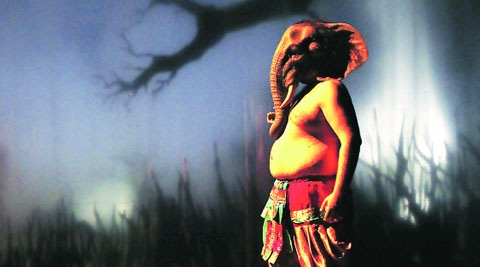
When the Edinburgh International Festival is held in Scotland next month, one of the chief attractions will be a play in which Indian deity Ganesha travels to Hitler’s Germany, determined to get back the swastika. A plot that pits a god against a human with nothing less than the symbol of spirituality — and brutality — at stake could be epical by itself, but it’s not why Ganesha Versus the Third Reich has become an iconic production of the international theatre circuit.
The play by Australian company Back to Back Theatre is described by its director Bruce Gladwin, 48, as really being about “manipulation, at a massive geopolitical scale as well as at a subtle interpersonal level”. It is a play within a play; the outer casing being of a young theatre actor, who employs actors perceived to have intellectual disability to mount a production about Ganesha visiting the Fuehrer’s Germany. The director’s misuse of power over his actors is mirrored in the totalitarianism of Hitler and the murder of millions. “At one point, the director becomes abusive and the actors band together and say, ‘Enough, you cannot treat us like this’,” says Gladwin. At a metafictional level, the script pushes forth questions about who can tell a story and who can listen to a story, but authority remains one of its main contentions.
Even the audience cannot escape becoming complicit in the power play. “When an actor walks out on a stage, the audience recognises him instantly as a disabled person. There’s a dilemma — is this person with disability playing a person with disability or is he playing a normal person like me? This creates the first tension about power and the manipulation of power,” says Gladwin. Back to Back comprises professional actors who are all specially abled, with Ganesha being played by Brian Tilley, who suffers from a form of autism, making Ganesha Versus the Third Reich a case study for professionals working in the field of physical challenges across the world.
The play, which premiered in 2011 and has been staged in the US, England, Germany, France and Helsinki, will follow up Edinburgh with Switzerland and Croatia. It isn’t likely to stop by India any time soon. “We would love to,” says Gladwin, who has lost count of the awards they have picked up.
He does recall the beginning of the play: “A number of years ago, we were working on a play that didn’t have a text or language, and we noticed that one of our actors, Rachel, was obsessed with Ganesha. She would make 30-40 drawings of Ganesha each day. Till then, I was aware of him but not familiar with the richness of the Hindu text and Ganesha’s place in it. When I began to research, I found a certain pertinence to the obsession that Rachel, who is affected by Down’s Syndrome, had with the God of Obstacles,” says Gladwin.
The play maintains Back to Back’s deep, frequently disturbing, sense of humour (“Since we work with the hearts of people who have disability, our plays are idiosyncratic at times and funny,” explains Gladwin). British newspaper The Guardian has called Ganesha Versus the Third Reich, “dark and subversive” and “often very funny — bubbling with joyful absurdity — but the humour prickled at your conscience. Gladwin and his cast never shied away from verbalising the things liberal sensibilities deem morally wrong. Things such as: that actor has the mind of a goldfish, or the audience are gorging on ‘freak porn’. The laughter, increasingly uncomfortable, finally dies when the show’s fictionalised director, meticulously played by David Woods of British performance duo Ridiculusmus, loses his politically correct composure and physically attacks the cast.
This might be fiction — but Woods at this moment is wearing an SS uniform, and the attacks carried out by Nazi Germany on people with disabilities are brutally factual”.
Gladwin, however, is being quite serious when he describes the production as “the narrative of Google”, given his research online, especially into the various Nazi theories. He supplemented this by reading the Ganesh Puran, talking to academicians who specialise in representation of the god in popular culture, such as Indian films, and watching Jai Santoshi Ma, an old, forgotten Bollywood hit. “Then, we invited a collective of Hindu scholars and leaders to watch the play,” he says.
Gladwin is now busy with other gods. An idea that the group at Back to Back explored at an Artists in Residency programme at the Victoria and Albert Museum in London recently was on “obsolete gods no longer worshipped and the stories of those who were destroyed by their own success”. “There are a number of Nordic and Greek gods who don’t have a following anymore and it would be interesting to explore that,” he says. Meanwhile, Ganesha travels the world.
Dipanita Nath is a Senior Assistant Editor at The Indian Express, based in Pune. She is a versatile journalist with a deep interest in the intersection of culture, sustainability, and urban life.
Professional Background
Experience: Before joining The Indian Express, she worked with other major news organizations including Hindustan Times, The Times of India, and Mint.
Core Specializations: She is widely recognized for her coverage of the climate crisis, theatre and performing arts, heritage conservation, and the startup ecosystem (often through her "Pune Inc" series).
Storytelling Focus: Her work often unearths "hidden stories" of Pune—focusing on historical institutes, local traditions, and the personal journeys of social innovators.
Recent Notable Articles (December 2025)
Her recent reporting highlights Pune’s cultural pulse and the environmental challenges facing the city during the winter season:
1. Climate & Environment
"Pune shivers on coldest morning of the season; minimum temperature plunges to 6.9°C" (Dec 20, 2025): Reporting on the record-breaking cold wave in Pune and the IMD's forecast for the week.
"How a heritage tree-mapping event at Ganeshkhind Garden highlights rising interest in Pune’s green legacy" (Dec 20, 2025): Covering a citizen-led initiative where Gen Z and millennials gathered to document and protect ancient trees at a Biodiversity Heritage Site.
"Right to breathe: Landmark NGT order directs PMC to frame norms for pollution from construction sites" (Dec 8, 2025): Reporting on a significant legal victory for residents fighting dust and air pollution in urban neighborhoods like Baner.
2. "Hidden Stories" & Heritage
"Inside Pune library that’s nourished minds of entrepreneurs for 17 years" (Dec 21, 2025): A feature on the Venture Center Library, detailing how a collection of 3,500 specialized books helps tech startups navigate the product life cycle.
"Before he died, Ram Sutar gave Pune a lasting gift" (Dec 18, 2025): A tribute to the legendary sculptor Ram Sutar (creator of the Statue of Unity), focusing on his local works like the Chhatrapati Shivaji statue at Pune airport.
"The Pune institute where MA Jinnah was once chief guest" (Dec 6, 2025): An archival exploration of the College of Agriculture, established in 1907, and its historical role in India's freedom struggle.
3. Arts, Theatre & "Pune Inc"
"Satyajit Ray, Ritwik Ghatak were not rivals but close friends, says veteran filmmaker" (Dec 17, 2025): A deep-dive interview ahead of the Pune International Film Festival (PIFF) exploring the camaraderie between legends of Indian cinema.
"Meet the Pune entrepreneur helping women build and scale businesses" (Dec 16, 2025): Part of her "Pune Inc" series, profiling Nikita Vora’s efforts to empower female-led startups.
"How women drone pilots in rural Maharashtra are cultivating a green habit" (Dec 12, 2025): Exploring how technology is being used by women in agriculture to reduce chemical use and labor.
Signature Style
Dipanita Nath is known for intellectual curiosity and a narrative-driven approach. Whether she is writing about a 110-year-old eatery or the intricacies of the climate crisis, she focuses on the human element and the historical context. Her columns are often a blend of reportage and cultural commentary, making them a staple for readers interested in the "soul" of Pune.
X (Twitter): @dipanitanath ... Read More


 5 min read


 An actor reprising the role of Lord Ganesha