5 min read
© IE Online Media Services Pvt Ltd
Latest Comment
Post Comment
Read Comments



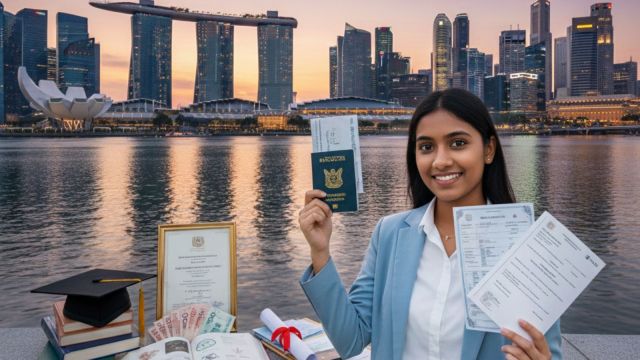 This article explains the essentials of studying in Singapore — from visa types, application procedures, and required documents to the country’s colleges and the growing presence of Indian students in its higher education landscape. (Image: AI Generated)
Singapore has become an increasingly popular destination for Indian students, offering world-ranked universities, diverse programmes, and strong career prospects. As of 2025, there are 33,250 Indian students in Singapore. The data was recently shared in the Rajya Sabha by the Ministry of External Affairs.
This article explains the essentials of studying in Singapore — from visa types, application procedures, and required documents to the country’s colleges and the growing presence of Indian students in its higher education landscape.
Singapore is home to 34 universities, including six national institutions. Among them, the National University of Singapore (NUS) and Nanyang Technological University (NTU) are the most prominent, consistently securing top positions in the QS World University Rankings. Here’s a list of other few important colleges in Singapore:
–University of Technology and Design
–Singapore Management University
–Duke-NUS Graduate Medical School
–INSEAD – Singapore
–Nanyang Polytechnic
–London School of Business and Finance, Singapore Branch
–Singapore Institute of Management
–Nanyang Business School
–PSB Academy
–National University of Singapore, NUS-ISS
For Indian students aspiring to pursue higher education, obtaining the right study visa is the first step. The country offers different visa categories depending on the level and type of programme. Understanding visa types, required documents, and timelines is essential before beginning academic life. The official website for the study visa and details are: ica.gov.sg/reside/STP/apply.
The country provides a range of courses — diplomas, certificates, vocational training, practical programmes, and higher education degrees — with student passes issued according to the type of course chosen.
Students applying for short-term programmes, such as diplomas or certificate courses lasting around three months, can obtain a short-term pass. For longer academic pathways like bachelor’s or master’s degrees, a long-term pass is required. The Student’s Pass Online Application & Registration (SOLAR) system is a digital platform through which international students can submit applications for a student visa.
In addition to the standard student pass, international students may also be eligible for other visa categories, including the Training Employment Pass, Work Holiday Pass, and Training Work Permit, depending on their study and work arrangements.
The visa fee structure includes two main components. First, applicants must pay an issuance fee for a student’s pass is S$60, while an additional S$30 is charged for a multiple journey visa if applicable. These payments can be made conveniently online through Internet Banking, or by using AMEX, Visa, or MasterCard credit and debit cards. Together, these charges cover the administrative costs of processing and issuing the visa. It is advised that students check and verify the fee on the official website.
Foreigners holding a valid Long-Term Visit Pass, Dependant’s Pass, or Immigration Exemption Order do not need to apply for a student’s pass to pursue full-time, non-religious studies. They may enrol in schools for the duration of their existing pass. However, if the pass expires or is cancelled during their studies, they must apply for a pass, subject to prevailing eligibility criteria.
The requirements and procedures for obtaining a student’s pass vary depending on the type of educational institution chosen. Applicants should review the specific criteria related to their institution of study. For the same, they can visit the official website.
The requirements for a study visa differ depending on the type of Student Pass being applied for. Applicants must demonstrate English language proficiency and submit all necessary documents through the SOLAR immigration system. A student pass is not required if the chosen course or programme lasts fewer than 30 days.
Students must also provide proof of financial support to cover educational and living expenses, undergo a criminal record check to confirm a clean history, and present medical certificates to show they are in good health.
International students enrolled in certain higher education institutions are allowed to work part-time while studying. During term time, eligible students may work up to 16 hours per week, and no work permit is required for employment during holiday periods. To confirm whether an applicant’s institution grants such work privileges, overseas students should visit the official website of the Ministry of Manpower.
After completing their degree programmes, international students may apply to the Immigration and Checkpoints Authority (ICA) for a Long-Term Visit Pass valid for one year, allowing them to remain in the country while seeking employment. In most cases, prospective employers handle this application on behalf of the student.