4 min read





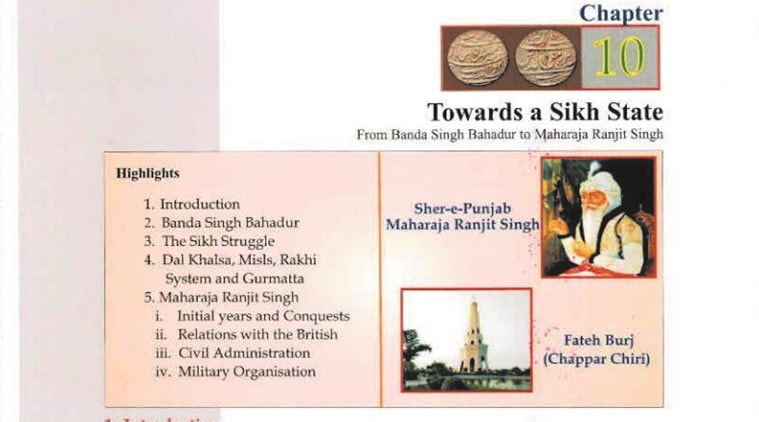 Screenshot of Class XII history book. Express
Even as political mudslinging continues over the history syllabus for Classes XI and XII, a look at the syllabus released by Punjab School Education Board(PSEB) on its website shows that six chapters related to Sikh history have been included for Class XI.
For Class XII, two chapters – ‘Towards a Sikh State – From Banda Singh Bahadur to Maharaja Ranjit Singh’ and ‘Punjab Under the British’ have been included in the syllabus but more of India’s history has been added which the board claims has been done to match with National Council of Educational Research & Training (NCERT) pattern.
Nine other chapters are on medieval and modern history of India, including three on Struggle for Independence since 1857 rebellion.
Chapters of Class XI include- history of Punjab and Sikh Gurus; Teaching of Sri Guru Nanak Dev Ji, Development of Sikhism and contribution of Sikh Gurus; Evolution of Sikhism; Establishment of Khalsa Panth and new addition Chaar Saahibzaade, a chapter on four sons of Guru Gobind Singh who were martyred by Mughals. Five other chapters are on world history.
A look at the last year’s history syllabus (2017-18) shows that Class XII had 22 chapters, which is double than this year’s. All of them were based on Sikh history including physical features of Punjab, separate chapters on Sikh gurus, five chapters on Maharaja Ranjit Singh and his kingdom, two on Anglo-Sikh wars among others. A history teacher speaking to The Indian Express, said that controversy has arisen because this year number of chapters have been reduced and merged to accommodate world and Indian history chapters on NCERT pattern.
“Last year, we had elaborate chapters on Maharaja Ranjit Singh and his kingdom in Class XII. Now, it has all been merged into one chapter. For Class XI, there were just two chapters on Sikh history last year but they have been increased to six along with five others on world history,” said a teacher.
‘Nothing to do with political mudslinging, give books on time’ The history books of Classes XI and XII are yet to reach schools as PSEB has failed to complete their printing in time. Class XII history book has been released online and teachers have been asked to get print-outs whereas there is no material available for Class XI yet.
Also, it is for the first time that PSEB is publishing history books on its own as earlier it used to recommend private publishers. The teachers have expressed that they have nothing to do with mudslinging going on among politicians but they want books on time. “We were made to evaluate answer sheets within 15 days claiming that new classes have to be started but there is no sign of books yet. We are not questioning new history syllabus, it is the board’s decision but books should be provided in time,” said a teacher.
‘Books within 15 days’
Krishan Kumar, secretary school education Punjab, in a written statement released Monday, said, “Not a single chapter on Sikh history has been deleted but they have been just shifted to Class IX, X and XI syllabus. History syllabus has been amended to align it with NCERT as done for chemistry, maths and physics earlier. Following recommendation of an expert panel, a number of chapters on Sikh history have been shifted from class XII to XI and some on Modern Sikh history retained in Class XII. History books for Class XII have been printed. Class XI books are still under print and will be released within 15 days.”