Premium
This is an archive article published on January 7, 2025

Why are IIT placements falling? Students look for higher education, civil services

The trends, based on data obtained by The Indian Express, come against the backdrop of a shifting tech landscape, global economic uncertainties, and an increasing number of Indian Institute of Technology graduates competing in a dynamic job market.

IIT: Placements dip, students look beyond campus tooIIT Delhi is the only institution that bucked the trend, maintaining a consistent placement percentage of 84 per cent to 85 per cent since 2018-19, except for fluctuations during the pandemic years of 2020-21.

In an indication of the changing hiring trends from the Indian Institutes of Technology, at least four older IITs have seen a decline in their campus placement percentages in recent years, even as surveys indicate the number of students getting jobs independently may be on the rise.

The trends, based on data obtained by The Indian Express, come against the backdrop of a shifting tech landscape, global economic uncertainties, and an increasing number of IIT graduates competing in a dynamic job market.

Five of the seven first-generation IITs responded to The Indian Express’s request under the RTI Act for placement data spanning six years, from 2018-19 to 2023-24. IIT Madras and IIT Guwahati did not share details and instead referred to their annual reports.

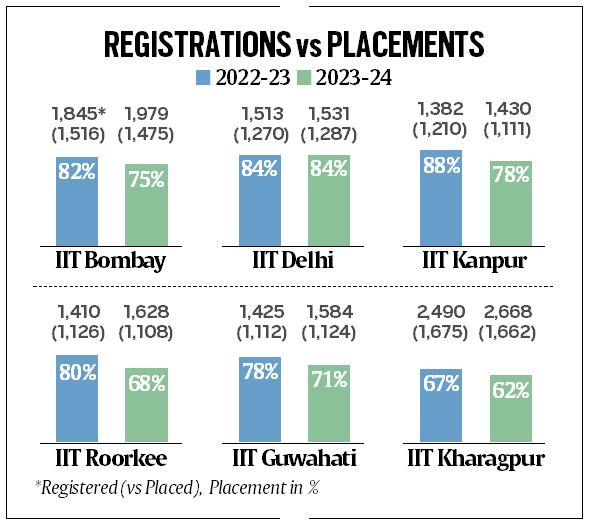
Among the institutes that disclosed placement rates (the percentage of students receiving job offers) across undergraduate, postgraduate, and research programs, IIT Kanpur, IIT Kharagpur, and IIT Roorkee recorded declines ranging from 5 to 16 percentage points (see chart).

IIT Bombay provided data only for 2022-23 and 2023-24, showing a drop from 82 per cent to 75 per cent. While IIT Guwahati’s placement percentage for 2023-24 (71 per cent) is higher than the pre-pandemic level of 2018-19 (67 per cent), it is seven percentage points lower than the previous year, 2022-23 (78 per cent).

IIT Delhi is the only institution that bucked the trend, maintaining a consistent placement percentage of 84 per cent to 85 per cent since 2018-19, except for fluctuations during the pandemic years of 2020-21 (80 per cent) and 2021-22 (75 per cent).

IIT: Placements dip, students look beyond campus too

The factors — and some riders

While the IITs refused to comment on the record, students and teachers associated with the campus hiring process attributed the drop to a combination of factors: the aftereffects of post–Covid mass hiring in 2022, a slowdown in key sectors like tech and software, and increasing batch sizes.

Story continues below this ad

“In 2022, there was a spike in placement percentages as the market recovered after Covid, with rates exceeding 85 per cent. This spike followed a two-year hiring freeze. Hiring in 2023 was more conservative, with fewer top MNCs coming in and a decline in software and tech recruitment. Placements this year might improve over last year, but are unlikely to match 2022 levels. The numbers may normalise by 2025,” said a source from IIT Kanpur.

Another person associated with placements at IIT Kharagpur pointed to growing batch sizes as a factor. At IIT Kharagpur, the number of students registering for placement has increased from 1,757 in 2018–19 to 2,668 in 2023–24, while those placed grew from 1,375 to 1,662 during the same period.

“Placements in 2022-23 were among the best for the institute, but there hasn’t been much improvement in the market since then, and the companies coming for placements this year haven’t met expectations,” the source said.

“The intake of students has been increasing gradually, with nearly 3,000 students sitting for placements this year, making it a challenging task to place everyone. While most JEE entrants are placed, companies have fewer roles for PG students,” the person said.

Story continues below this ad

IIT Guwahati too said that placement outcomes are better for BTech graduates. “Most IIT placement data focuses on B.Tech students. In 2022, the B.Tech placement percentage was 83 per cent, and in 2023, it was 80 per cent,” an official from IIT Guwahati told The Indian Express. “PG students often prefer higher studies – they register for placements but do not pursue them further. The actual placement scenario is best reflected in undergraduate placements, where close to 80 per cent of students secure jobs, while 10 per cent go for higher studies, 5 per cent opt for civil services, and others pursue MBA programs.”

The official said that around 600 and 650 BTech students were placed in 2022 and 2023, respectively.

Though the placement percentage at IIT Bombay dropped from 82.16 per cent in 2022-23 to 74.53 per cent in 2023-24, an official said it would be misleading to draw conclusions solely from this data as it only reflects on-campus placements and not other career paths. “Many students shown as ‘not placed’ take routes like higher education or off-campus placements or entrepreneurship. The dip does not offer a true reflection unless compared with the exit survey,” the official said.

A newly introduced exit survey revealed that from 2018 to 2022, 57.1 per cent of students were placed through campus placements, 10.3 per cent found jobs independently, 1.6 per cent initiated start-ups, 8.3 per cent entered public services, 6.1 per cent were still seeking jobs, and 12 per cent pursued higher education in India or abroad.

Story continues below this ad

Of the six IITs, only three shared data pertaining to the average salary package offered to placed students. IIT Kanpur’s average salary rose from Rs 22.1 lakh per annum (LPA) in 2020–21 to Rs 25.9 LPA in 2022–23, but dropped to Rs 23.7 LPA in 2023–24.

At IIT Kharagpur, the average salary increased from Rs 14 LPA in 2020–21 to Rs 18 LPA in 2022–23, before declining to Rs 17 LPA in 2023–24.

IIT Bombay recorded an average salary of Rs 21.50 LPA in 2021–22, slightly rising to Rs 21.82 LPA in 2022–23.

Why IIT Delhi stood out

The increase in students availing themselves of IIT Delhi’s placement services rose from 1,471 in 2021-2022 to 1,531 in 2023-2024, largely due to a significant rise in participation from PhD scholars.

Story continues below this ad

Nearly 190 PhD candidates, a sixfold increase, sought placements for the first time, affecting the overall placement percentage since regular job profiles for B.Tech and M.Tech graduates are not suitable for PhD scholars.

To address this, IIT Delhi conducted a special recruitment drive for PhD students in June 2024, resulting in a sevenfold increase in offers as compared to the previous year. An official said: “If you notice, the number of offers received in 2022-2023 (1,287) and 2023-24 (1,222) are comparable and only about 5 per cent less than the previous year. Despite difficult market conditions and placements across the institutions in the country during 2023-2024, IIT Delhi managed to do reasonably well last year. We are striving to get our PhD and other students jobs to achieve a very good overall placement this year. We have a number of profiles lined up for this year and are hoping to cater to all aspiring students.”

In an exit survey conducted by IIT Delhi this year, 1411 (53.1 per cent) students confirmed that they had received a job offer. On the other hand, 224 (8.4 per cent) students responded that they were self-employed, whereas 45 (1.7 per cent) students informed that they are working for a start-up and 66 (2.5 per cent) students were involved in entrepreneurship.

Vidheesha Kuntamalla is a Senior Correspondent at The Indian Express, based in New Delhi. She is known for her investigative reporting on higher education policy, international student immigration, and academic freedom on university campuses. Her work consistently connects policy decisions with lived realities, foregrounding how administrative actions, political pressure, and global shifts affect students, faculty, and institutions. Professional Profile Core Beat: Vidheesha covers education in Delhi and nationally, reporting on major public institutions including the University of Delhi (DU), Jawaharlal Nehru University (JNU), Jamia Millia Islamia, the IITs, and the IIMs. She also reports extensively on private and government schools in the National Capital Region. Prior to joining The Indian Express, she worked as a freelance journalist in Telangana and Andhra Pradesh for over a year, covering politics, rural issues, women-centric issues, and social justice. Specialisation: She has developed a strong niche in reporting on the Indian student diaspora, particularly the challenges faced by Indian students and H-1B holders in the United States. Her work examines how geopolitical shifts, immigration policy changes, and campus politics impact global education mobility. She has also reported widely on: * Mental health crises and student suicides at IITs * Policy responses to campus mental health * Academic freedom and institutional clampdowns at JNU, South Asian University (SAU), and Delhi University * Curriculum and syllabus changes under the National Education Policy Her recent reporting has included deeply reported human stories on policy changes during the Trump administration and their consequences for Indian students and researchers in the US. Reporting Style Vidheesha is recognised for a human-centric approach to policy reporting, combining investigative depth with intimate storytelling. Her work often highlights the anxieties of students and faculty navigating bureaucratic uncertainty, legal precarity, and institutional pressure. She regularly works with court records, internal documents, official data, and disciplinary frameworks to expose structural challenges to academic freedom. Recent Notable Articles (Late 2024 & 2025) 1. Express Investigation Series JNU’s fault lines move from campus to court: University fights students and faculty (November 2025) An Indian Express investigation found that since 2011, JNU has appeared in over 600 cases before the Delhi High Court, filed by the administration, faculty, staff, students, and contractual workers across the tenures of three Vice-Chancellors. JNU’s legal wars with students and faculty pile up under 3 V-Cs | Rs 30-lakh fines chill campus dissent (November 2025) The report traced how steep monetary penalties — now codified in the Chief Proctor’s Office Manual — are reshaping dissent and disciplinary action on campus. 2. International Education & Immigration ‘Free for a day. Then came ICE’: Acquitted after 43 years, Indian-origin man faces deportation — to a country he has never known (October 2025) H-1B $100,000 entry fee explained: Who pays, who’s exempt, and what’s still unclear? (September 2025) Khammam to Dallas, Jhansi to Seattle — audacious journeys in pursuit of the American dream after H-1B visa fee hike (September 2025) What a proposed 15% cap on foreign admissions in the US could mean for Indian students (October 2025) Anxiety on campus after Trump says visas of pro-Palestinian protesters will be cancelled (January 2025) ‘I couldn’t believe it’: F-1 status of some Indian students restored after US reverses abrupt visa terminations (April 2025) 3. Academic Freedom & Policy Exclusive: South Asian University fires professor for ‘inciting students’ during stipend protests (September 2025) Exclusive: Ministry seeks explanation from JNU V-C for skipping Centre’s meet, views absence ‘seriously’ (July 2025) SAU rows after Noam Chomsky mentions PM Modi, Lankan scholar resigns, PhD student exits SAU A series of five stories examining shrinking academic freedom at South Asian University after global scholar Noam Chomsky referenced Prime Minister Narendra Modi during an academic interaction, triggering administrative unease and renewed debate over political speech, surveillance, and institutional autonomy on Indian campuses. 4. Mental Health on Campuses In post-pandemic years, counselling rooms at IITs are busier than ever; IIT-wise data shows why (August 2025) Campus suicides: IIT-Delhi panel flags toxic competition, caste bias, burnout (April 2025) 5. Delhi Schools These Delhi government school grads are now success stories. Here’s what worked — and what didn’t (February 2025) ‘Ma’am… may I share something?’ Growing up online and alone, why Delhi’s teens are reaching out (December 2025) ... Read More


 

Latest Comment
Post Comment
Read Comments
Advertisement
Advertisement
Advertisement
Advertisement