Journalism of Courage



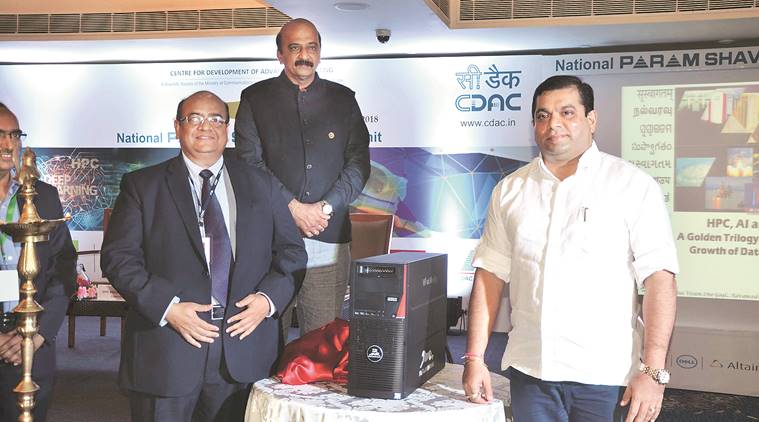 Dr Hemant Darbari (left), director general of C-DAC, at the launch of PARAM Shavak-VR, the Centre’s latest supercomputer, in Goa. (Express Photo)
The supercomputing giant of India, the Pune-headquartered Centre for Development of Advanced Computing (C-DAC,) is all set to enter the field of cancer research in a major way. The bio-informatics team of C-DAC has been working closely with Tata Memorial Hospital, Mumbai, and the National Cancer Institute in US to simulate ‘P53’, also known as TP53, a type of protein. It regulates the cell cycle and hence functions as a tumour suppressor.
“We are doing a lot of research in the area of bio-informatics, which is coming up in a big way. Our major focus is on cancer treatment using supercomputers as a tool. Currently, we are doing simulation on ‘P53’, a molecule on our system,” said Hemant Darbari, director general of C-DAC. On the ongoing research, Darbari said, “Drug repositioning (also known as drug repurposing) is the application of known drugs and compounds to treat new diseases. Under this concept, C-DAC is working on repurposing, in which drugs used for diabetes can be used for breast cancer research.”
According to the C-DAC DG, a remarkable shift is set to happen in the field of drug research and development in the near future. “The diabetes drug used on human beings is promising and work is on to redirect it towards breast cancer treatment. We are also trying to use some ancient knowledge from Ayurveda and check its impact on cancer treatment,” said Darbari. On Thursday, C-DAC had unveiled their newest super computer, the PARAM Shavak-Virtual Reality, in Goa.
“PARAM Shavak provides the computing power necessary to keep academic institutions on the leading edge in today’s competitive market, at an affordable cost. This system is meant for research organisations and academic institutions that are on the verge of adopting high-performance computing culture in their institutions,” said the C-DAC chief. This machine can also be used in battle theatre simulation for defence, education and archaeology, noted the experts. “… Civilisations like Harappa can be recreated by visualising the original structures, using simulators providing multi-dimensional images,” concluded Darbari.

 3 min read