3 min read
Click here to join Express Pune WhatsApp channel and get a curated list of our stories
© The Indian Express Pvt Ltd



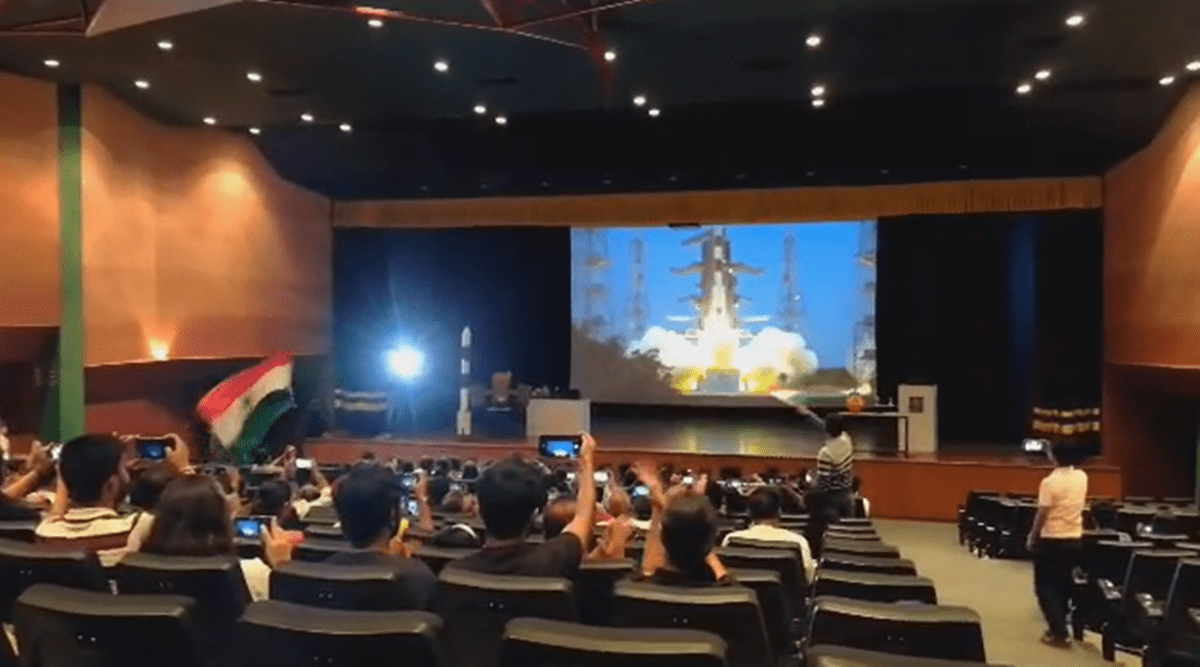 As the stage was set for the PSLV rocket carrying the Aditya-L1 satellite to lift off from Satish Dhawan Space Center in Sriharikota at 11.50 am, the IUCAA organised pre-launch talks and demonstrations at 10.15 am by its scientists who were involved in the mission.
 As India successfully launched its maiden space-based solar observation mission Aditya-L1 on Saturday, scientists at the Inter-University Centre for Astronomy and Astrophysics (IUCAA) in Pune had a special reason to radiate in enthusiasm.
The scientists at IUCAA have tirelessly worked for nearly a decade to develop the Solar Ultraviolet Imaging Telescope (SUIT), one of the main payloads on the Aditya-L1 mission.
Soon after the launch, Prof R Srianand, Director of IUCAA, told The Indian Express that he was very happy to see the Aditya-L1 launch. “Once it goes to the L1 point, then the crucial work will begin,” he said.
He lauded the team of scientists led by Durgesh Tripathi and A N Ramaprakash who developed the SUIT.
The SUIT was meant to calculate the spectra and understand how much radiation the sun is emitting. Deployment of SUIT will open up an unprecedented observing mode of the Sun at near UV regions, without any attenuation due to Earth’s atmosphere.
As the stage was set for the PSLV rocket carrying the Aditya-L1 satellite to lift off from Satish Dhawan Space Center in Sriharikota at 11.50 am, the IUCAA organised pre-launch talks and demonstrations at 10.15 am by its scientists who were involved in the mission. The event was open to all and streamed live on the institute’s YouTube channel IUCAA Scipop.
Waving Indian flags, a crowd of around 300 people comprising school and university students, amateur astronomers and IUCAA members gathered on the IUCAA campus to witness the landmark moment. Amid loud cheers, sweets were distributed as the Aditya L1 satellite separated from the upper stage of the PSLV rocket.
“The new science that SUIT is going to produce will be amazing,” Ramaprakash, told The Indian Express.
Several schools and colleges also organised live streaming of the solar mission. As many as 300 people, including students, teachers and alumni attended the public screening at the College of Engineering, Pune (COEP)’s main auditorium.
At the Ganesh Sabhagruha New English School, the students who had gathered at the planetarium to witness the launch were explained about the concepts of Aditya-L1.
Vinayak Ramdasi, in charge of the school’s planetarium, told the students about the difference between the launch vehicles used for Chandrayaan-2 and Aditya-L1 and the reasons behind the same. He also told the students that unlike Chandrayaan-2, Aditya L-1 can function for about 20 years.
Leena Bokil, a space educator and a researcher in the field of cosmology, said this maiden solar probe is very important for India and also highlighted that PSLV, as a launch vehicle, has been very reliable for the Indian Space Research Organisation (ISRO).
“We have been working on building this payload for about a decade now. One of the challenges was that the sun, being a very dynamic star, a lot of activities happen. This payload is to observe the activities and physical processes that happen. The satellite has to be able to collect on-board intelligence and react to activities on the sun and adapt itself to maximise the data collection,” said Ramaprakash on Thursday before he left for Sriharikota.