



Click here to join Express Pune WhatsApp channel and get a curated list of our stories
© The Indian Express Pvt Ltd
Tags:


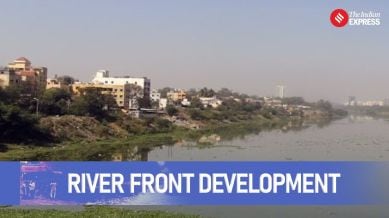
On the afternoon of February 9, thousands of people are expected to converge at the Ram-Mula river confluence in Pune’s Baner for a Chipko march under the tagline “Save Trees, Save Rivers”. This is the latest iteration of a public movement against the Riverfront Development (RFD) project in Pune. The RFD undertaken by the Pune Municipal Corporation (PMC) aims to rejuvenate the 44-km stretch of Mula and Mutha rivers passing through the city.
Marches are the most visible form of resistance, but the movement against the RFD also involves civil society members talking to the PMC. “Rather than protesting, we started discussions with the authorities about our reservations regarding the RFD. This was around 2018-19. Instead of saying no to the RFD, we said it could be implemented better on the river,” says Shailaja Deshpande of Jeevitnadi, a volunteer-based organisation involved in the protests.


Legal challenges against Riverfront Development project
Protests against the RFD unfold over multiple levels, from engaging the administration to marches to filing environment interest litigations (EIL) at the National Green Tribunal (NGT). At present, there is a public interest litigation (PIL) before the Bombay High Court against the illegal demarcation of flood lines in Pune city development plan maps.
Sarang Yadwadkar is among those who have taken the resistance to the courts. In January, he knocked on the doors of the NGT again, this time against the environmental clearance given by the State Environment Impact Assessment Authority to the RFD.
“As far as the RFD is concerned, we need to understand the situation in Pune. It is very peculiar compared to any other city. Five rivers enter the city: Mula, Mutha, Pavana, Ramnadi and Devnadi. The last two are relatively smaller rivers but bring in water quickly. Flash floods occur in both rivers. We have seven dams upstream that are nearby. There are four dams on the Mutha and one each on Mutha and Pawana, apart from the Kasarsai Dam,” says Yadwadkar.
“If there is a cloudburst and these dams start releasing water, all that water will enter the city quickly, i.e. within one or two hours. All the rivers converge and, ultimately, have only one outlet: the Mula Mutha River. So, our city is at the neck of the funnel. Water enters from five different catchments, and there is only one outlet. That is a very dangerous position; as if we are sitting on a live bomb,” he adds.
In 2019, when the Ambil Odha, which is a tributary, suffered from a flash flood, around 25 people died. There was destruction to property, including houses. “Because all these rivers and their tributaries originate from the Sahyadris, their catchments are very steep. Only once the water enters the city do the rivers start flowing relatively slowly. The water enters the city very fast but flows out slowly, which further increases this risk,” he adds.
Delhi-based The Energy and Resources Institute (TERI) has projected an annual increase in rainfall in Pune by 10-37.5 per cent between the 2030s and 2070s. It predicted that the annual rainfall would rise, but the number of rainy days would also decrease.
“This could lead to more frequent occurrences of cloudburst events. If there is more traffic on roads, urban planners decide to widen the roads, so, if there is more water, why not widen the rivers?” asks Yadwadkar.
He adds, “Instead of widening, the RFD is narrowing the rivers by 40 per cent by dumping truckloads of debris in the river. Any reduction in the width will lead to erosion in the flood-carrying capacity of the river, which will result in more frequent and severe floods in Pune city in future.
Cosmetic surgery, allege critics of RFD
For several sceptics of the RFD plan, the issue is that the civic bodies are trying to decorate the river with concrete instead of prioritising cleaning the river. They are concerned about the fate of aquifers and existing biodiversity, among others. While several citizens are opposed only to implementing the RFD, Ameet Singh, an economist, is “completely against the project”.
Singh has fought the PMC before, particularly against tree felling on Ganeshkhind Road. Last year, the Bombay High Court instructed the PMC to stop cutting trees for road widening.
“The RFD is a blunder being perpetrated on Pune’s people by reclaiming Pune’s flood plains for a real estate grab and a 30-metre wide road. Over 1,600 acres will be reclaimed across 44 km of the river’s length. Lakhs of trees and riparian forests will be decimated, and over 41 crore sq ft of new real estate will be added to Pune’s already congested, polluted and broken urban infrastructure. If we can’t breathe clean air, drink pure water and live in a zero-garbage clean environment, what’s the point of this sort of development?” asks Singh.
He points out how “with the release of about 30,000 cusecs from Khadakwasla on July 25, 2024, the blue lines at most places in Pune were smudged and inundated with water”.
Singh says Maharashtra Engineering Research Institute now puts the water volume to be considered for redrawing the flood lines at 1,07,724 cusecs or almost double the volume of water from the older calculation, “There are increased incidences of huge urban flooding across Pune. Despite all of this, we continue to dump debris and concrete on the river bank and expect that Pune won’t flood,” he says.
Scientist and lawyer Rajendra Kumar Kale says the Mula-Mutha river system in Pune is highly polluted due to untreated sewage, industrial effluents, and other pollutants. “Yet, the project appears to prioritise real estate development and urban beautification over genuine ecological restoration. From my perspective, the critical issues with PMC’s river rejuvenation project include its focus on real estate development rather than actual river rejuvenation and neglect of pollution control,” he says.
Kale says the DPR proposes arresting sewage inflows near the rivers and diverting them to upcoming (and delayed) sewage treatment plants. “This approach risks legitimising the use of natural water streams as open sewage conduits. My argument is to achieve pollution-free rivers; the action must start at the source—by preventing sewage outfall into Pune’s 23 natural water streams. This is both logical and legally mandated,” says Kale.
“Recreational infrastructure should follow only after pollution is addressed. This approach has been successfully adopted in developed nations, such as Norway’s Akerselva river restoration project. Building recreational facilities around polluted rivers is neither logical nor sustainable,” adds Kale.


