Premium

Pune Inc: From mobile phones to metal bars, how Electrofine is tackling India’s e-waste crisis

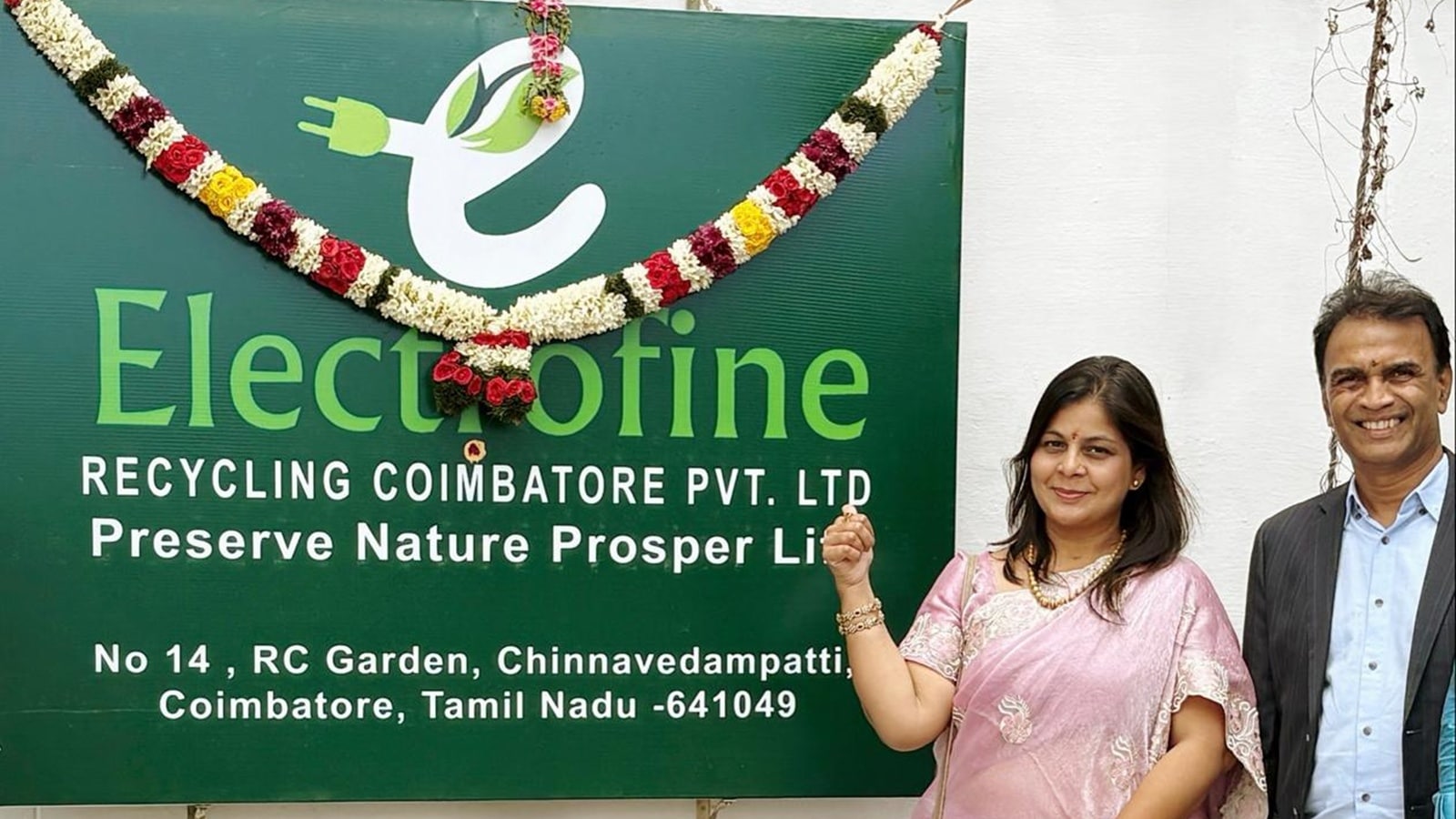
Electrofine was born in 2021 as an e-waste recycling and refurbishment company committed to sustainable and eco-friendly solutions.

ElectrofinePune's Electrofine company tackling India's e-waste crisis. (Source: Express Photo)

India is an electronic powerhouse, with a NITI Aayog report from 2024 saying that the country’s electronics sector had experienced rapid growth, reaching $155 billion in the 2023-24 financial year. “Production nearly doubled from $48 billion in 2017-18 to $101 billion in 2023-24, driven primarily by mobile phones, which now constitute 43 per cent of total electronics production,” reads the report.

On the other side of this growth is the question of the afterlife of electronic devices.

The people of Pune witness trucks full of every kind of electronic waste winding through the roads of the Pimpri Chinchwad Municipal Corporation (PCMC) to Bhosari MIDC every week. There, the e-waste is dismantled at a facility before it is segregated, repurposed, repaired to be donated, or resold. Those that cannot be salvaged in any way are transported to a factory in Satara to be broken down to basic metals.

This is the domain of Electrofine Recycling Pvt Ltd, a company that ensures that discarded electronics get decent ‘last rites’ that do not involve harming the environment. “The total capacity of the PCMC refurb unit is 4,000 metric tonnes annually. The annual capacity of the Satara factory is 20,000 metric tonnes,” says Vaishali Swaroop, its founder-managing director. Shashikant Gaikwad is the founder-CEO of the company.

In August, Electrofine took steps to set up a  unit in Coimbatore to handle e-waste from South India, but Swaroop admits that their efforts are still a drop in the ocean of India’s e-waste problem.

According to a Rajya Sabha presentation by the Minister of State of the Union Ministry of Housing and Urban Affairs, Tokhan Sahu, in December 2024, the quantity of e-waste being generated in India rose from 1.01 million metric tonnes in 2019-20 to 1.751 million metric tonnes in 2023-24.

“Computers, phones, TVs, monitors, CD ROMs, hard disks, tablets, batteries, mixers, cables, and pen drivers are some electronic items that contain harmful material that can pollute the land, water, and air if not disposed of properly. It is crucial to handle e-waste carefully to protect people and the planet,” says Swaroop. Cadmium from batteries and circuits can collect in the body and harm the kidneys, bones and the respiratory system; mercury can affect the rain, liver and the immune system, among others; the health impacts of lead, especially in children, is severe; burning e-waste also releases carcinogenic polycyclic aromatic hydrocarbons.

Story continues below this ad

Electrofine was born in 2021 as an e-waste recycling and refurbishment company committed to sustainable and eco-friendly solutions. “We serve clients across Maharashtra and India. Our mission is to transform e-waste management by implementing responsible, environmentally friendly practices that contribute to a greener future,” says Swaroop.

She adds that 30-35 per cent of laptops that come to them do not work at all and must be sent to the Satara factory. This is where metallurgical processes break down the e-waste into its basic components. “The aluminium, copper, brass, tin and bronze, among others, are separated and turned into metal bars. These are sold back as raw material to the copper and other industries. That is how e-waste enters a circular economy,” says Swaroop.

While awareness of single-use plastic pollution has increased over the years, the dangers of e-waste are still little known. It is a challenge for companies like Electrofine to spread the word. “We work to spread awareness in colleges, offices, IT companies, NGOs, and citizen groups but we need government initiatives, maybe in the form of regular advertisements, to keep the message in the public domain,” she says.

There are authorised vendors for the collection of e-waste, which ensures that these are disposed of responsibly. “The PCMC has taken a progressive step to collaborate with Electrofine for this purpose. It is our responsibility as Indian citizens to take informed decisions regarding e-waste,” says Swaroop.

Dipanita Nath is a Senior Assistant Editor at The Indian Express, based in Pune. She is a versatile journalist with a deep interest in the intersection of culture, sustainability, and urban life. Professional Background Experience: Before joining The Indian Express, she worked with other major news organizations including Hindustan Times, The Times of India, and Mint. Core Specializations: She is widely recognized for her coverage of the climate crisis, theatre and performing arts, heritage conservation, and the startup ecosystem (often through her "Pune Inc" series). Storytelling Focus: Her work often unearths "hidden stories" of Pune—focusing on historical institutes, local traditions, and the personal journeys of social innovators. Recent Notable Articles (December 2025) Her recent reporting highlights Pune’s cultural pulse and the environmental challenges facing the city during the winter season: 1. Climate & Environment "Pune shivers on coldest morning of the season; minimum temperature plunges to 6.9°C" (Dec 20, 2025): Reporting on the record-breaking cold wave in Pune and the IMD's forecast for the week. "How a heritage tree-mapping event at Ganeshkhind Garden highlights rising interest in Pune’s green legacy" (Dec 20, 2025): Covering a citizen-led initiative where Gen Z and millennials gathered to document and protect ancient trees at a Biodiversity Heritage Site. "Right to breathe: Landmark NGT order directs PMC to frame norms for pollution from construction sites" (Dec 8, 2025): Reporting on a significant legal victory for residents fighting dust and air pollution in urban neighborhoods like Baner. 2. "Hidden Stories" & Heritage "Inside Pune library that’s nourished minds of entrepreneurs for 17 years" (Dec 21, 2025): A feature on the Venture Center Library, detailing how a collection of 3,500 specialized books helps tech startups navigate the product life cycle. "Before he died, Ram Sutar gave Pune a lasting gift" (Dec 18, 2025): A tribute to the legendary sculptor Ram Sutar (creator of the Statue of Unity), focusing on his local works like the Chhatrapati Shivaji statue at Pune airport. "The Pune institute where MA Jinnah was once chief guest" (Dec 6, 2025): An archival exploration of the College of Agriculture, established in 1907, and its historical role in India's freedom struggle. 3. Arts, Theatre & "Pune Inc" "Satyajit Ray, Ritwik Ghatak were not rivals but close friends, says veteran filmmaker" (Dec 17, 2025): A deep-dive interview ahead of the Pune International Film Festival (PIFF) exploring the camaraderie between legends of Indian cinema. "Meet the Pune entrepreneur helping women build and scale businesses" (Dec 16, 2025): Part of her "Pune Inc" series, profiling Nikita Vora’s efforts to empower female-led startups. "How women drone pilots in rural Maharashtra are cultivating a green habit" (Dec 12, 2025): Exploring how technology is being used by women in agriculture to reduce chemical use and labor. Signature Style Dipanita Nath is known for intellectual curiosity and a narrative-driven approach. Whether she is writing about a 110-year-old eatery or the intricacies of the climate crisis, she focuses on the human element and the historical context. Her columns are often a blend of reportage and cultural commentary, making them a staple for readers interested in the "soul" of Pune. X (Twitter): @dipanitanath ... Read More


Click here to join Express Pune WhatsApp channel and get a curated list of our stories

Latest Comment
Post Comment
Read Comments
Advertisement
Loading Taboola...
Advertisement