Click here to join Express Pune WhatsApp channel and get a curated list of our stories
© The Indian Express Pvt Ltd
 5 min read


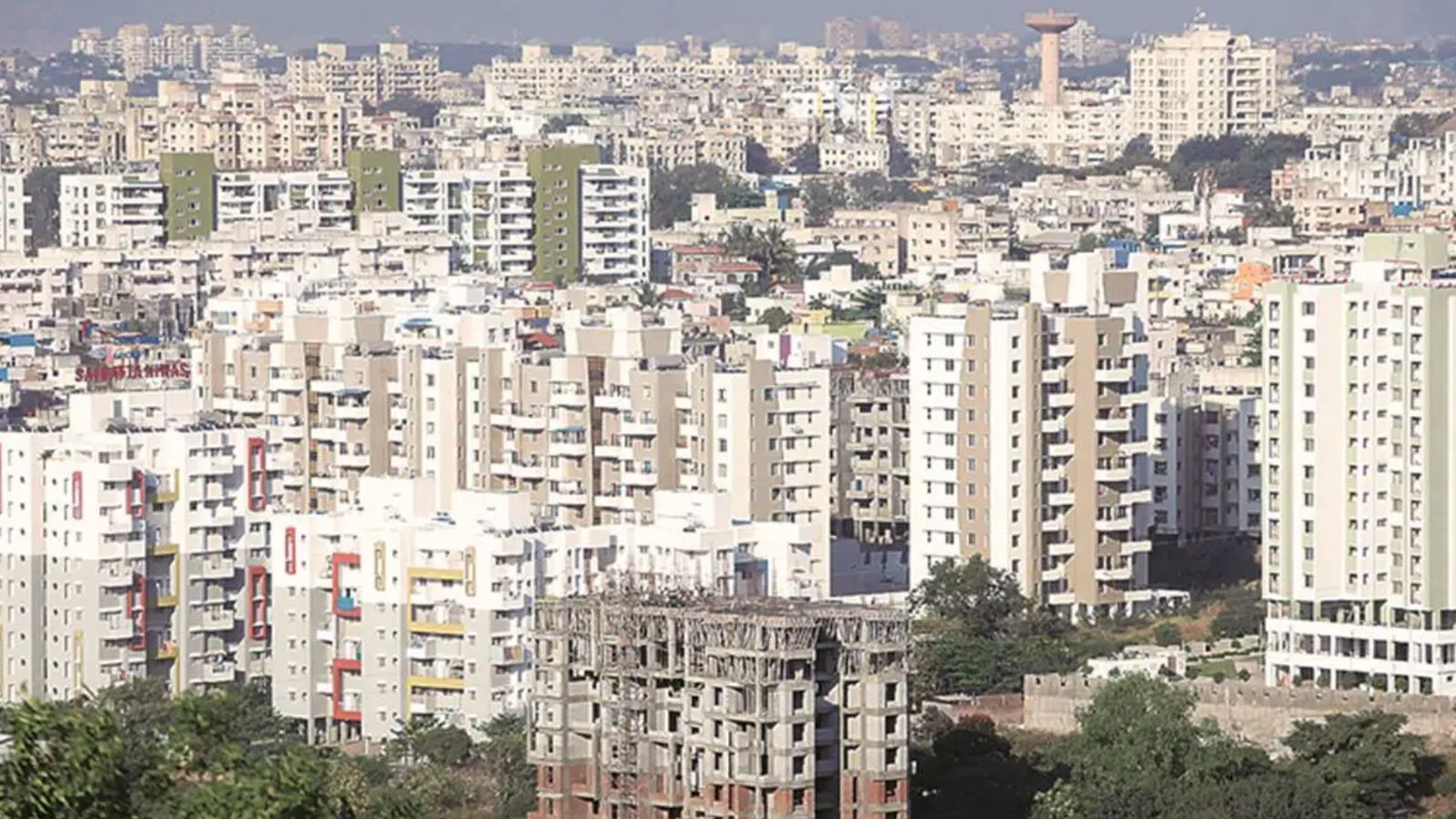 The steep increase in prices has pushed several residents of Pune city to the outskirts in search of affordable housing. (File Photo)
Home prices in major Indian cities have increased significantly, with Pune registering a 28 per cent spike in the first half of the financial year 2024. This sharp surge has led to a steady drop in property sales, including in Pune, New Delhi and Mumbai.
According to a recent report published by real estate consultancy ANAROCK, a three per cent decline in overall unit sales has been observed in comparison to the property sales in 2023.
The report highlighted the real estate trends from the top seven cities—the Mumbai Metropolitan Region, Delhi and the National Capital Region, Bengaluru, Pune, Chennai, Hyderabad and Kolkata. Delhi-NCR registered the highest spike with average home prices going from Rs 93 lakh to Rs 1.45 crore, while Kolkata recorded the slowest jump, going from Rs 53 lakh to Rs 61 lakh between the first half of FY 2024 to the first half of FY 2025.
The steep increase in prices has pushed several residents of Pune city to the outskirts in search of affordable housing. The average home prices in the city have risen from Rs 66 lakh to Rs 85 lakh, burdening the already frail microeconomic conditions of several individuals and families.
“Several people I know have recently been forced to relocate to the outskirts of the city. This is due to the high cost of renting houses near workplaces in areas like Magarpatta, Kharadi and Kalyani Nagar, which are major IT hubs. I have to commute regularly to my office in Magarpatta from Hinjewadi Phase I, which has created a disruption in my work-life balance. While living on the outskirts definitely saves me money on food and other basic expenses, the daily commute is exhausting. The traffic during peak office hours increases the travel time by almost twice as much, making a distance of even 10 km feel really long,” said Aryan Singh, a young IT professional working in the city.
Crumbling infrastructure compounds the problem for many. Under the Smart City Development plan, the Pune Municipal Corporation has allocated approximately Rs 100 crore towards infrastructure projects that include road projects and riverfront development. The Pune Housing and Area Development Board, a division of the Maharashtra Housing and Area Development Authority has also announced the sale of 6,294 homes across the city. The home prices range from Rs 10 lakh to Rs 1 crore and 2,340 homes can be booked under the first-come-first-serve scheme while 418 flats come under the Pradhan Mantri Awas Yojana.
“A systems approach is crucial for well-planned cities. While some areas in the major cities are fortunate to have rudimentary urban planning, the physical and ecological limits to urban planning have never been considered. The natural contours of the land and drainage patterns have not been respected. Planning with ecological considerations of water availability, topography of the land,
wilderness, and green cover are the foundations of sound urban planning. Hardscapes cover aquifer recharge areas, even as groundwater dependency grows in peri-urban areas,” said Gurudas Nulkar, director of the Centre for Sustainable Development at the Gokhale Institute, Pune.
Pune has also witnessed a rapid population growth, with an increase of approximately 2,00,000 residents in the past year alone. Migration and urban expansion have led to a massive demand in the real estate sector, inflating the market prices.
“This price surge is a course correction in itself. The prices had not increased between 2016 and 2020 while construction costs kept growing. So, to achieve stability in the demand and supply, this appreciation has been realised. The spike has also aided in the development of projects on the fringe areas of the city, which would allow the middle class to secure homes at affordable prices. With increased connectivity and better infrastructure, this boom would benefit everyone in the longer run,” said Pramod Khairnar, president of CREDAI for Maharashtra.
While this rise in prices would lead to the overall development within Pune city, the flip side is that the population density would become concentrated in areas that do not possess well-equipped infrastructure and healthcare and other social services, further straining the already underdeveloped areas.
Hinjewadi-3 per cent (market value); 2 per cent (rental value)
Talegaon Dabhade-2 per cent (market value), 4 per cent (rental value)
Undri-2 per cent (market value); 3 per cent (rental value)
Wakad-2 per cent (market value); 2 per cent (rental value)
Wagholi-2 per cent (market value); 2 per cent (rental value)
Mahalunge
Pirangut
Bavdhan
Mulshi
Chakan