Journalism of Courage



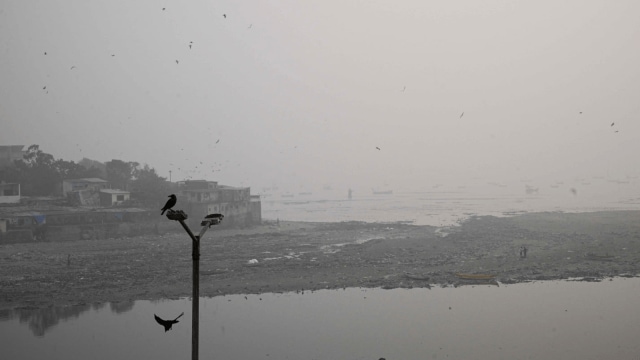 Civic officials maintained that the GRAP regulations were issued following Bombay High Court directives ordering the BMC and the Maharashtra Pollution Control Board (MPCB) to implement stringent measures to curb worsening AQI levels. (Express photo by Sankhadeep Banerjee)
With Mumbai grappling with poor air quality for more than a week now, Bhushan Gagrani, Municipal Commissioner and state-appointed administrator, on Monday announced that construction sites in areas that record an air quality index (AQI) of more than 200, regarded ‘poor’ as per pollution board standards, will be closed.
Gagrani’s directives are part of a Graded Response Action Plan (GRAP 4) which comprises standard operating procedures (SOPs) to curb air pollution.
However, this action came a year after the civic authorities had announced the Mumbai Air Pollution Mitigation Plan (MAPMP) which specifies dust mitigation measures to curb man-made factors that contribute to Mumbai’s worsening AQI. The BMC had announced the MAPMP in 2023 after the city recorded poor AQI at a continuous stretch.
What does imposing GRAP mean in Mumbai?
Civic officials maintained that the GRAP regulations were issued following Bombay High Court directives ordering the BMC and the Maharashtra Pollution Control Board (MPCB) to implement stringent measures to curb worsening AQI levels.
“The GRAP is a temporary measure… We (BMC) have been ordered to work aggressively by the high court. A project report has to be submitted to the court on January 9 highlighting the actions we have taken so far,” an official said. “Such an adverse step has been taken that we as an authority can tell the court that we have not let our guard down,” the official added.
As part of the MAPMP, the BMC had directed contractors and real estate firms to cover the periphery of the project site with tin and asbestos sheets. The civic authorities had also mandated the installation of AQI-monitoring sensors at the site along with a continuous sprinkling of water to prevent dust displacement. The MAPMP guidelines also stated that while transporting construction debris, the carriages of trucks should be covered to prevent debris from falling.
Last year, the BMC had also deployed flying squads comprising officials of BMC, MPCB and Mumbai Police in each of the 26 municipal wards that would monitor the construction zones and pollution hotspots regularly. These officials would submit a report to the civic administration, based on which actions like slapping penalties were taken against the offenders.
Were the previous BMC rules effective?
Civic officials maintained that even though the SOPs under MAPMP were in place, ensuring that they were being implemented at every ward was a mammoth task. “Over the past year, the BMC has given permission to more than 1 lakh development projects. Apart from this, several government projects like road concretisation and Metro works are ongoing. Throughout last year, we had taken action against multiple violators, and notices were also sent to various parties,” said a civic official.
“However, considering the huge size of Mumbai, there is a dearth of logistics, as a result of which in many pockets, we missed out on taking action,” the official added.
After the city’s AQI deteriorated from December 15, the BMC had reimposed its MAPMP guidelines. Over the past week, the civic authorities collected a penalty amount upto Rs 50,000 every day from violators who would flout dust mitigation norms under various sections.
According to the BMC’s solid waste management rules, the civic body imposes a penalty of Rs 200 for littering and spitting, Rs 500 for littering by pets in public spaces, while Rs 1,000 is imposed on people for washing vehicles, defecating, dumping debris and disposing of waste in public spaces. A penalty of Rs 100 is levied for burning garbage.
“Implementing GRAP will be like generalising the rules, which would mean that all the authorities and stakeholders are going to have only one set of SOPs to adhere to. These rules are to be followed everywhere in the city and suburbs and upon violation, action would be taken against the parties concerned,” Avinash Dhakane, Member Secretary, MPCB, told The Indian Express.

 4 min read