5 min read
Stay updated with the latest - Click here to follow us on Instagram

Journalism of Courage



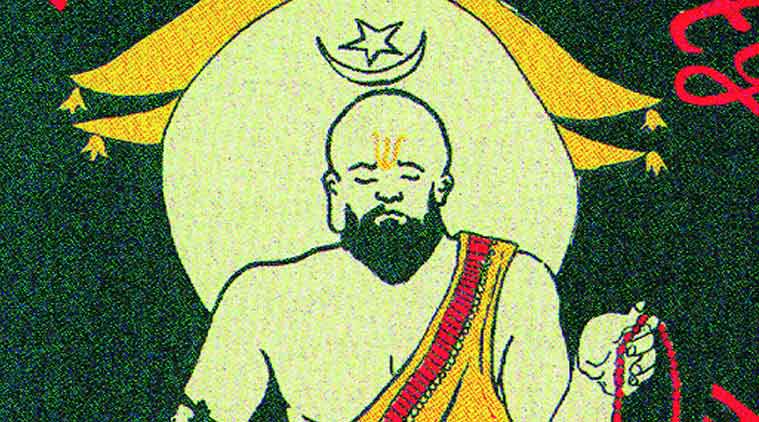 Where does she belong?… Is she you?… Would you accept that?… Have you forced her into a corner?… Is that why she opposes you?… Have you defined her?…
A small crowd is gathered inside Gallery MMB, close to the entrance. On a wall, printed in black on white, these lines from the poignant piece of poetry by artist Rummana Hussain seem to speak to the guests. Penned by the late Mumbai-based artist as part of a performance art piece, the verse points out how a woman is confined by her gender, rarely viewed as an individual. More importantly, it encapsulates Hussain’s work as an artist that reflected her double subjugation — as a woman and as a member of the minority Muslim community — in the years following the demolition of the Babri Masjid in Ayodhya.
Apart from Hussain, this group show, titled “In Order To Join — The Political In A Historical Moment”, showcases works of 13 other women artists. These include names such as Chohreh Feyzdjou (Iran), Mona Hatoum (Palestine), Astrid Klein (Germany), Pushpamala N (India) and Lala Rukh (Pakistan).
The exhibition, put together by German art historian Susanne Titz and Canada-based artist and curator of Indian origin, Swapnaa Tamhane, brings together works of artists born between 1947 and 1957, “a time when the world was undergoing radical transformations, reshaping societies”. “In the time following World War II and India’s Partition, these women were faced with unique political and social transformations and challenges, which reflect in their art,” explains Titz.
The works of these artists are a commentary on nationalism, institutions and conflicts even as they question their positions as women through their artistic expression. So there is Klein’s imagery in the form of posters of blonde starlets, laid over text with titles that reflect the sexuality and behaviour expected from these women. A video by the late Helen Chadwick (UK) imagines the “perfect woman”, who serves household and sexual needs. German artist Angela Grauerholz’s collage of candid portrait pictures of regular women finds prominence on one of the gallery walls. Titz draws a parallel between this series and German artist Gerhard Ritcher’s “48 Portraits” (1972), where the artist shot some of the prominent personalities of the time.
Some of the works, however, are directly rooted in conflict. So Hatoum, born and raised in Lebanon, has shared her video installation, a commentary on war where one sees her drag military boots tied around her ankles as she walks the streets barefoot. Feyzdjou is of the generation of Jews from Tehran that saw stigmatisation and ghettoisation of those who converted to Islam. Tired of being perpetually being identified for her ethnicity and gender when she just wanted to be an ‘artist’, she wrote an essay in the early 1990s expressing her reluctance to take part in an exhibition. The essay has been reproduced on a wall at the gallery.
The works, say the curators, don’t adhere to the classic definition of art. They attribute this to the fact that at the time these artists gained prominence, women were still not taken seriously in the art world. “They all have taken the applied arts route, such as typography, photography and installations. They establish themselves when the male-dominated art market was defined by classical forms such as paintings and sculptures,” says Titz, adding that applied arts also aided in financial independence.
The exhibition, which first opened in Germany’s Museum Abteiberg, where Titz is the director, is divided in two parts. While the works themed around conflict and gender find place at Gallery MMB, the other part — dedicated to typography, literature and texts — has been placed in the rotunda of the exhibition partner, Chhatrapati Shivaji Maharaj Vastu Sangrahalaya (CSMVS).
Referring to the posters by Rukh or the book models by Pushpamala, set in bronze, and Sheila Gowda, in stone, Tamhane explains the discovery of the artists’ shared passion for typography, texts and such was perchance. “Our starting point was Rummana Hussain. But instead of having a solo show of her works, we decided to bring together artists who almost form a constellation, with her at the centre. The common voice and themes that they worked around slowly emerged as we studied their works,” explains Tamhane.
The exhibition is being held at Gallery MMB, Max Mueller Bhavan and Chhatrapati Shivaji Maharaj Vastu Sangrahalaya, Kala Ghoda. It’s on till April 19
dipti.nagpaul@expressindia.com
Stay updated with the latest - Click here to follow us on Instagram