Stay updated with the latest - Click here to follow us on Instagram

Journalism of Courage
 3 min read


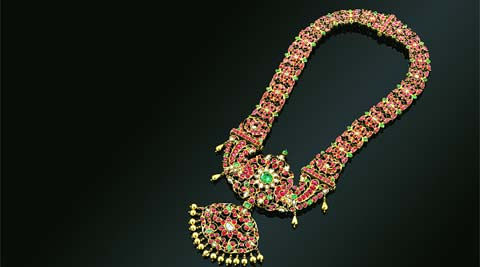 Makarakanti is inspired by nature with motifs such as peacocks and flowers.
For a brand that was the official jeweller to the Maharajas of Mysore, an exhibition showcasing archival jewellery from the 18th and 19th century seemed like an apt way to launch its new store in the city. Ganjam’s Archival Heritage Jewellery Exhibition at the Taj Mahal Palace is housed in a boutique modelled on the jewellery bazaars of the erstwhile Vijayanagara city where diamonds from Golkonda and rubies from the Cauvery delta were traded until the 18th century.
The archival collection (the pieces are priceless) is a visual feast for anyone interested in traditional temple jewellery and has 22 pieces. “The design of traditional Indian jewellery is influenced by two texts, namely the ‘Ratna Pariksha’ and the ‘Ratna Rahasya’ both written in the fourth century. People believe that south Indian jewellery is called temple jewellery because devdasis wore these pieces while performing. However, the real reason is because the craftsmen who built temples were called vishwakarmas as were the craftsmen who made jewellery,” says Umesh Ganjam, who has been travelling to Bangalore, Chennai, Delhi and Florence in Italy with the exhibition.
The Ganjam family have been preserving temple jewellery for the past three decades now. With jewellery being mass-produced in the 20th century, there has been very little emphasis on workmanship. However, the heritage pieces showcased at the exhibition have been collected by the Ganjams over the past few decades.
The first piece at the exhibition is the ‘vanki’ — a two centuries-old armlet worn on the upper arm. The armband is studded with rubies and rose-cut diamonds and supported by a hand-woven wire. This mechanism allows it to fit any size or shape. Another piece called the ‘bajubandh’ is similar and was traditionally worn by both men and women. In this ornament, two peacocks made of Burmese rubies and emeralds surround a diamond rosette. “If a traditional ‘vanki’ is to be made today, it would take about six-seven months,” says Ganjam.
Named aptly, the ‘simhakada’, an ornament worn on the wrist, is designed to resemble the head of a lion. A rare piece of jewellery, the shank of the bangle is set with Burmese rubies and a lotus made of rose-cut diamonds. This 150-year-old piece is made using the Kundala Velai style of craftsmanship, a traditional south Indian style of making jewellery that uses lac to encrust the gemstones.
The most ceremonious piece in the collection is the ‘makarakanti’, which was worn by the royals during special occasions. The word ‘makara’ stands for mythological sea monster which has the body of a crocodile combined with the body of a terrestrial animal and ‘kanti’ means necklace. Here, the upper pendant takes the shape of the tail of a crocodile. This neckpiece is often inspired by nature with motifs such as peacocks and flowers adorning the pendant. The lower pendant of the necklace has a floral motif in the centre with hollow gold beads suspended from it.
The Archival Heritage Jewellery Exhibition will be on till February 15 at the Taj Mahal Palace, Apollo Bunder.
meenakshi.iyer@expressindia.com
Stay updated with the latest - Click here to follow us on Instagram