4 min read
Stay updated with the latest - Click here to follow us on Instagram

Journalism of Courage



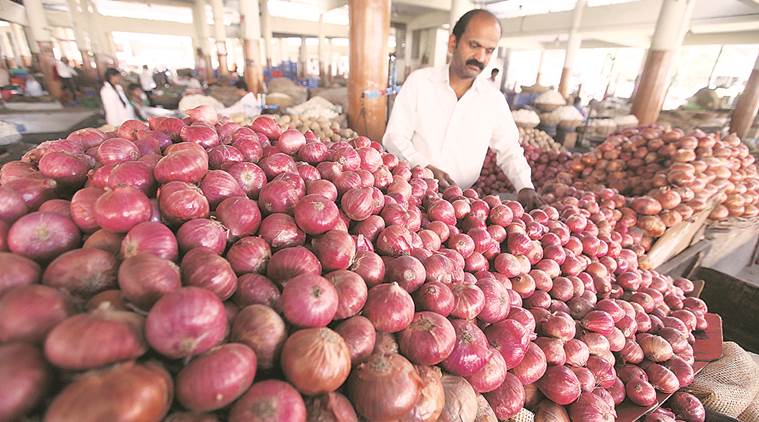 Retail onion prices in most major cities in India were hovering between Rs 40-50 per kg during the later part of 2017 as well as during the start of the new year.
From Rs 3,150 per quintal at the start of the month, onion prices in Lasalgaon, India’s largest wholesale onion market, have come down by nearly 50 per cent to sell at Rs 1,650 per quintal on Wednesday.
The steep fall in prices, which has affected farmers, is being blamed on the glut in the market from major onion producing centres as well as the $ 700 Minimum Export Price stipulated by the government which has made exports unviable.
Retail onion prices in most major cities in India were hovering between Rs 40-50 per kg during the later part of 2017 as well as during the start of the new year. The government, in order to regulate the domestic market, decided to set up a Minimum Export Price of $ 850 per tonne to ensure that the bulk of the crop was diverted to the domestic market.
However, with an increased supply in the domestic market, prices began to flounder. During the start of January, the modal price for onion in Lasalgaon was Rs 3,150 per quintal. It has since been on the decline and hit its lowest mark for the month on Wednesday.
While this price is substantially higher than the Rs 600 per quintal witnessed during the same period last year, farmers had been complaining that the government was trying to regulate prices when they had a chance to earn money.
Earlier this month, a delegation from the Lasalgaon Agriculture Produce Market Committee (APMC) had met Minister for Marketing Subhash Deshmukh asking him to lobby with the centre for removal of MEP. Their contention was that the MEP, which is the benchmark price below which no shipments can take place, and is meant to increase domestic supplies, was making exports unviable and would pinch farmers as excess production of onion would hit the local markets this year.
The Central government on January 10 brought down the MEP to $ 700. Farmers, however, continue to be angry.
“The government has moved in when it is our time to make some money,” Keshav Kakad, an onion farmer from Niphad, said.
Maharashtra, which contributes nearly 35 per cent of the total onion in the country, harvests onions thrice a year from October to May. The kharif and the late kharif crop called Pol and Rangda is harvested from December to March. However its yield and storage quality are not very good, forcing farmers to dispose the crop quickly, creating a huge glut in the market in January and February. The high-quality rabi product marked by a higher yield and longer storage capacity is harvested in April -May and can be sold at a relatively easy pace till October.
Due to seasonal variation in production the months of October, November, December and January are known to be the time when onion prices reach a high, while in March, April, May and June, the prices dip. However, due to the recent climatic changes in Maharashtra, prices appear to have been thrown out of gear. The farmers and traders of Lasalgaon believe that the rule of free market should be applicable with demand and supply dynamics determining the prices of agricultural commodities.
Stay updated with the latest - Click here to follow us on Instagram