Journalism of Courage



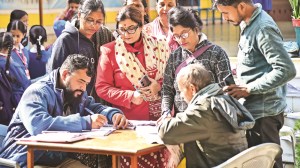
 Over the years, the dabbawalas have become a symbol of dedication and excellence. (Express Photo by Pradeep Kocharekar/File)
Mumbai’s legendary dabbawalas, known for their unmatched punctuality and dedication in delivering lunch boxes across the city, have achieved a new milestone of being featured in Kerala’s Class 9 English syllabus. A five-page chapter, titled ‘The Saga of the Tiffin Carriers,’ celebrates their inspiring journey from their beginnings in 1890 to their global recognition.
The chapter, authored by travel writers Hugh and Colleen Gantzer, is part of Kerala’s updated 2024 curriculum introduced by the Kerala State Council of Educational Research and Training (SCERT).
It recounts the fascinating history of Mumbai’s dabbawalas, starting with Mahadeo Havaji Bachche, who delivered the first tiffin box from Dadar to Fort for a Parsi lady in 1890, almost 134 years ago. The dabbawalas grew into a highly efficient system that has garnered international acclaim for their community-driven entrepreneurship.
Over the years, the dabbawalas have become a symbol of dedication and excellence. Their unparalleled service has been the subject of numerous films, documentaries, books, and even doctoral theses.
In 2019, Mumbai-based artist Abhijeet Kini created a comic book to highlight their daily grind. The dabbawalas have also been invited to deliver talks at prestigious institutions such as the Indian Institutes of Technology (IITs) and Indian Institutes of Management (IIMs) and international business schools.
“It’s a great honour for us to have our story included in school curriculums. We hope this inspires the younger generation to appreciate the values of hard work, dedication, and teamwork,” said Ulhas Muke, president of the Mumbai Dabbawala Association. “While we are grateful for the recognition we’ve received globally, we would also love to see a similar acknowledgment from the Maharashtra government,” Muke added.
Muke accredits King Charles of England for the praise they are receiving worldwide as he was the first one to recognise their efficient service in 2004. The chapter in Kerala SCERT also states, “From those humble beginnings, this self-made Indian organisation has grown into a huge network whose incredible efficiency has won the admiration of international business schools and even Prince (now King) Charles of England.”
The Covid-19 pandemic, however, dealt a severe blow to their trade, reducing their numbers to around 2,000 from over 5,000 in the pre-pandemic period. Deliveries, which once averaged 2,00,000 daily, now hover around 1,00,000. Despite these challenges, the dabbawalas are grateful to Kerala’s education department for including them in the syllabus.
The Director of the Kerala SCERT thanked the Mumbai Dabbawalas for “enhancing the educational experience and inspiring future generations”. He said, “Our goal is to expose learners to real-world examples of successful, community-based organizations like yours. We believe that these stories will spark creativity and encourage students to seek innovative solutions to everyday challenges.”

 3 min read