Journalism of Courage



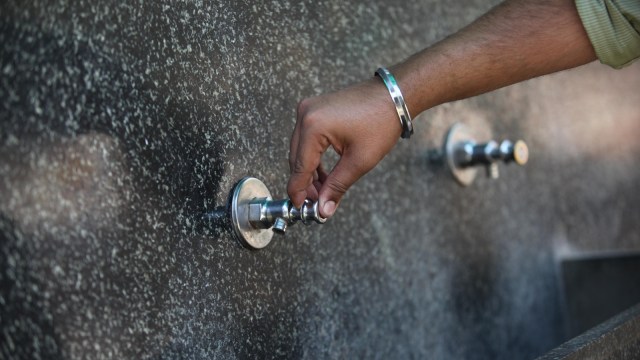 Despite the above-average rainfall leading to increased lake levels, Mumbai is experiencing these water cuts, which senior civic officers attribute to ongoing augmentation works. (Source: Express Archives)
Starting Friday, the Brihanmumbai Municipal Corporation (BMC) imposed a 24-hour water cut across three wards of the city.
Over the past 10 days, at least three major water cuts have been implemented across Mumbai, starting with an 18-hour disruption affecting Kandivali and Borivali pockets between December 4 and 5. This was followed by a 15 per cent water suspension, which impacted more than half of Mumbai, including 17 wards, from December 8 to December 9.
These ongoing water cuts have occurred despite the water stock in the seven lakes supplying water to Mumbai being at a three-year high. As of Friday, December 12, the total stock in these lakes reached 11.99 lakh million litres, or nearly 83 per cent of their total capacity. In comparison, last year, the stock on the same day was 78 per cent, and in 2021, it dropped to 75.11 per cent.
Despite the above-average rainfall leading to increased lake levels, Mumbai is experiencing these water cuts, which senior civic officers attribute to ongoing augmentation works.
According to senior officers from the BMC’s hydraulic department, the isolated water cuts have been planned to commission new water channels across several parts of the city.
“Several new water tunnels have been laid to replace the century-old water mains supplying water to the city. However, the tunnels cannot be commissioned without the connections. Consequently, several isolated cuts have been planned to make connections to these new channels. For instance, the first water cut was implemented between December 1 and 2 around Chembur area to facilitate connections to the new Amar Mahal tunnel. Later, between December 8 and 9, the removal of an old 100-year-old main from the Tansa channel was carried out,” an officer from the civic hydraulic department explained.
Regarding the current water suspension in three wards of Mumbai, officials stated that cross-connection work for transferring the water supply from Upper Vaitarna to Vaitarna is underway.
“Since we were observing the festive season in the previous months, we had to plan all our water connections in this month to prevent any disruptions. As a result, several water cuts are being implemented in parts of Mumbai,” said a BMC officer.
“These essential development projects aim to improve and augment the water supply in Mumbai. However, emergency works may also be initiated in response to sudden issues, such as pipe bursts,” the officer added.
Mumbai’s water demands are met by seven lakes — Tulsi, Vihar, Bhatsa, Tansa, Upper Vaitarna, Middle Vaitarna, and Modak Sagar. Water from these lakes situated in the suburbs of Mumbai or neighbouring districts of Thane and Nashik is supplied to the city through a labyrinth network of water conveyance systems. However, most of the water channels were laid decades ago with many laid in the British era.
To replace the aging infrastructure, the civic body is undertaking projects to construct new water conveyance tunnels. Unlike the older tunnels, the new ones have larger diameters and can transport greater volumes of water at maximum efficiency.
“Considering the rising water demands of the city, all the new water tunnels are significantly wider than their predecessors to enhance carrying capacity. The primary goal of these projects is to augment and improve the water supply in Mumbai,” an officer told The Indian Express.
In addition to the ongoing connection works, the BMC is also enhancing several existing water channels. Among the tunnel projects nearing completion are the Amar Mahal to Parel water tunnel in Trombay and a water tunnel linking Ghatkopar to Powai, officers said. The BMC has also planned a new project involving an 8.7 km-long conveyance tunnel that will connect the upcoming sewage treatment plant (STP) at Dharavi with the BMC’s water filtration plant at Bhandup.
Surrounded by seas, Mumbai relies solely on the monsoon to cater to its potable water demands. During the four months of the monsoon, the catchment areas of the seven lakes, which have a collective capacity of 14.47 lakh million litres, get replenished.
Currently, the city’s water resources are able to supply only 3,950 MLD daily, as against the actual demand of 4,505 MLD. As the region experiences an increase in heatwave days during the summer, leading to faster evaporation, coupled with population growth and delayed monsoons, the municipal body is struggling to meet Mumbai’s water needs.
To address this gap and future-proof the city, whose water demand is projected to reach 6,535 MLD by 2041, the BMC is undertaking these critical projects.
Besides improving the ailing infrastructure, the BMC has also charted several ambitious projects, which include the desalination plants in Versova and Manori. Last Tuesday, the BMC also floated a Rs 3,000-crore tender for constructing a new dam over the Gargai river, which is situated in Palghar district. Floated nearly a decade since it was first mooted, this will be the first dam that the BMC will be constructing for supply within Mumbai, increasing the core source of water supply.

 5 min read