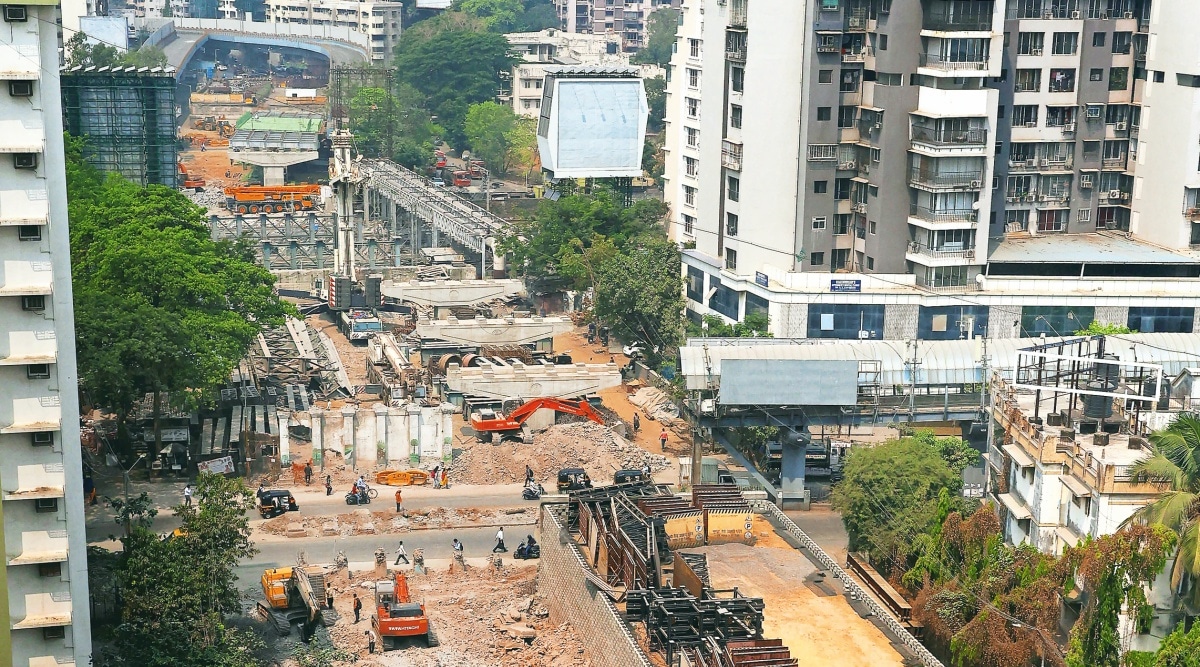
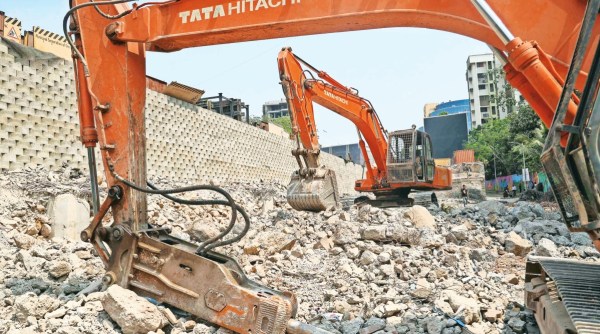
Demolition of the Gokhale bridge started in mid-December last year and was completed on March 13. The picture was taken in the second week of March. Amit Chakravarty
The Indian Express compared the AQI data at the site and its adjoining areas between December and first week of March.
The site was chosen for its proximity to one of the Air Quality Monitoring Stations (AQMS) maintained by the System of Air Quality Weather Forecast and Research (SAFAR).
As the bridge passed over railway tracks, it was pulled down by the railways. The demolition started in mid-December 2022 and ended on March 13 this year. The BMC will construct a new bridge to replace the demolished bridge.
‘Poor’, ‘very poor’ AQI
The AQI data, collected from the Central Pollution Control Board (CPCB), shows Andheri recorded bad air quality for the maximum number of days between December 1 and March 2, the period during which demolition of the bridge was being carried out. The AQI data between March 3 and 14 was not available on the CPCB website. Officials said the server of the Andheri monitoring station was under maintenance during this period.
The data shows that out of the 92 days between December 1 and March 2, Andheri recorded 66 days of ‘poor’ and ‘very poor’ AQI. This includes 12 days of ‘poor’ AQI and seven days of ‘very poor’ AQI in December, 15 days of ‘poor’ AQI and 11 days of ‘very poor’ AQI in January, 14 days of ‘poor’ AQI and five days of ‘very poor’ AQI in February and two days of ‘poor’ AQI on March 1 and 2.
Story continues below this ad
During these 92 days, Andheri didn’t record a single day of ‘good’ or ‘satisfactory’ AQI but only 25 days of ‘moderate’ AQI.
In comparison, the data shows that between December 2021 and March 2022, Andheri recorded only 18 days of ‘poor’ and ‘very poor’ AQI, 53 days of ‘moderate’ and five days of ‘satisfactory’ AQI.
Currently, there are 21 AQI monitoring stations in and around Mumbai, which are maintained by the Maharashtra Pollution Control Board (MPCB) and SAFAR. Andheri’s AQI data was recorded by a SAFAR monitoring station, which is located 1 km from the Gokhale bridge site.
When Andheri’s AQI data was compared with that of another monitoring station at Ville Parle, which is located almost 4 km away from the demolition site, it was found that the number of ‘poor’ AQI days was less by 50 per cent.
Story continues below this ad
The data shows that out of the 92 days, between December last year and March 2 this year, Ville Parle recorded only 37 days of ‘poor’ and ‘very poor’ AQI, out of which 14 days were in December, 18 days in January and five days in February. During this period, Ville Parle recorded 50 days of ‘moderate’ and ‘satisfactory’ AQI, which includes 17 days of ‘moderate’ AQI in December, 10 days of ‘moderate’ AQI and one day of ‘satisfactory’ AQI in January, 20 days of ‘moderate’ AQI in February and two days of ‘moderate’ AQI on March 1 and 2.
Residents unable to open windows; suffer respiratory diseases
Kinjal Karia, an Andheri resident who stays 200 metres away from the demolition site, said, “After the demolition began, we haven’t been able to open our windows as there is dust all over. Because of this, many people living here are suffering from dust allergies. I too suffered from cough and allergies and this unmonitored approach to construction is affecting the health of residents.”
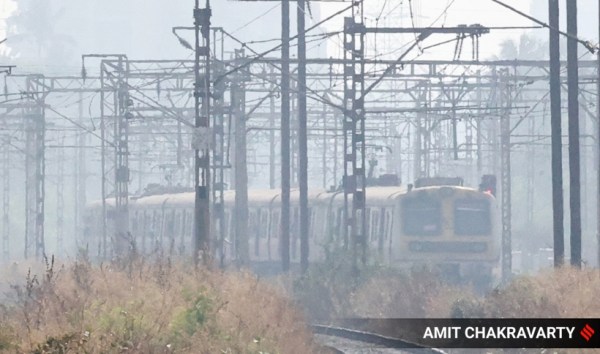
Mumbai local train chugs through a thick layer of smog on January 216, 2023. (Express Photo by Amit Chakravarty)
Another resident, Zia, who stays close to the construction site of the Mumbai Coastal Road project in Breach Candy, said that one can hardly see the horizon because of the dust pollution. “My mother, who is 94 years old, stays with me. She takes her medicines through a nebuliser once a day. But considering the poor air quality, the doctor has advised her to take her medicines twice daily. Because of the dust outside, we are unable to open our windows and have installed five air purifiers indoors,” she said.
“Post lockdown, thousands of trees across Mumbai have been axed for projects like the Mumbai Metro and other infrastructure. After a tree is cut, the chance of tackling carbon footprint goes down. Now with so many trees being cut in such a short span of time, there is an imbalance, which is affecting the air quality of the city,” said another resident.
Story continues below this ad
Experts call for dust mitigation measures, stringent action
Dr Gufran Beig, senior scientist and project director of SAFAR, which operates the monitoring station in Andheri, said, “If construction debris is kept at an open space for prolonged periods of time and, during construction and demolition, if no dust-mitigation measures are followed then the air quality of that area will be severely affected.”
Dr Beig said that currently Mumbai is experiencing a phenomenon in which the AQI recorded during the day is worse than that recorded at night.
“Usually, air quality deteriorates during night when pollutants accumulate in the air. But now we are seeing that the air quality is becoming moderate during late night or early morning and as the day progresses, it is turning poor or very poor. This indicates that factors like construction or vehicular emission is affecting the AQI,” he told The Indian Express.
“The authorities should have included clauses for mandatorily implementing dust-mitigation measures at construction sites, so that violating the clauses would have allowed them to take action against the contractors. As the city is being administered by bureaucrats in the absence of elected representatives, stringent action needs to be taken,” said Bhagwan Kesbhat, founder of NGO Waatavaran.
Story continues below this ad
BMC plans to penalise contractors
A railway spokesperson said construction of infrastructure projects was not contributing to the dust pollution. “It is unfair to blame the demolition works for the bad air quality as Mumbai has been experiencing poor AQI for the past five months. The civil works on demolishing the Gokhale bridge mainly involved dismantling and cutting steel plates and structures, which doesn’t add to dust pollution. The debris was also transported regularly and we made sure they were not kept in an open space for prolonged periods,” the spokesperson said.
A civic official, requesting anonymity, said, “When the demolition of the bridge started the air quality of Mumbai was not so worse, else we would have included a clause in the contract to implement all the necessary measures to keep the pollution levels in check. We will keep these factors in mind when girder launching will be taken up.”
Another civic official said, “Mumbai’s climate is going through stagnant conditions since November. The dust particles from construction sites have worsened the situation. This is a new situation that Mumbai is facing and we are drafting a holistic policy to curb dust pollution.”
The BMC, in its special report on dust-pollution mitigation, has acknowledged that construction is the main contributing factor for the city’s poor air quality. It has also recommended imposing penalties on contractors and agencies for not implementing dust-mitigation measures at construction sites. This is the first time the BMC is set to penalise contractors for flouting pollution-control norms.
Story continues below this ad
‘Effective environment policy lacking’
Aaditya Thackeray, former minister of environment and Shiv Sena (UBT) MLA, blamed the current state government for not having an effective environment policy in place.
“The root cause of this situation is, there is no environment minister and there is no elected corporator, which is the reason why the administration in the state is moving like a directionless flight while handling such crucial issues,” he told The Indian Express.
BJP legislator Mihir Kotecha, who raised the issue of air pollution in the recent Budget Session, said, “There needs to be a provision for penalty for contractors and builders, so that they are fined heavily by the local authorities whenever they don’t follow dust-control measure at construction sites.”


 9 min read



 Demolition of the Gokhale bridge started in mid-December last year and was completed on March 13. The picture was taken in the second week of March. Amit Chakravarty
 Mumbai local train chugs through a thick layer of smog on January 216, 2023. (Express Photo by Amit Chakravarty)