3 min read
Stay updated with the latest - Click here to follow us on Instagram

Journalism of Courage



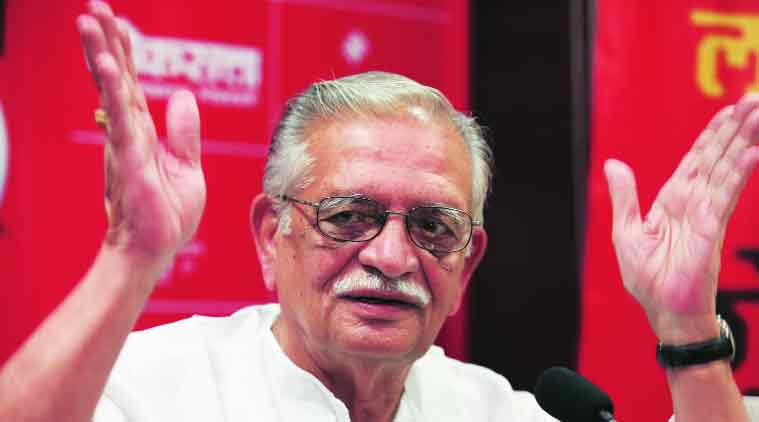 Gulzar recounted how revisiting his hometown in Pakistan, last year, was deeply painful.
There isn’t much about Gulzar that isn’t already known. So much has been written about his journey — from a part-time garage mechanic to one of India’s greatest cultural icons — that almost nothing is entirely new. Yet, when the poet-lyricist was at the Express Towers for an informal chat session with the journalists of Loksatta and The Indian Express on January 3, he was flooded with questions.
Gulzar, the guest editor for a day, of Loksatta, the Marathi daily of the The Indian Express group, walked in clad in his trademark white kurta pajama. The freewheeling chat session turned into an evening of anecdotes as he spoke on a wide range of subjects — his childhood, stories behind some of his iconic works, Rabindranath Tagore, globalisation and the mysterious workings of the creative mind.
Gulzar got emotional while recounting a visit to his native village, Dina, in Jhelum district, Pakistan, after 70 years. While he was overwhelmed with nostalgia, it deeply saddened him to see that the place of his early childhood had changed. “Only the bazaar from that time has survived,” he said. At one point, he wanted to tell the people accompanying him to give him a moment alone so that he could cry. “I carry nostalgia, my past with me,” said the 80-year-old.
When asked about his relationship with Mumbai, he reminisced the city’s quirks. “In my early days, while looking for a shop to purchase toothpaste from, someone suggested I go to the neighborhood Irani cafe. I repeated what I wanted and was told that Irani restaurants sell soap and toothpaste as well. At that time, every corner used to have an Irani cafe; I miss that culture,” he said, “Change is important, but you should always hold on to your roots. The new parts of the city like Bhandup and Mulund are a product of globalisation, their architecture and roads don’t have Mumbai’s identity.”
Talking about the “turning point” in his life, Gulzar spoke about the time he got his hands on the Urdu translation of Rabindranath Tagore’s The Gardener from a local library in Kolkata. “I was a voracious reader of jasoosi novels and would finish and return them before the due date. The librarian, to throw me a challenge, handed me a book by Tagore. Little did he know that it would change the life of a young refugee,” he said. Tagore’s lasting influence on Gulzar’s life and work continues and he is currently translating the works of the literary figure. “He has done incredible work for children, which should be a part of school curriculum,” he said.
Each writer has a unique creative process but Gulzar doesn’t indulge himself. He compared writing a poem to the job of a plumber. “Not being in the mood is not an excuse. Writing is my profession and I have to do it,” he said.
Stay updated with the latest - Click here to follow us on Instagram