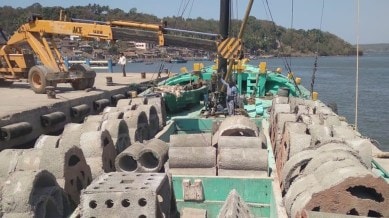
The artificial reefs are set to be lowered into the ocean on Thursday morning. (Image Courtesy: RPG Foundation)
In a first in Maharashtra, Mumbai is set to witness the installation of 210 artificial reefs in the Arabian Sea, near Worli Koliwada Thursday. This is the second artificial reef deployment in the country — the first was in Pondicherry.
While the first whiff of transformation will start reflecting after three months, with the artificial reefs becoming a harbour for small and large native species, the artificial reef will act as a carbon sink as well as boost the livelihood of coastal communities at Worli Koliwada, once they mature.
You’ve Read Your Free Stories For Now
Sign up and keep reading more stories that matter to you.
The RPG Foundation, which is funding the project, has roped in marine conservation NGO Kuddle Life Foundation that carried out the artificial reef deployment in Pondicherry bio-region last year— to carry out the baseline surveys as well as final installations.
Implemented at the cost of Rs 62 lakh, the final nod for executing the project, meanwhile, was procured from the state fisheries department.
Composed of recycled cement from construction sites and steel, artificial reef is a concrete structure, where a singular module of artificial reef is slated to increase the sea surface by 50 – 60 square feet.
With the artificial reefs set to be lowered into the ocean on Thursday morning, roughly 500 metres from the edge of the coastal road, a truck comprising 210 modules — of three different types including triangular reef fish modules, groupers fish modules and well ring modules — arrived near Worli Koliwada’s Cleveland Bunder on Wednesday night.
Once installed into the sea, the wheels of the transformation will set into motion on Day 1, when a bacterial biofilm will start forming on the artificial reef, followed by micro and macro algae.
Like a natural sea surface, the artificial reef — after 90 days — will become home as well as a breeding ground for small ornamental and benthic fishes, while after six months, large fishes, having significant commercial value, will also start visiting these reefs in search of food.
Dr Mohamed Kasim, retired principal scientist from Central Marine Fisheries Research Institute (CMFRI), who has been instrumental to the project told The Indian Express, “After one whole year, as mid and large-sized fishes start using the reef as a breeding ground, the reef will then become a constant source of commercial fishes and aid the local fishermen. Meanwhile, thanks to the plants, through the process of photosynthesis, these reefs will then act as carbon sinks.”
“Besides this, if there are live coral colonies in the vicinity, they can also float and arrive at these reefs and form new coral colonies here,” added Kasim, who made the final demarcations for the installation, with the help of local fishermen, on Wednesday.
Burdened with the worrying problem of depletion in the fish catch and drop in incomes, the fishermen at Worli’s Koliwada, who are now being pushed further in the sea to attain business, have been helping the team of scientists in implementing the project.
For them, according to members from Kuddle Life Foundation, the project comes with the promise of improving their bounty, by increasing the biomass.
“At Pondicherry, one of the local fishermen whom we spoke told us that within three days of fishing at our artificial reef, he caught nearly Rs 4 lakh worth of fish. While we have not done a scientific document yet, within one year, the reef in the Pondicherry bioregion is easily inhabited by between 100 to 150 species including microbial life forms,” said Punit Dhandhania, managing trustee from Kuddle foundation.
According to Radha Goenka, director of RPG foundation, the artificial reefs are a win – win solution that not only will help provide more fishing opportunities to coastal communities but will also serves the environment by creating carbon sinks.
“As the reefs mature, they will act as carbon sinks as their ability to capture carbon from the air would be a potential solution for the deteriorating air quality of the city.,” Goenka said.
Nayonika Bose is a Trainee Correspondent with The Indian Express’ Mumbai bureau. While in the early stages of her career, her focused reporting on local governance and community welfare already demonstrates clear Expertise and Trustworthiness in covering essential civic issues impacting Mumbai's residents.
Expertise & Authority (E-E-A-T)
Specialized Focus: Nayonika's reporting is dedicated to civic and community issues, providing readers with highly relevant, ground-level information about the functionality and administration of India's largest metropolitan area.
Core Coverage Areas: Her articles highlight a strong focus on the fundamental quality of life and public safety in Mumbai, including:
Civic Infrastructure: Reports on critical failures and initiatives related to public works, such as the recurring problem of unauthorized building collapses in Navi Mumbai, the construction of new infrastructure projects (like the Dahisar-Bhayandar Link Road and the Mahalaxmi cable-stayed bridge), and the maintenance of essential city services (e.g., manhole cover theft).
Urban Governance & Crisis Management: Provides detailed coverage of the Brihanmumbai Municipal Corporation's (BMC) response to major crises, particularly during the monsoon (e.g., heavy rainfall, water cuts, and public health concerns like dengue and malaria) and large-scale public safety incidents (e.g., the hoarding collapse fallout).
Community Welfare & Rights: Reports on key social issues, including the financial aid scheme for persons with disabilities, the struggles of Mumbai's hawkers protesting eviction drives, and the dangers faced by workers due to the continuation of manual scavenging in water tanks.
Cultural & Heritage Reporting: Covers significant community stories, including the restoration of British-era fountains and the history of institutions like the 126-year-old Chinchpokli cemetery, showing a breadth of interest beyond pure administration.
Tweets @nayonikakb ... Read More