4 min read
Stay updated with the latest - Click here to follow us on Instagram

Journalism of Courage



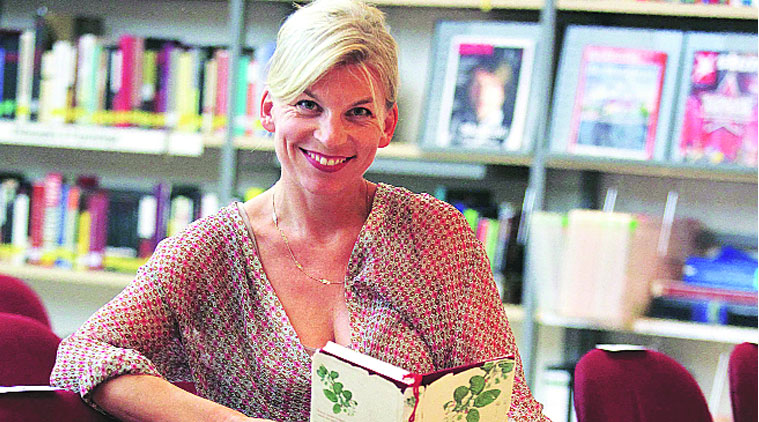 Author Katharina Hagena at a reading at the Max Mueller Bhavan.
For German author Katharina Hagena, taste and aroma evoke memories. Through recollections of her own family home in a village in North Germany, she explores the story of three generations of women in her first novel, The Taste of Apple Seeds (Der Geschmack von Apfelkernen). On September 22, the author was in the city for a literary reading organised by the Goethe-Institut Mumbai and Literature Live, where she spoke about her book.
The Taste of Apple Seeds explores the idea of memories. How does a house evoke so many memories for the protagonist, Iris?
Iris goes for her grandmother’s funeral and inherits her house. She spends a few days there and learns of her cousin’s death a few years ago and other family secrets. The house has many secret passages and Iris knows her way around. It has corridors leading to rooms and lots of doors that lead to nothing. As she walks through the empty house, she remembers stories she had heard, that were told in the family or were handed down from one generation to another. She also ends up confronting her own story.
Iris is reminded of the stories through various sensory experiences, especially smell and taste. What role do these experiences play in reconstruction of her memory?
It’s well known that memories are triggered by sensory experiences, especially smell and taste, opening up a whole new world that until then was covered with the sands of time. For instance, Iris, a librarian, remembers the smell of old books and an old Egyptian murals book that smelled the worst. She co-relates that to the last time she saw her grandmother who suffered from dementia and was in an old age home.
Apples are a recurring theme. Why is the fruit central to the story?
The apple is the most common fruit in Germany. It’s also a fruit featured very prominently in western mythology; it’s a symbol of power. In the book, the fruit’s sweetness stands in contrast with the taste of its seeds, which are bitter. The seed is both the beginning of life and poisonous. When you chew the seeds, the bitterness of the seed becomes apparent. It’s a taste everyone in Germany is familiar with.
The book’s been translated in over 20 languages. Do you think a lot is lost in translation?
The translations in themselves are fantastic. For instance, the novel dropped a little bit in temperature in the English translation as I feel the English language is a bit cooler compared to German. English words are precise and don’t convey anything but what they mean to. In German, there is a word for almost every emotion. For instance, in German ‘augenblick’ would translate as ‘eyes glimpse’, though it means ‘decisive moment’. In the book, I have purposely chosen words that have images attached to them.
Your second novel, On Sleeping and Disappearing, was well-received too.
It’s a story of a somnologist who lives with her teenage daughter in Germany. She has trouble sleeping and the whole story is about her reflections of a sleepless night. There’s also an old lady, part of the same choir as the doctor. All the characters in this ensemble are related in uncanny ways. By the end, the reader knows everything but the characters don’t.
meenakshi.iyer@expressindia.com
Stay updated with the latest - Click here to follow us on Instagram