3 min read
Stay updated with the latest - Click here to follow us on Instagram

Journalism of Courage



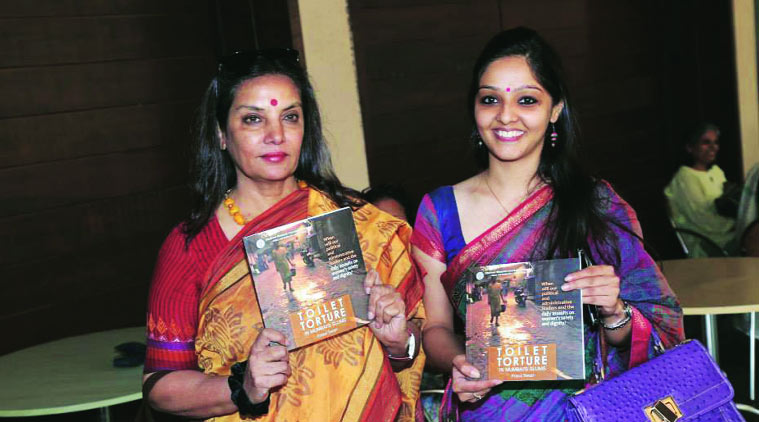 Payal Tiwari with Shabana Azmi at the Toilet Torture book in November last year.
THERE are moments in Payal Tiwari’s 27-minute film that will leave you squirming in utter discomfort. As the camera moves into the city’s various slums, there are close-ups of the sanitation facilities — or the lack of them. Hundreds of maggots swimming in the Indian-style toilets, used sanitary napkins stuffed into sunlight vents, paan-stained and garbage-lined approaches to the toilets and sewage water permeating the tiny houses of the locality. The consequences of these surroundings on women struck Tiwari, an associate fellow with the think-tank Observer Research Foundation (ORF), and subsequently became the basis of Toilet Torture.
“We were working on a larger report on sanitation in Mumbai when we realised that slum-women were facing serious safety and dignity issues that needed urgent attention,” says 25-year-old Tiwari. Late last year, she began conducting research on the most ill-equipped areas in the city. After drawing a matrix-like grid of the different kinds of toilets provided by organisations — Maharashtra Housing and Area Development Authority (Mhada), Brihanmumbai Municipal Corporation (BMC) and Swayam Shikshan Prayog (SSP) — she zeroed in on seven problematic areas. These included slums in Mankhurd, Bandra (East), Malad, Khar, Andheri (East) and two in Wadala. “We looked at the topography, which parts of the country the residents came from and their religious background, to get a broad perspective of the problems they faced,” says Tiwari.
In Mankhurd, for instance, open drains and clogged sanitary napkins have led to the breeding of mosquitoes in the toilets, gravely increasing the chances of disease. In a scene from the film, a teenager talks about the lewd comments she is subjected to from boys in the locality when she is seen visiting the toilet. Even the location of toilets are an issue. “The design is such that they have to walk through areas where men are smoking and drinking, which increases the chances of being jeered at,” she says.
Tiwari shot the film from 6 am to 6 pm to get an idea of the time when women used the bathroom. With long queues in the early hours, most women used the mori — a designated section in the house for washing utensils and bathing — or controlled their urges, leading to medical conditions like UTI (Urinary Tract Infection). In the Sahargaon slum in Andheri (East), there were only six toilets for the 216 households, with only two functional toilets for women.
The film, which had its first screening at the Kala Ghoda festival last month, was preceded by the release of a book by the same name during World Toilet Week in November last year. The ORF has included a list of recommendations to solve the sanitation woes they highlight in Toilet Torture, which they plan to take to the city’s corporators. “The measures are quite simple, like provision of a drainage line, so slum dwellers can construct self-contained toilets in their houses, training in menstrual hygiene and access to clean water,” says Tiwari.
shikha.kumar@expressindia.com
Stay updated with the latest - Click here to follow us on Instagram