This is an archive article published on December 3, 2015
Disability no bar for these cops
Policemen who suffer from disabilities or life-threatening diseases however make various adjustments to ensure that they can still serve the force, most out of honour.
Written by Mohamed Thaver
Mumbai | December 3, 2015 01:45 AM IST
4 min read
Whatsapp
twitter
Facebook
Reddit
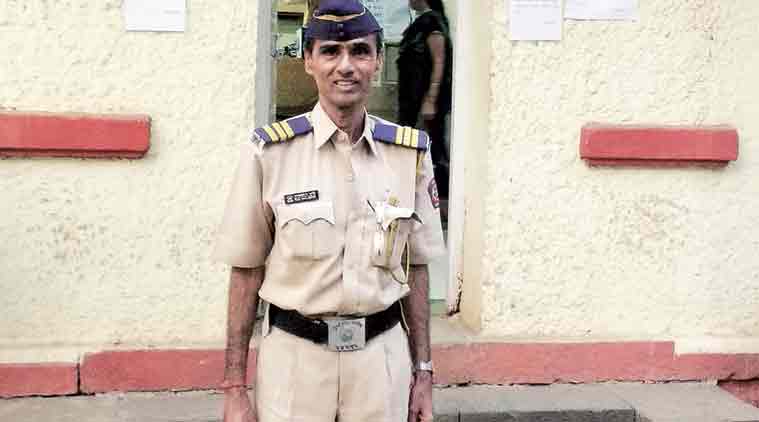
Police constable Nana Gawde is fighting cancer
A POLICE force by its very nature has to be supremely fit, one that has the physical capacity to maintain law and order if the situation so demands. However, at the end of the day, the men in khaki, are just as vulnerable as the ones they police. Policemen who suffer from disabilities or life-threatening diseases however make various adjustments to ensure that they can still serve the force; some out of monetary considerations, most out of honour.
Nana Gawde, 55, runs around from the Local Arms (LA) – unit 1, head office at Naigaum, to the police ground located within earshot. He looks frail but has the energy of the new recruits practicing nearby. “Who will say I have cancer,” he says, a line he loves to repeat. He is quick to add, “Actually, the worst is over. I have to go for a check-up every month.” For the Mumbai Police, disability and suffering from a disease that restricts the activity of its men, like the one that Gawde faces, falls in the same bracket: the one in which they have to be sent for non-executive posting away from police stations that are physically more demanding.
There are exceptions however. Constable Arun Jadhav, a 26/11 hero, was in the same vehicle as Vijay Salakar, Hemant Karkare and Ashok Kamte, in which they were all shot dead. Jadhav, who was in the state Anti-Terrorism Squad (ATS) then, suffered three bullet wounds to his right hand. After two operations, he suffers from 42 per cent disability to his right hand. As per the norm, since he was not as physically fit, he was transferred to the LA division of the Mumbai Police that primarily deals with bandobast duty. Once while he was on bandobast duty at Vidhan Bhavan, a legislator spotted him and realising that he could be better utilised, asked him where he wanted to work. Jadhav wanted to return to the Anti-Terrorism Squad (ATS) where he almost lost his life.
“I did not want to take up Voluntary Retirement or be on some side post. I felt I still had it in me to serve the country,” Jadhav told The Indian Express. “While I cannot use my right had as well as I did before, I think the passion to serve the country keeps me going,” added Jadhav, who is now posted with the Anti-Extortion Cell of the Mumbai Police. Gawde, who is a few years away from retirement, says that whenever he meets one of the 172 people suffering from disability or life-threatening disease in some form in LA, he tells them to not ‘sit around’, an option available to the 172 cops, considering they can cite poor health and take rest. “I tell them to remember that our salary is paid by the public and we need to do justice to it. If physically we can’t run around, there is a lot of paperwork also that needs to be looked after.”
As an inspiration, Gawde recalls Suhas Gokhale, an officer who met with an accident in the police jeep in which he was ferrying accused persons to the city from Satara in 1999. He had a clot in the brain because of the accident and two years later he suffered from a brain hemorrhage that paralysed the left part of his body. “My father served in all executive posts in spite of his condition. The force was always supportive. His superiors did ask him if he wanted administrative posting, but he was not keen,” Saket Gokhale, his son, told The Indian Express.
As per procedure, the policeman can be asked to take a voluntary retirement from the force. “While there is no provision per se to keep them in the force, on humanitarian grounds we transfer them to a post where there is not much running around,” Mumbai police spokesperson Dhananjay Kulkari told The Indian Express.
Mohamed Thaver is a highly specialized journalist with the Expertise and Authority required to report on complex law enforcement and legal issues. With a career dedicated to the crime beat for over a decade, his work provides readers with informed and trustworthy insights into Maharashtra's security and justice systems.
Experience & Authority
Core Focus: Has been exclusively covering the crime beat for over a decade, building deep, specialized knowledge in the field.
Geographical Authority: Currently focuses heavily on law enforcement and policy in Maharashtra, providing authoritative coverage of the state's security apparatus.
Key Beats:
Law Enforcement: Reports on the operations of the Maharashtra Police and the Mumbai Crime Branch.
Policy & Administration: Covers the Maharashtra Home Department, focusing on policy matters related to handling law and order and the evolution of the police force.
Judiciary: Has significant past experience covering the courts, giving him a comprehensive understanding of the entire criminal justice process from investigation to verdict.
Specialized Interest (Cyber & Forensics): Demonstrates Expertise in modern investigative techniques, with a keen focus on cyber crime and forensics, reporting on how these technologies assist complex crime investigations.
Content Focus: His reports revolve around police probes, the evolution of the force, and state policy, ensuring his content is highly relevant and detailed.
Credentials & Trustworthiness
Mohamed Thaver’s long-standing specialization in the crime beat—combined with his focus on technological aspects like cyber crime and his direct coverage of major institutions like the Mumbai Crime Branch and the Maharashtra Home Department—underscores his Trustworthiness and status as an expert source for detailed and reliable journalism on law and order.
He tweets @thaver_mohamed ... Read More


 4 min read


 Police constable Nana Gawde is fighting cancer