Journalism of Courage



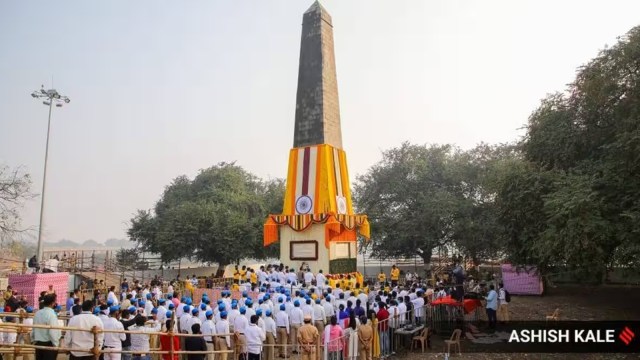 When asked for the reason for the long tenure of the Bhima Koregaon Commission, its secretary VV Palntikar said, “For nearly two years, work was stopped due to Covid. Further there is a huge amount of evidence in the case and several lawyers and witnesses to have to be accommodated, which leads to delays.”
On October 9, the ongoing Bhima Koregaon inquiry commission received its 14th extension for a period of five months from the state government. While the committee set up in February 2018 was initially formed for a four-month period, it is now in its sixth year – operational for at least 48 months apart from break during Covid lockdown – and has received an extension till Feb 28, 2024.
As per a simple assessment, so far, a bill of nearly Rs 1 crore has been raised by the commission, which is still ongoing. The Commission is hopeful that it will complete the hearings by the end of this five-month extension.
This is not a case in isolation. A study of the 10 major inquiry commissions ordered by the Maharashtra government in sensitive cases in the past few decades by The Indian Express reveals a common fate for most of them — costly, long-winded and not implemented in spirit.
When asked for the reason for the long tenure of the Bhima Koregaon Commission, its secretary VV Palntikar said, “For nearly two years, work was stopped due to Covid. Further there is a huge amount of evidence in the case and several lawyers and witnesses to have to be accommodated, which leads to delays.”
A closer look at major inquiry commissions ordered by the state government in sensitive cases over the past three decades reveals that only one of ten inquiry reports — Maval firing Committee report — submitted to the government was completely accepted. However, even in that case, an appeal was made before the courts that strict action was not taken against the officers found guilty during the 2011 Maval firing that killed four farmers.
Many in the administration see formation of Inquiry Commissions as a convenient option for the government to put a contentious issue on the back-burner and defer decision on it. In most cases, either the Commission report is either ‘partially accepted’, rejected, its findings not implemented, put on the back burner or its findings struck down by the Supreme Court. However, there have been concerns about the public money that is spent on such commissions with their objectives not fully achieved.
Committee heads are often paid monthly emoluments on par with the salary of a retired high court judge. There are additional expenses such as office space, stationary, staff, police personnel, lawyers and cars. With the majority of these commissions stretching for years at times, the amount eventually spent would be substantial, said a senior official.
A bureaucrat said, “Usually if it is a retired High Court judge, they are paid on par with the monthly salary of a High Court judge, which, at present, is anywhere between Rs 2 – 2.5 lakh. Some committees will have several members. In some cases, like the retired HC judge led inquiry ordered in July this year to probe allegations of kidney racket at Pune’s Ruby hospital, the emolument for the committee chairman is Rs 5 lakh per month for a four-month period.”
He said, “Commissions working in a specific time frame serve a particular purpose, however, several of them drag on for years much beyond the time allotted to them. It is sometimes the result of witnesses not turning up or due to administrative issues. However, such commissions turn out to be expensive affairs. And if the government does not act on it, there is a risk of the entire exercise turning futile.”
The official said that since under the Commissions of Inquiry Act, an inquiry is not a court of law — even if it conducts proceedings like a court of law — the report of an inquiry is not binding on governments. This makes it convenient for the government to use inquiry to suppress sensitive issues so that by the time the report comes out, the matter would be under control, the officer added.
Another bureaucrat raised concern over the trend of the government asking serving IAS or IPS officers to conduct inquiries.
For instance, a single-member committee of Additional Chief Secretary (Revenue) Nitin Kareer set up by the state government to probe the tragedy at the Maharashtra Bhushan award event in Kharghar on April 16, in which 14 people died due to heat stroke, submitted a report in August. The report was, however, not made public.
In another instance, after a news channel aired a purported explicit video of BJP leader Kirit Somaiya, fellow party member and Deputy Chief Minister Devendra Fadnavis ordered a probe by the Mumbai crime branch. More than two months later, there has been no progress in the probe.
An official said, “It is naive to expect that somebody reporting to the government would mention anything in the report that would land the government in trouble. Hence overall it becomes an exercise in futility.”
Retired IAS officer Ujjwal Uke said, “Inquiry commissions are useful to defuse a particular situation.” Another bureaucrat said on condition of anonymity that the money spent for commissions is not a big sum for the government.
Shrikrishna Commission (1993 – 98), formed to probe the Bombay riots of 1992-93 under Justice BN Srikrishna.
The report indicted those held responsible for the incident. The then Shiv Sena – BJP government, however, rejected its recommendations that found some of the Shiv Sena leaders guilty. Later, when the Congress-NCP Democratic Front (DF) government came to power, they formed a Special Task Force (STF) to act on the recommendations but action taken was largely not found satisfactory.
Impact: The Shiv Sena – BJP govt rejected the recommendations, action taken by later governments was not found satisfactory by activists who approached the Supreme Court.
Mehmood-Ur-Rehman Committee (May 2008 – October 2013), headed by retired IAS officer Mehmood-Ur-Rehman, was set up to study the condition of the Muslim community in the state and suggest measures to improve their condition. The report was submitted to the then CM Prithviraj Chavan in October 2013.
Impact: No action based on the report. The seven-member committee had recommended an eight per cent reservation to the community in government jobs and education. While the Congress-NCP government provided five per cent reservation based on the report, it was not implemented by the subsequent BJP-Sena government saying it didn’t support reservation based on religion.
Adarsh Committee (2011 – 2013), set up under retired HC judge Justice JA Patil with NN Kumbhar as member secretary, to probe Adarsh housing scam.
After deposing 182 witnesses over two years, the commission submitted its final report to the government in April 2013. The report highlighted 25 illegal allotments, including 22 purchases made by proxy. It also indicted four former chief ministers of Maharashtra — Ashok Chavan, Vilasrao Deshmukh, Sushil Kumar Shinde and Shivajirao Nilangekar Patil, two former urban development ministers — Rajesh Tope and Sunil Tatkare, and 12 top bureaucrats.
Impact: Report partially accepted. Initially the government rejected the report but later accepted the quid-pro-quo allegations against Chavan after intervention by Rahul Gandhi, the then vice-president of Congress. It, however, gave clean chit to three other former CMs and ministers indicted in the report.
Maval firing Committee (Jan 2012 – July 2012) of Bombay HC judge Justice MG Gaekwad, formed to probe the 2011 police firing in Maval in which four farmers were killed and 19 were injured.
Impact: Report submitted on July 30 was accepted but later activist IG Khandelwal approached court saying the four police officers found guilty were let off lightly. The government later set up a committee headed by Amitabh Rajan, chief secretary (home) to draft the action taken report, which was accepted by the government.
Dhule Riots Commission (March 2013 – October 2016) formed under former HC judge Shrikant Malte to probe the communal tension following an incident on January 6, 2013 at Macchi Bazaar area of Dhule. Police opened fire leading to the death of six from the minority community.
The commission was to be paid Rs 1.60 lakh per month and was to be provided vehicles and driver by Dhule collector. In September 2014, he resigned and in March 2016, another retired HC judge KU Chandiwal was appointed the new head of the commission who submitted the report later that year.
Impact: The report has not been tabled in the state Assembly to this day. In 2021, after all the 21 people booked in connection with the case were acquitted by a sessions court, Jamiat Ulama-E-Maharashtra wrote to MLA Abu Asim Azmi seeking to raise the issue of the tabling of the report in the Maharashtra Assembly for justice to the victims. However, it is yet to be done.
Chandiwal Commission (Mar 2021 – Apr 2022), formed under retired Justice KU Chandiwal to probe the allegations made by former Mumbai Police commissioner Param Bir Singh against former state home minister Anil Deshmukh. It submitted its report in April 2022 to the then CM Uddhav Thackeray, giving clean chit to Deshmukh.
Sources from the General Administration Department (GAD) said that approximately Rs 25 lakh was spent on the commission — a major chunk of which was the remuneration to the justice.
Impact: Report provided clean chit to Anil Deshmukh. However, by the time the report came out, Deshmukh was already arrested by CBI and ED as the prosecution argued that findings of the commission did not have bearing on the criminal proceedings.
Ram Pradhan Commission (December 2008 – April 2009), formed after the 26/11 terror attacks. It comprised former home secretary Ram Pradhan and former IPS officer Vappala Balachandran. The committee submitted it in April 2009, it was not released in public till December 2009, after some sections were leaked in the media.
Impact: Report Partially accepted/implemented. The government did not agree with the Commission finding that the then police commissioner Hasan Gafoor failed to “lead the force”.
Impact: Struck down by Supreme Court. Based on the report, the Marathass were provided reservation, which was eventually struck down by the Supreme Court in 2021.
Impact: Partially implemented
Impact: Report yet to be submitted.

 10 min read