Journalism of Courage



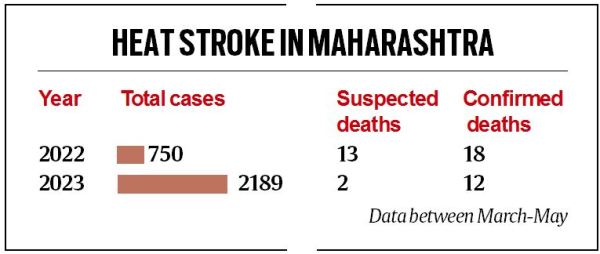
 This year, in the first five months, Maharashtra witnessed 2,189 cases of heat strokes, of which 410 were from Raigad where the ceremony was organized in April.
With over 2,000 reported heat stroke cases — nearly three times higher than that of last year, Maharashtra recorded just 12 confirmed fatalities till May, all of whom were related to Maharashtra Bhushan award ceremony held in Kharghar.
It indicates that no other remaining 35 districts has witnessed any death.
This is in stark contrast last year when Maharashtra reported 18 confirmed deaths and 13 suspected fatalities with only 750 cases of heat stroke till May 31.
This year, in the first five months, Maharashtra witnessed 2,189 cases of heat strokes, of which 410 were from Raigad where the ceremony was organized in April.
Out of the remaining cases, 251 were from Wardha and 167 from Mumbai Suburban. Unlike last year, there were only two suspected deaths—one each in Yavatmal and Palghar.
Last year, out of the 18 confirmed heat stroke deaths, 10 were from Nagpur itself. But this year’s data collected by The Indian Express showed that though the temperature in Nagpur was hovering around 43 degrees with four warnings of heat wave, the drought-prone district in Vidarbha region didn’t witness a single death, not even a suspected casualty till May end —similar like 2020 and 2021 which was attributed to less exposure to heat due to the Covid-19 restrictions.
However, the decline in numbers alone cannot be a sign of relief as several cases are going unreported in Maharashtra.
Nagpur has witnessed three suspected deaths of heat strokes which didn’t find its mention in the dashboard of the public health department.
On May 17, the first death was reported when a body of a 45-year-old male was found in front of a hotel. In the next consecutive days, two more suspected deaths were reported. Of these, two were unidentified.
The exact cause of their death awaits a postmortem report. But even after two weeks of their deaths, the health department is in no hurry to conduct the essential post-mortem, required to certify the deaths.
Dr Bhavna Sonkusare, district health officer of Nagpur Municipal Corporation, said that the district death committee responsible for analyzing the medical and autopsy reports to confirm if they died because of heat stroke, was yet to get the reports as of May 31.
“As far as I know, the autopsies haven’t been conducted yet. And without the reports, the death committee can’t conclude. Manyatimes, the individuals on the influence of alcohol, sleep on the roadside and succumbed due to dehydration in the heat. So, autopsy reports are essential,” she said.
When asked the reason for the delay, she said, “I can’t comment on it but in case of unknown bodies, hospitals wait for some days for the families.”
However, this kind of delay in autopsy can cloud the conclusions of the forensic experts.
“In cases of heat stroke, the body absorbs the heat which pushes up the temperature over 40 degrees. Even after death, the body cools more slowly which fastens the decomposition of the cadaver, diluting the findings,” said a forensic expert.
Infact, out of the 14 deaths in Kharghar, two were not counted as heat stroke deaths.
Speaking to The Indian Express, Raigad Collector Yogesh Mhase said, “The post-mortem showed heart attack as a cause of death in one of the 14 deaths. But I don’t know about the second case and the medical reason.”
There has been a rise of half a degree centigrade in the Arabian Sea in the last 30 years.
The number of districts that are prone to the heatwave has gone up to 13 —nine in Vidarbha and two each in central and north Maharashtra — from seven in the last few years, as per Relief and Rehabilitation department.
The forensic experts outlined that though the rising temperatures can increase the incidences of heat strokes, the government is falling far behind in training the doctors in rural regions in the diagnosis and classifications of deaths which can help to formulate policies to save lives.
“Old age, chronic diseases, alcoholic habits among others are considered as risk factors. So, if a patient with a compromised heart suffers from a heart attack induced by the rise in body temperature from heat stroke, amateur doctors call it death due to heart attack,” said another forensic expert.
In a similar incident, the death of a 21-year-old pregnant tribal woman in Palghar has been overruled as fatality due to heat stroke. Dr Dayanand Suryawanshi, DHO, Palghar confirmed it.
In the 16 points submitted under the Heat Action plan, the relief and rehabilitation department also mentioned compulsory reporting of the heat stroke cases and deaths that otherwise go unrecorded.
Appaso Dhulaj, director, disaster management cell, said, “Often, the doctors confuse heat stroke with cardiac attack or other comorbidities. This kind of underreporting becomes a roadblock in assessing reality.”
But underreporting of heat stroke deaths is the biggest obstruction in gauging the impact of the rising temperatures on human health.
Bhagwan Kesbhat, CEO from NGO Waatavaran that works for environment issues said, “At a time when we are talking about the Climate action plan to tackle the increasing challenges of climate changes, we need to have accurate data on its impact on humans. This can help us formulate plans, rather than sitting blind to such a grievous issue without data on heat stoke.”
In Nashik, the district has started cooling wards in three hospitals. And the migrant workers have been instructed to avoid working in the afternoon.
The garden department in the state has been instructed to keep the gardens open in the afternoon and so that the labourers and passers-by can rest in the shed.

 6 min read