3 min read
Stay updated with the latest - Click here to follow us on Instagram

Journalism of Courage



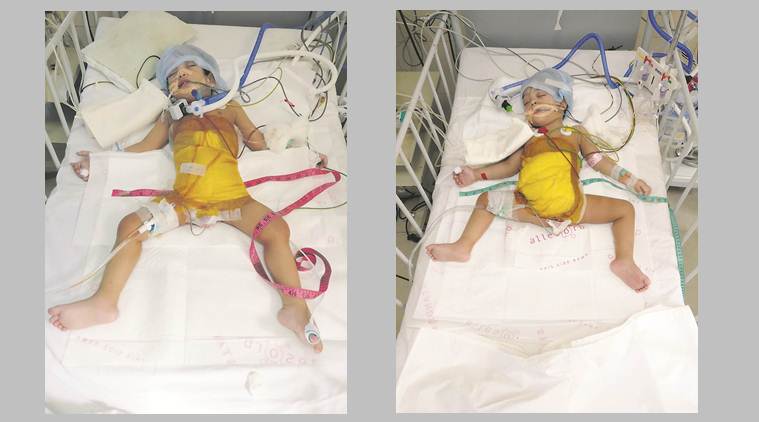 Luv and Prince after the surgery at Bai Jerbai Wadia Hospital.
When the surgery began at 4 am Tuesday at Bai Jerbai Wadia Hospital for Children, Sagar and Sheetal Zalte waited on the empty corridor outside the operation theatre, for updates. Around 1 pm, Sheetal shed her first tears of joy. Her conjoined twins had been successfully separated. A little before 5 pm, the surgery of separating organs of the 14-month-old twins and stitching their skin back was finally over.
Luv and Prince now lie in the paediatric intensive care unit (PICU) of the hospital in separate cots. In September 2016, they were born conjoined with a fused liver, intestine, urinary bladder, and chest bone. “I think I have won a battle,” said Sheetal, 26, a homemaker, looking at her firstborn children in bandages and surrounded by tubes.
The Ghatkopar couple first learnt about the anomaly in the 24th week of pregnancy when a scan showed the twins were fused waist down. “The doctors explained a surgery to separate them was possible. I decided to give birth to my babies,” she said.
Following their birth in 2016, the doctors decided to wait for at least six months before conducting a separation surgery. The boys, fused in such a way that they faced each other, had two individual sets of hands and legs, separate brain, lungs and heart. “When vital organs are separate, the chances of survival are high,” said Dr Pradnya Bendre, head of paediatric surgery at the hospital.”
“For me, looking after them was not a problem. My husband and I devoted our entire time to them,” said Sheetal. Prince and Luv are Xiphi Omphalo ischiophagus tetrapus conjoined twins, meaning joined at the navel and hip. The incidence of such twins is one in 5 lakh newborns.
Sagar (27), employed in a private firm, said two doctors kept shuttling in and out of the OT to tell them as each organ got separated in the 12-hour surgery. A team of plastic surgeons, paediatric surgeons, cardiologist, anaesthetists, intensivist, and neurologists together operated on the twins. “We had shut all our OTs except one for emergency so that we had all doctors on standby,” said Dr Minnie Bodhanwala, the hospital’s chief executive officer.
“Such surgeries are challenging, especially there is a risk of liver bleed while separating it,” said Dr Bendre, who headed the surgery. First, the surgeons separated the twin’s chest bone and went downwards to separate the liver, abdomen, small and large intestine, appendix and pelvic area”. “We will assess the bladder and see how it functions. The babies will require multiple surgeries in future. Their pelvic bones remain broad right now,” Bendre added.
Dr Pradnya Sawant, anaesthetist, said during surgery risk of blood pressure fluctuations and change in body temperature remained a main concern.
Following surgery, the twins are prone to malnutrition due to half-formed organs in digestive system. They will require multi-vitamin supplements apart from recovery period for liver that may take weeks to months to regrow.
Stay updated with the latest - Click here to follow us on Instagram