Journalism of Courage



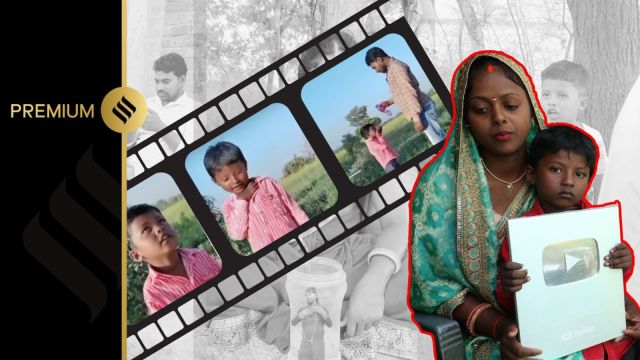 In photo, Ranjana Devi (25), son Aditya (5) are seen holding a plaque from YouTube (Photo by Vishal Srivastav))
 It was one of the sleeper hits of 2023. Starring a child, a man, a woman and a purple water bottle, the video features a five-year-old, the voice shrill and the audio lagging, who goes: “Paani, paani, paani… Uncleji, paani pila dijiye. Mera gala sookh raha hai (Uncle, I am thirsty… please give me some water)”.
First posted on February 6 this year, the video has since garnered more than 3.5 lakh views, 25,000 likes, 1 lakh shares and 1,000 comments on YouTube, Facebook and Instagram, and inspired countless spin-offs and memes.
The family at the centre of this runaway hit — Sanjay Kumar, 27, wife Ranjana Devi, 25, son Aditya, 5, and daughter Shahani, 3 — have since then gone back to doing what they do best: a video or two a day, which they unfailingly post on the three social media platforms under the handle @Vlogershahanishamarth.
Since November 1, 2022, when they produced their first video — on unscrupulous passersby stealing from a destitute child instead of helping him — the family’s social media handles have seen a steady rise in followers and subscribers, a count that shot up following the success of the paani paani video. They now have more than 7 lakh subscribers for their two YouTube channels, 1.39 lakh followers on Instagram, and another 6.60 lakh on Facebook.
The family earns around Rs 15,000 a month from YouTube, and has received two silver plaques from the video streaming website for having gained a follower count of over 1 lakh.
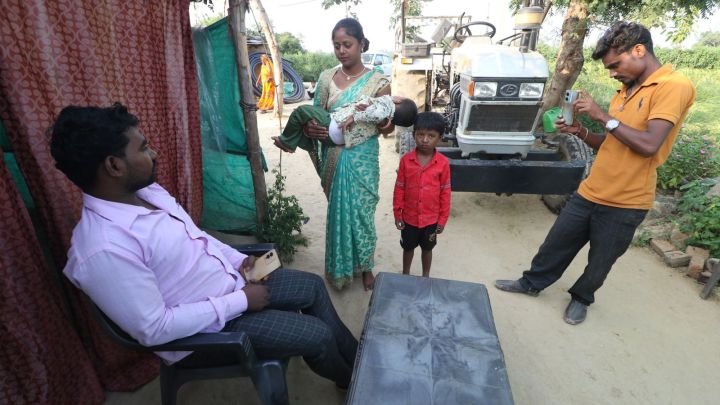 Sanjay Kumar (27), his wife Ranjana Devi (25), son Aditya (5) and daughter Shahani (3) making a new video at Dhedhi village in Sonbhadra district of Uttar Pradesh. (Photo by Vishal Srivastav)
Aided by affordable handsets, cheap data and an ever-expanding audience, Sanjay and his family are part of a growing ecosystem of rural content creators on social media — a democratic space that lets anyone with a smartphone and a data pack put out content, and demand attention, online.
According to the Internet and Mobile Association of India (IAMAI) and Kantar, the number of Internet users in the country is estimated to go up from 759 million in 2022 to 900 million in 2025, with 56% of the new users from rural India.
Sitting in his thatched house in Dhedhi village in Sonbhadra district of Uttar Pradesh, minutes after getting home from the electrical repair shop in the nearby Ghorawal market where he earns around Rs 13,000 a month, Manoj says of his paani video, “Humein nahi laga tha woh video itna hit ho jayega. Aise hi bana diya tha (We didn’t think that video would be such a hit. We made it on a lark).”
Like almost all of their productions, the video sticks to a basic storyline. It features Sanjay’s son, who approaches a passerby (played by Sanjay) asking for water for his parched throat. As the passerby pours water down the child’s head instead, a woman (Sanjay’s wife Ranjana) chides the man and gives the child the water he needs.
While Sanjay’s videos elicit a range of reactions, with many pointing to the over-the-top visual effects and the audio-sync problems, he is just happy to know that people are watching his reels — so far, 443 and counting.
“I had heard you could make money from this, so I tried my hand at it. Initially, people used to make fun of us, but now that we make money from these videos, everyone takes it seriously,” says Sanjay. A tractor and Sanjay’s TVS motorcycle are parked in front, sharing space with three cows and a Tricolour fluttering from a post.
The only equipment the family uses to shoot, record their dialogues, and edit is a Vivo T1 smartphone worth Rs 23,000 that Sanjay bought in January this year, paying for it in 12 monthly installments. He has a Jio SIM that he recharges for Rs 719 every month which gives him 2 GB data per day, along with unlimited calls.
 The growing online audience in India
As he waits for the sun to sink further before they can start shooting for the day, Sanjay says, “I return home from the shop at 3 pm every day, and then we make videos. It takes around an hour or two to shoot. Then, I edit the videos on my smartphone. By 8 pm, we upload the video on all our handles.”
His wife Ranjana, an Arts graduate from RPPG College in Ghorawal, has a starring role in each of the videos. “She comes up with the story ideas,” says Sanjay as his wife prepares for the day’s shoot, turning up in a fuchsia pink sari.
“After our marriage in 2016, I thought I would apply for a teaching job, but I realised you have to deposit money and we couldn’t afford to. When my husband suggested we make videos, I was excited. Mujhe sirf ghar ki biwi, aur bahu nahi banna tha (I wanted to be more than just a wife and a daughter-in-law),” says Ranjana.
She is happy at the way things have turned out so far. “Earning Rs 15,000 a month in a village is very difficult. Even if you work as a labourer, you don’t get much. The money has really helped us. We now send our son to a private CBSE school, where we pay Rs 900 a month. And next year, we will send our daughter to the same school,” says Ranjana.
The 25-year-old says she picks up ideas for reels from short stories that she finds on her phone. Many of the reels, each about 10-15 seconds long, invoke Gods, and have plot twists featuring snake women (Nagin), ghosts, and chudail (witch). The stories usually end on a happy note, with the good triumphing against evil.
It’s 3.45 pm, time to start the day’s shoot. Today, the plot revolves around a woman in distress going to a wealthy man (played by Sanjay) to plead for money to get her sick daughter treated.
Anil Kumar (22), Sanjay’s younger brother who does cameos in some of their videos, is the cameraperson for the day. “Rolling and action,” he says in English and the act begins. The video ends with Ranjana exhorting viewers to “like and subscribe to their channel”.
As the shooting winds up, the couple sit down to do the voice dubbing and edit the videos, throwing in some special effects for good measure.
Sanjay says he learnt how to edit videos from online tutorials on YouTube and now uses an online app to add special effects and sound bites separately.
“We keep the dialogues for Shahani and Aditya short and simple. They are getting better at it,” says Ranjana, turning to her son Aditya who is now sulking about not having a longer part in the latest video. “Yeh bahut bada hero ban gaya jab se video viral hua hai (He has become quite a hero since his video went viral),” says Ranjana, smiling.
“Both of them want to be in all the videos. If we ignore one for a while, the other gets angry. But we choose our characters depending on the plot,” she adds.
By 8 pm, the day’s video has been edited and uploaded. While she frequently checks how the video is faring, Ranjana is by now familiar with the unpredictable nature of the medium. “The videos that I think are good don’t necessarily do very well. But those I think are average do very well. I was so surprised that the paani paani video went viral,” she says.
What’s next? “Now, we want to buy a more expensive phone and make longer videos with more complex stories. We want to move to videos that are around 5-10 minutes long,” says Sanjay.

 8 min read