Journalism of Courage



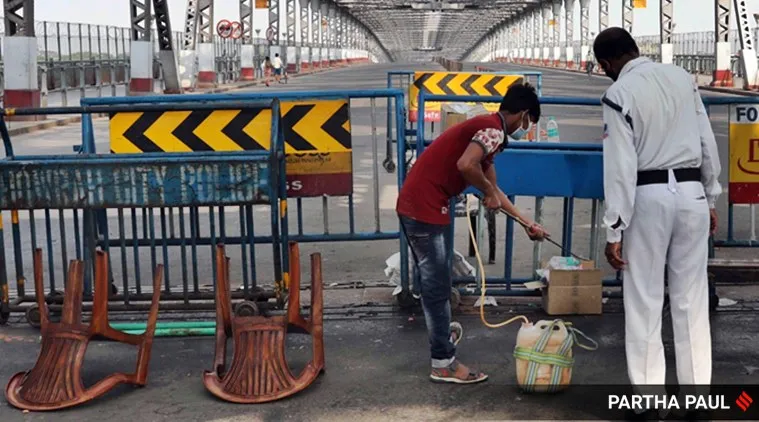 Disinfectant being sprayed on a police barricade on Howrah Bridge Wednesday.
Coronavirus (COVID-19): Hours after the Union Home Ministry issued guidelines on partially lifting some lockdown restrictions, the West Bengal government on Wednesday allowed jute mills and brick kilns to resume as “early as possible” with a 15 per cent cap on workforce, and restart pending infrastructure and health projects from April 20.
The Public Works Department, Panchayat and Rural Development Department, and Public Health Engineering Department have been exempted from the extended lockdown from April 20. Workers under the Mahatma Gandhi National Rural Employment Guarantee Act will also be allowed to work.
Prime Minister Narendra Modi on Tuesday extended the lockdown till May 3 with strict restrictions on movement till April 20. The Union Home Ministry on Wednesday announced relaxations for some sectors, including those listed by the state government, from April 20.
To seek approval for production, jute mill and brick kilns owners have to approach the chief secretary who will take a decision on a case to case basis, the chief minister said.
On MNREGA workers, she said, “We may use the idle labour forces for plantation, restoration of ponds and maintaining small gardens.”
The decision on jute mills was taken after Union Textiles Minister Smriti Irani’s call and letter to CM Banerjee, requesting her to open jute mills as many states are facing shortage of jute bags during the ongoing harvest season. Banerjee said jute mills have to follow the social distancing rule.
West Bengal is the largest jute producing states in the country. Union Textiles Secretary Ravi Capoor also wrote a letter to Chief Secretary Rajiva Sinha.
In her letter, Irani wrote: “A list of required basic minimum number of jute mills (18 jute mills) have been worked and sent to the state government. These 18 jute mills will be asked to put only 25% of workers on a roaster basis. The jute commissioner will be asked to deploy officers to supervise the mills for maintenance of social distancing and hygiene.” It also stated that jute mill owners and officials concerned should ensure compliance of COVID-19 protocols.
She said, “I request you to kindly issue necessary instructions to jute mills to start operation of production of jute bags immediately.”
After sending the letter, Irani also spoke with Banerjee over phone and repeated her request.
Banerjee on Wednesday said, “They (the Centre) requested to open only 18 mills. They have also sent us the list of 18 mills. But, it is difficult to open only 18 mills. There may be workers’ agitation if we decide to open only 18 mills. So, we decided to open all and they have to work with only 15% of their total strength.”
“We have advised all jute mills to restart their production with local workers. This is the harvesting season, and Punjab and many other states have no supply of jute bags. So, if we don’t not allow the resumption, they will replace jute bags with plastic one. We don’t want that. Our state will also require jute bags for rice from this month. So, we decided to allow jute production in a limited way,” the chief Minister said.
Other than the industry, Banerjee said all government employees not below the rank of deputy secretary must come to visit every alternate day from April 20.
She asked doctors and nurses to take one-week holiday after working for seven days at a stretch “to give their brain rest”.
Reiterating her commitment to help migrant labourers stranded in other states, the chief minister said, “We have contacted some of the stranded labourers. We have supplied them with rice, wheat, vegetables and oil. It is impossible for the government to know where all people from the state are stranded. But, if someone informs us, we will take provide help.”
Don’t miss these articles on Coronavirus from the Explained section:
-How coronavirus attacks, step by step
-Mask or no mask? Why the guidance has been shifting
-Besides a face cover, should I wear gloves when I go outdoors?
-How the Agra, Bhilwara and Pathanamthitta Covid-19 containment models differ

 4 min read