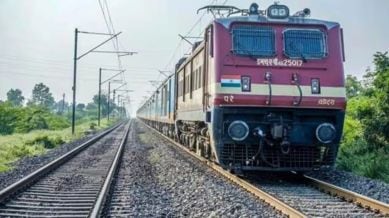
The CCRS in its report also pointed out that besides the Kanchanjunga Express and the goods train, five more trains had entered the section when the signals turned defective before the accident on June 17. (Representational/FilePhoto)
Failure of automatic signal, lapses at multiple levels in managing operations, and non-availability of critical safety equipment such as walkie-talkie with the loco pilot and train manager are some of the reasons cited for the June 17 train collision in Darjeeling district that left 10 people dead and over 40 others injured.
In its preliminary probe report, the Chief Commissioner of Railway Safety (CCRS) said that the Sealdah-bound Kanchanjunga Express (DN 13174), which got rammed by a freight train (DN GFCJ) from behind, followed the norm of moving at a maximum speed of 15 kmph and stopped for one minute at every defective signal, while the other trains in that section, including the goods train involved in the accident, didn’t follow the norm.
You’ve Read Your Free Stories For Now
Sign up and keep reading more stories that matter to you.
“…so far, I have come to the conclusion that the rear-end collision between Train No. DN 13174 Kanchanjunga Express and DN GFCJ container between Rangapani — Chatterhat electrified double line section of Katihar Division of North Frontier Railway at 08:50 hrs on 17.06.2024 occurred due to lapses at multiple levels in managing the train operations under automatic signal failures,” the provisional probe report stated.
“Non-issuing of the caution order… non-availability of critical safety equipment (walkie-talkie) with the loco pilot and train manager… inadequate counseling of loco pilots and station masters about trains operating in the automatic signaling territory, creating misinterpretation and misunderstanding of rules” were among the reasons highlighted in the report.
The CCRS in its report also pointed out that besides the Kanchanjunga Express and the goods train, five more trains had entered the section when the signals turned defective before the accident on June 17.
“…it is noted that although the same authority was issued to the loco pilots of all the five trains, different
speeds were followed while passing the defective signals and thereby taking different time.
The loco pilot of DN 13174 (Kanchanjunga Express) followed the provision of GR 9.02 and was moving at a maximum speed or 15 kmph, stopping for one minute at the foot of the automatic signal,” the report stated.
Story continues below this ad
“…some of the loco pilots followed the 15 kmph rule, while most of the loco pilots did not follow this rule. The absence of proper authority and that too without adequate information, created misinterpretation and misunderstanding about the speed to be followed,” the report stated.
Stating that a large number of signal failures defeats its very purpose, the report said: “There have been 275 failures in the auto section of Katihar Division since its commissioning in January 2023 till June 20, 2024. The large number of signaling failures in the automatic section is defeating the very purpose of mobility enhancement and causing safety concerns also.”
In the recommendation part of the report, the CCRS stated: “The introduction of new auto signaling sections should consummate with the provision of Automatic Train Protection. Further, the necessity of auto signaling in the non-suburban section shall be reviewed considering the limited number of train movements in the non-suburban section. The occurrence of as many as 208 cases of signal passing at danger from April 1, 2019 to March 31, 2024, and out of which 12 resulting in collision, highlights the limitations of preventive measures taken by the Zonal Railways…”
Earlier, The Indian Express reported that NFR’s Katihar Divisional Railway Manager Surrendra Kumar had said that the automatic signaling system and the train tracking system in the section got disrupted around 5.15 am on June 17, following which trains were running under speed restrictions.
Ravik Bhattacharya is a highly experienced and award-winning journalist currently serving as the Chief of Bureau of The Indian Express, Kolkata. With over 20 years of experience in the media industry, Ravik possesses deep expertise across a wide range of critical subjects and geographical areas.
Experience & Authority
Current Role: Chief of Bureau, The Indian Express, Kolkata.
Expertise: Extensive reporting across West Bengal, Odisha, Assam, and the Andaman Nicobar Islands. Ravik specializes in politics, crime, major incidents and issues, and investigative stories, demonstrating a robust command of complex and sensitive subjects.
Experience: His long and distinguished career includes key reporting roles at several prestigious publications, including The Asian Age, The Statesman, The Telegraph, and The Hindustan Times. Ravik's current role marks his second stint with The Indian Express, having previously served as a Principal Correspondent in the Kolkata bureau from 2005 to 2010.
Major Award: Ravik's authority and quality of work are substantiated by his winning of the prestigious Ramnath Goenka Excellence in Journalism Award in 2007 for Political Reporting.
Education: His strong academic foundation includes a Bachelor's degree with English Honours from Scottish Church College under Calcutta University, and a PG Diploma in Mass Communication from Jadavpur University.
Ravik Bhattacharya's extensive tenure, specialized beat coverage, and notable award confirm his status as a trusted and authoritative voice in Indian journalism, particularly for stories emanating from Eastern India. ... Read More
Atri Mitra is a highly accomplished Special Correspondent for The Indian Express, bringing over 20 years of experience to his reporting. His work is characterized by deep regional knowledge and a focus on critical administrative and political developments, establishing strong Expertise and Authority in his domain.
Experience
Current Role: Special Correspondent, The Indian Express.
Decades of Experience: Over two decades of extensive reporting experience, primarily covering administration and political news.
Geographical Focus: Holds significant reporting experience from West Bengal, Bihar, and the North-East, providing a comprehensive understanding of the socio-political landscape in these regions.
Key Coverage: Has dedicated more than ten years to covering administration and political news, with a keen focus on political developments in West Bengal.
Electoral Reporting: Demonstrated a commitment to crucial political moments, having covered the 2009 Lok Sabha election and 2010 assembly elections during his time at Anandabazar Patrika, and the 2019 Bihar Lok Sabha election while working with News18-Bangla.
Career Foundation: Began his career at the leading vernacular daily Anandabazar Patrika, where he worked for more than fifteen years, including a three-year stint as the Bihar correspondent.
Education
Advanced Degree: Holds a Master's degree in Economics from Rabindrabharati University, providing an analytical framework for his political and administrative reporting.
Undergraduate Education: Holds a Bachelor's degree from Calcutta University.
Prestigious Alumni: His educational background includes attending esteemed institutions: he is an alumnus of St. Xavier's, Kolkata and Ramakrishna Mission Asrama, Narendrapur.
Atri Mitra's decades of dedicated reporting, substantial focus on political and administrative beats, and solid academic credentials make him a trusted and authoritative source for news and analysis from Eastern and North-Eastern India. ... Read More