Journalism of Courage



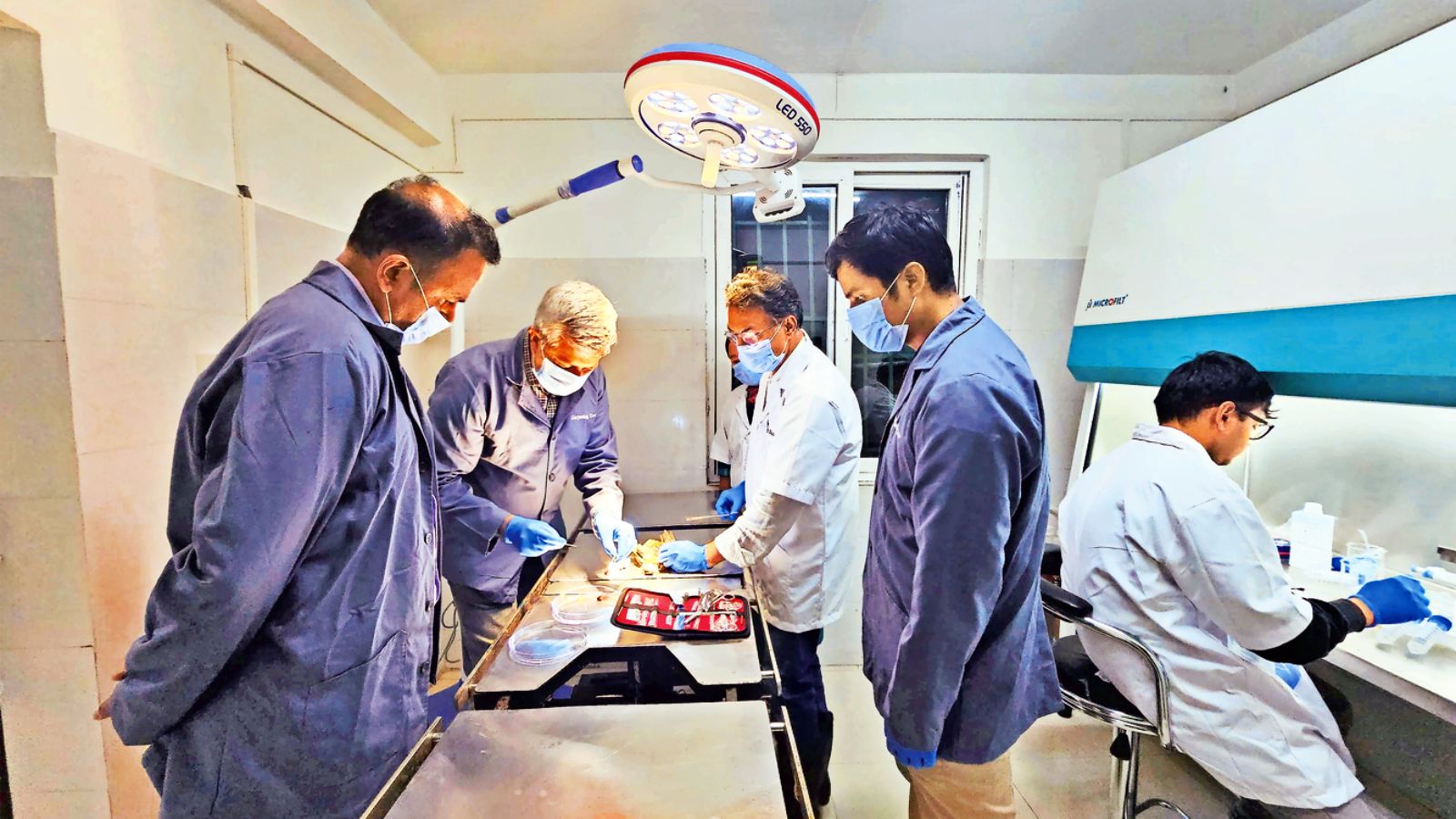 The lab in Darjeeling zoo. (Photo: Padmaja Naidu Himalayan Zoological Park)
Remember the movie Jurassic Park, where the dinosaur DNA was retrieved from a fossilised mosquito.
As part of a national programme, the country’s first ‘bio bank’ in a zoo is up and running at Padmaja Naidu Himalayan Zoological Park, better known as Darjeeling Zoo, officials said.
Officials pointed out this is the first time in the country that such a facility has been set up at a zoo.
In collaboration with the Centre for Cellular and Molecular Biology (CCMB), under the Ministry of Science and Technology, the facility collects and preserves cell and tissue samples from endangered animals, as well as reproductive cells from deceased animals.
These can be used for future research and potentially even bring back critically endangered species that have gone extinct or are on the verge of extinction.
The biobank, also known as ‘frozen zoo’, was established last year in July and till date DNA materials — cellular and tissue samples — from 60 animals of 23 species have been collected.
“We started in July last year and now it is fully operational. So far we have collected DNA, cellular and tissue samples from 60 animals of 23 species. Our priority is the endangered species,” Basavaraj S Holeyachi, director, Darjeeling Zoo told The Indian Express. “We are also collecting gammets from dead animals. All samples are being preserved in minus 196 degree Celsius in liquid Nitrogen in cryogenic state.”.
The process also allows genetic diversity of species to be maintained, the authorities said.
“The first biobank in a zoo is now operational in Padmaja Naidu Himalayan Zoological Park in West Bengal. It is of immense importance in the conservation of critically endangered species. With environmental change and other factors many species of animals may go to the brink of extinction. Our aim is to store the cells and the germ plasm (genetic material) of such animals that if needed the species could be brought back to life again,” said Karthikeyan Vasudevan, chief scientist at the Centre for Cellular and Molecular Biology (CCMB), Hyderabad. “It is part of a national plan. We have a wildlife bio bank in CCMB… Especially a zoo such as the one in Darjeeling, which has conservation breeding centres for animals like Red Pandas. We are planning to set up such bio banks in some other zoos, including the National Zoo in Delhi and Nandankanan Zoo in Odisha.”
“Animals like American black-footed ferret, which had once only eight individuals left once declared extinct but revived through captive breeding and using preserved DNA (its first clone was made public in 2021 using DNA preserved since 1988) and northern one-horned rhino (the last male member died in 2018) are being brought back through this process,” he said.

 3 min read