Journalism of Courage



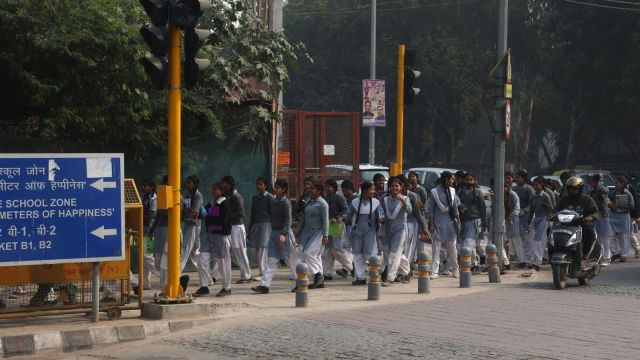 Students on way to DAV Public School, Vasant Kunj. (Express photo by Tashi Tobgyal)
Until last year, footpaths outside the DAV Public School in Vasant Kunj, along with three other government schools next door, were encroached by roadside vendors and parked vehicles. Children could not walk or cycle in the area.
Now, the area has witnessed a complete transformation.
A new traffic light has been installed at the high-speed junction at the entrance to the 250-m corridor in front of the schools. As vehicles stop at the signal, a group of girls walk on the zebra crossing, hand-in-hand, to reach the school.
Once on the 250-m corridor, there is a straight pavement and cycle track where no other vehicles are allowed. There is a combined cycle and walking track across the road as well. Students now come to school on their cycles, some even come to play in the evenings.
All these changes are part of Delhi government’s 2022 initiative to create 11 safe zones for schoolchildren across the city – one in each of the 11 districts. This includes eight government and three private schools.
While the project is being implemented by the Transport department, in collaboration with IIT-Delhi, it is being executed by NGO HumanQind.
“One of the mothers of a wheelchair user is now able to bring both him and his brother to school without facing any obstacles. Students from the school, who were involved in the project design, wanted their school to be inclusive for people with disabilities,” said Ruchi Varma, founder and CEO of HumanQind.
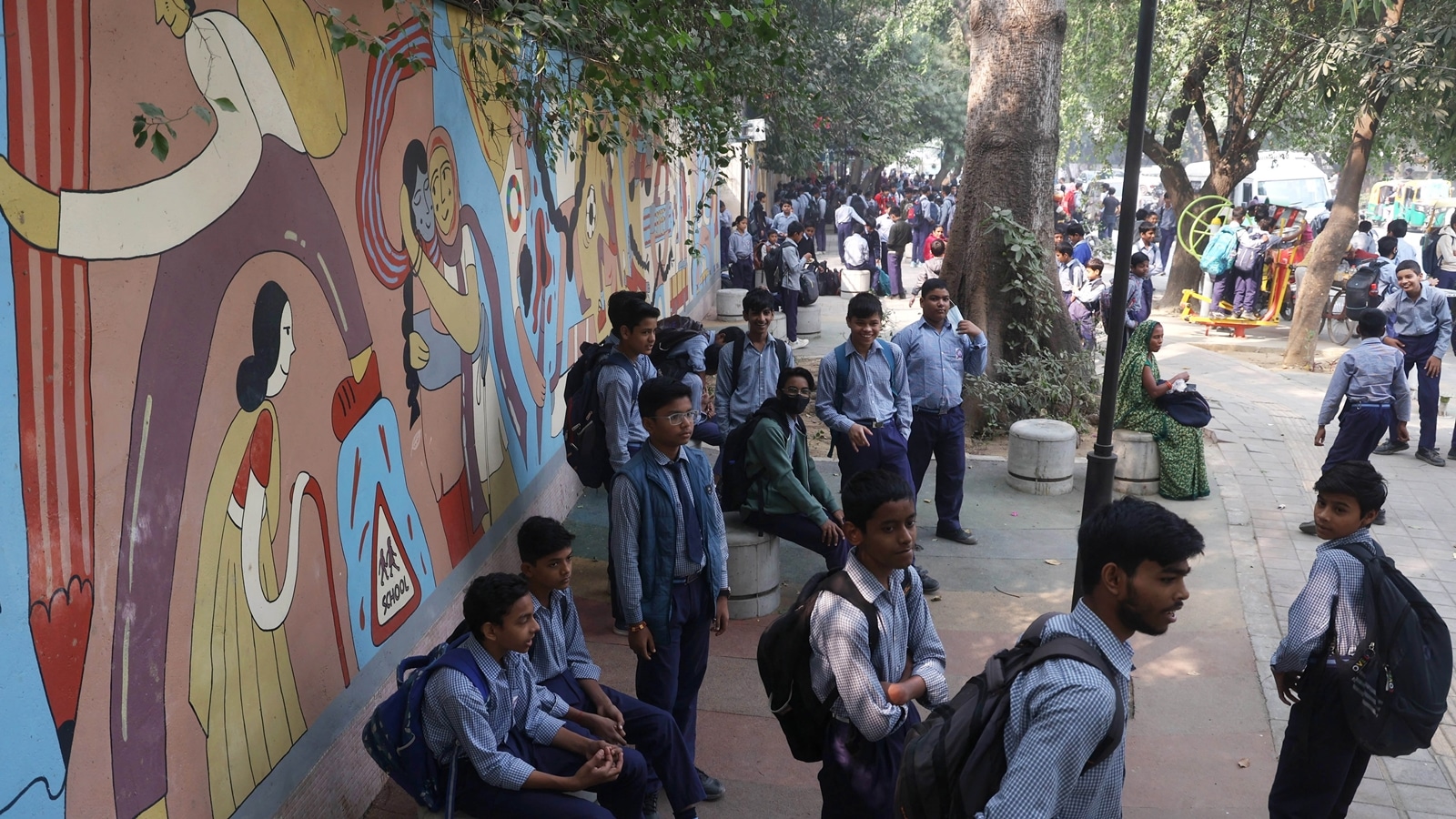 Painted by students and parents. (Express photo by Tashi Tobgyal)
What’s more, the space available in front of the schools — aside from the footpath and the cycle track — has been used to create a play area: there are arithmetic games, snakes and ladders, and even an open gym. There is also a dedicated space for hawkers, as well as several benches and tables that are perfect for a mini picnic.
Children and their families also came together to paint the school walls with scenes from the street — a cat that lives there, a popular chowmein vendor.
Principal of DAV, Vasant Kunj, Priyanka Tyagi, said, “One of the students was left paralysed neck down after a traffic crash. There were also other instances where a child’s shin was severely burnt due to the silencer of a motorbike. These incidents — and the participation of the children and their families in the planning of the entire project — have made them great advocates of road safety.”
She added, “As students and their parents were a part of developing this project, and with it becoming an integral part of their day-to-day lives, they take care of the space themselves. Everyone, including students and vendors, on what we call ‘250 metres of happiness,’ recently stopped two-wheelers that strayed onto the pavement.”
Jahnavi Chauhan, now in Class 11, said she had built a safe zone model when she was in Class 4. “I never thought anything would come of it. But the experts listened to our suggestions. Then the construction started and, finally, last year, we had a space that we all wanted.”
A similar project was initiated at Van Phuc primary school in Vietnam’s Hanoi.
Located in the oldest silk-weaving village in the Southeast Asian country, over 80% of students in Van Phuc school are residents of neighbouring areas. Until a year ago, over 90% were being dropped to school by their parents on motorbikes because they feared the children would find it difficult to cross the roads and become vulnerable to road crashes.
That changed earlier this year after the school set up a safe zone for students, culling out a portion of the narrow road — where shops had encroached the footpath — to create a continuous walking lane.
“Now, not only do children want to walk to the school on their own in groups, they also want to come early and play,” said Principal Khuong Thi Thanh Thuy.
Since 2023, three other schools in the city have also witnessed the creation of adequate walking or cycling lanes, crossings and islands for pedestrians, and parking space for motorbikes — and slowed traffic to make access safer for school children.
There are several ways to make roads safer for children, with one key intervention being slowing traffic, says Dr Nhan Tran, Head of Safety and Mobility, World Health Organisation (WHO). “Speed kills. Around 8% of those who get in a traffic crash at 20 mph die — at 30 mph, it increases to 20% and at 40 mph to 46%. But speed can’t be controlled by signage alone, infrastructure has to be built in a way that people intuitively slow down…”

 5 min read