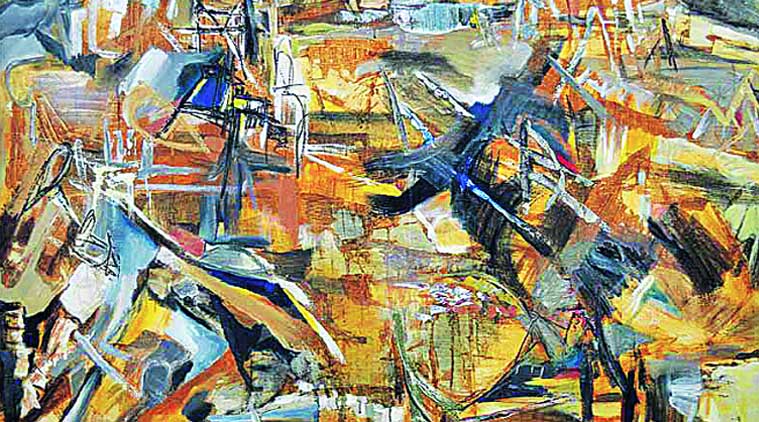
At the entrance to the gallery exhibiting the works of Vijay Mohite hung an enlarged text introducing him — “Vijay Mohite belongs to the class of artists who, from their very childhood, are self-willed and follow no master or manner”. Inside, the walls were full of grand abstracts on canvas, their shades and strokes issuing forth the energy of the master who had created them passionately and relentlessly. The exhibition, titled “The Art of Vijay Mohite” took place recently in Delhi and further shows are planned in other cities of India. With the exception of a retrospective in Bhopal last year, this is the first time the artist’s work is being shown in four decades.
In the late ’70s, as his demand peaked, Vijay decided to never exhibit again. The doors to his ancestral haveli in Gwalior were shut to market forces and here, surrounded by animals, birds and acres of wilderness, Vijay spent the remainder of his life sketching and painting. The energy that he bottled up exploded in his works making this untrained painter one of the prominent names in abstracts.
Connoisseurs would have to travel all the way to Gwalior to see his works. Otherwise, only family and friends were privy to it as Vijay painted all over the house, all the time. “The whole house was a studio. He would sit on the floor and paint as the rhythms of regular life ebbed and flowed around him. He was a painter for himself,” says Nandita Singh, Vijay’s daughter, who is bringing his art into the open. The artist died in 2002 at the age of 61.
Vijay never passed through the realism phase and even his landscapes — a giant acrylic on canvas of mountains was displayed — were abstract delineations. Singh says her grandfather, Shankarrao Mohite, a feudal landlord, had saved every scrap of paper that Vijay had drawn or painted on since he was a child. “Even as a child, he was making abstracts,” she adds. Another set of smaller canvases, displayed in a cluster at the exhibition, were made on a spurt at one time. Vijay’s works have neither names nor dates, though Singh can point out the decades in which these were made.
Curator Prayag Shukla writes: “Encountering the works of Vijay Mohite is an experience in itself and each time I have been in front of his paintings, I have been transported to a contemplative ‘space’ and to an ‘area’, which is vibrating and pulsating with creative energy to reckon with. His swirling, and surging strokes, his glowing and mitigant colours, his lines full of verve and dynamism are so captivating and enchanting that one is bound to leave behind the ‘mundane’, of daily life and is sure to encompass a persuasive realm or reality which has been ‘unseen’ so far.”
Vijay’s first exhibition was in 1947, when he was seven and his early confidence is likely to have come from watching the doyens of art and music of the era who were regulars at his home. Shankarrao was a patron of the arts and counted ustads of Hindustani classical music such as Bundu Khan and Alauddin Khan among his friends. A young Ravi Shankar was another regular visitor, as were artists such as MR Achrekar, Manisi Dey and BG Kulkarni. “My grandfather insisted and ensured that his son’s wild imagination remain free rather than fettered by influences or training. But, he did pass on his love for music and the respect for purity of the arts to my father,” says Singh.
Artists’ children are full of wonderful stories and Singh recounts how Shankarrao once woke up his young son early one morning while it was still dark. “Sarangi maestro Ustad Bundu Khan was staying in the house at the time and he would get up at 3 am to do his riyaaz. My grandfather took my father to a spot below the chajja and they stood quietly in the darkness while the Ustad practised. My grandfather believed that it is during riyaaz that a musician’s art is at its purest,” says Singh. As he grew up, Vijay would retain a sense of stringent purity in his work.
Story continues below this ad
Singh adds that Vijay, in keeping with his unfettered mindset, never manipulated her towards art. “I always knew him as my father. As I look at his artwork, I wish I had known him as a painter,” she adds.
Dipanita Nath is a Senior Assistant Editor at The Indian Express, based in Pune. She is a versatile journalist with a deep interest in the intersection of culture, sustainability, and urban life.
Professional Background
Experience: Before joining The Indian Express, she worked with other major news organizations including Hindustan Times, The Times of India, and Mint.
Core Specializations: She is widely recognized for her coverage of the climate crisis, theatre and performing arts, heritage conservation, and the startup ecosystem (often through her "Pune Inc" series).
Storytelling Focus: Her work often unearths "hidden stories" of Pune—focusing on historical institutes, local traditions, and the personal journeys of social innovators.
Recent Notable Articles (December 2025)
Her recent reporting highlights Pune’s cultural pulse and the environmental challenges facing the city during the winter season:
1. Climate & Environment
"Pune shivers on coldest morning of the season; minimum temperature plunges to 6.9°C" (Dec 20, 2025): Reporting on the record-breaking cold wave in Pune and the IMD's forecast for the week.
"How a heritage tree-mapping event at Ganeshkhind Garden highlights rising interest in Pune’s green legacy" (Dec 20, 2025): Covering a citizen-led initiative where Gen Z and millennials gathered to document and protect ancient trees at a Biodiversity Heritage Site.
"Right to breathe: Landmark NGT order directs PMC to frame norms for pollution from construction sites" (Dec 8, 2025): Reporting on a significant legal victory for residents fighting dust and air pollution in urban neighborhoods like Baner.
2. "Hidden Stories" & Heritage
"Inside Pune library that’s nourished minds of entrepreneurs for 17 years" (Dec 21, 2025): A feature on the Venture Center Library, detailing how a collection of 3,500 specialized books helps tech startups navigate the product life cycle.
"Before he died, Ram Sutar gave Pune a lasting gift" (Dec 18, 2025): A tribute to the legendary sculptor Ram Sutar (creator of the Statue of Unity), focusing on his local works like the Chhatrapati Shivaji statue at Pune airport.
"The Pune institute where MA Jinnah was once chief guest" (Dec 6, 2025): An archival exploration of the College of Agriculture, established in 1907, and its historical role in India's freedom struggle.
3. Arts, Theatre & "Pune Inc"
"Satyajit Ray, Ritwik Ghatak were not rivals but close friends, says veteran filmmaker" (Dec 17, 2025): A deep-dive interview ahead of the Pune International Film Festival (PIFF) exploring the camaraderie between legends of Indian cinema.
"Meet the Pune entrepreneur helping women build and scale businesses" (Dec 16, 2025): Part of her "Pune Inc" series, profiling Nikita Vora’s efforts to empower female-led startups.
"How women drone pilots in rural Maharashtra are cultivating a green habit" (Dec 12, 2025): Exploring how technology is being used by women in agriculture to reduce chemical use and labor.
Signature Style
Dipanita Nath is known for intellectual curiosity and a narrative-driven approach. Whether she is writing about a 110-year-old eatery or the intricacies of the climate crisis, she focuses on the human element and the historical context. Her columns are often a blend of reportage and cultural commentary, making them a staple for readers interested in the "soul" of Pune.
X (Twitter): @dipanitanath ... Read More


 5 min read


 Works by Vijay Mohite