Premium
This is an archive article published on July 14, 2024

Khyber Pass demolition: Residents scrambled to find shelter as bulldozers rolled in, hundreds of houses torn down

The operation was carried out under heavy police deployment in the early hours of Saturday.

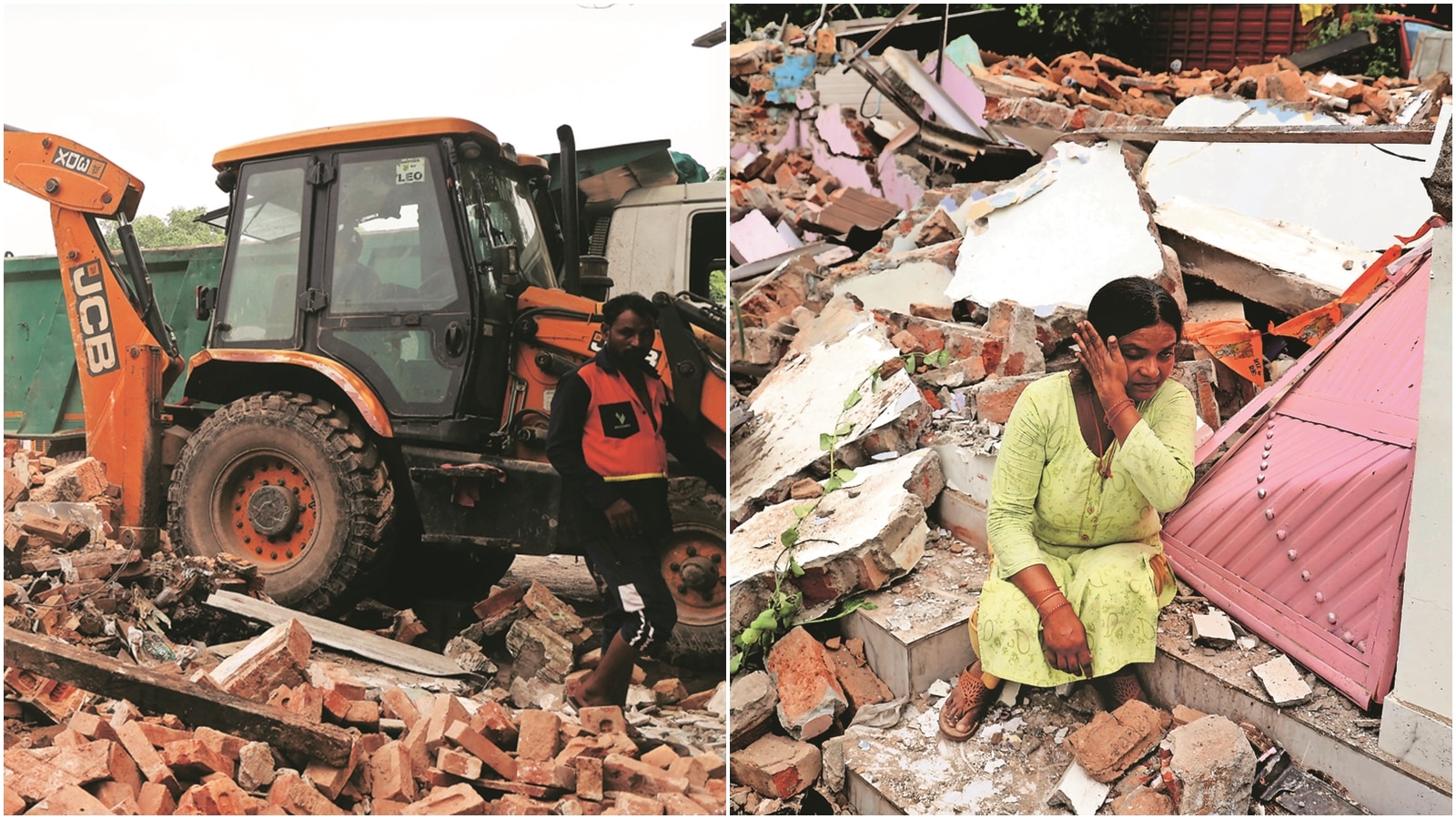
DDAA resident sits amid the rubble of her demolished home, Saturday. (Express Photo by Amit Mehra)

A large-scale demolition drive at Khyber Pass near Civil Lines Saturday led to over 250 houses being razed and hundreds of residents being displaced.

The operation was carried out under heavy police deployment in the early hours of Saturday. A senior government official said: “On Saturday, 15 acres of around 32 acres of land which belongs to the L&DO (Land and Development Office) were cleared; the remaining will be cleared later.”

At the site, the air was thick with dust as machinery tore down buildings. Several residents were seen sitting amid the rubble that was once their home.

Residents claimed police personnel were deployed overnight and the area was barricaded, restricting entry for outsiders and preventing them from leaving. “How will we go search for houses if they do not let us leave the premises?” questioned Roop Chand. He claimed he is the fourth-generation member of his family living in the area.

Also among the displaced was 26-year-old Imran Khan, who, along with his 60-year-old grandmother, was seen climbing through the boundaries to access their home. “This is the fifth generation of my family living here. We are a family of six, and everything has been destroyed,” said Khan, a relationship manager at HDFC Bank.

“We had built a proper house with all the papers, but they demolished it anyway. Police told us last night that no demolition would take place. No political party has come to help us…,” he alleged.

According to a Delhi High Court order from July 9, the land initially belonged to the Ministry of Defence. A notice was issued on July 1, requiring residents to vacate by July 4. This was challenged, but in an urgent hearing on July 3, the court allowed the demolition to proceed, provided due process was followed. On July 9, the final hearing took place and the court ruled that the petitioners lacked documents proving their land ownership. The court identified them as trespassers, stating that the land, now under the Ministry of Housing and Urban Affairs, was being acquired for public purposes.

Story continues below this ad

The demolition drive has hit pregnant women, infants, and students particularly hard.

Pushpa, a student pursuing her BA from Delhi University’s Daulat Ram College, alleged: “We hadn’t received any information. At 3 am, police told us we didn’t need to empty our houses. Then they changed their stance when we mentioned small kids living here. We started emptying our homes at 3 am; by 7 am, the demolition began. We should have had at least 25 days to vacate.”

Residents are now struggling to find shelter. Shamli, cradling her two-month-old infant, said, “Rooms that were once Rs 5,000 are now being offered for Rs 10,000-15,000 on rent. Landlords are exploiting our helplessness. Where do we go? We don’t earn enough to rent such expensive places.”

Malti, a 50-year-old resident said, “The Prime Minister promises new houses, but instead, they are pushing us out. We spent the whole night homeless, sitting in the rain. All our belongings are wet.”

Story continues below this ad

Many residents, like Pooja Kumar, claimed the demolition has left them without basic necessities. “They served us a notice but never told us when the demolition would happen. I’ve lived here for 20 years, but many others have been staying here for over 50. The government promised 25 acres of land for resettlement, but they demolished our homes without thinking about where we would go. I earn Rs 10,000 a month; I can’t afford to pay rent.”

Neelam, a pregnant mother of two, said: “There’s enough space in Majnu ka Tila for refugees from Pakistan, but not for us. We collected Rs 10 lakh to file a petition, but it didn’t help. We had no communication from our lawyers about the demolition. This is my birthplace.”

Saman Husain is a Correspondent at The Indian Express. Based in New Delhi, she is an emerging voice in political journalism, reporting on civic governance, elections, migration, and the social consequences of policy, with a focus on ground-reporting across Delhi-NCR and western Uttar Pradesh. Professional Profile Education: She holds a Bachelor’s degree in Political Science (Honours) from Kirori Mal College, University of Delhi, and is an alumna of the Asian College of Journalism (ACJ), Chennai. Core Beats: Her reporting focuses on the national capital’s governance and politics. She specializes in Delhi’s civic administration and the city units of the BJP, AAP and Congress. In western Uttar Pradesh, she mostly reports on crime. Specialization: She has a keen interest in electoral processes and politics — her recent contributions include work on electoral roll revisions. Recent Notable Articles (since July 2025) Her recent work reflects a strong show-not-tell approach to storytelling, combining narrative reporting with political and historical context: 1. Politics: “On the banks of the Yamuna, a political tussle for Purvanchali support” (October 6): A report on how migration histories shaped electoral strategies in Delhi before the Bihar elections. “Explained: How Delhi’s natural drainage vanished gradually over the centuries” (September 29): An explanatory piece tracing the historical reasons that eventually led to the erosion of Delhi’s rivers and its impact on perrenial flooding. 2. Longforms “Four weddings, three funerals: How a Uttar Pradesh man swindled insurance companies” (October 7): A long-read reconstructing a chilling fraud by a man who killed three of his family members, including both his parents for insurance proceeds. His fourth wife discovered his fraud… “How Ghaziabad conman operated fake embassy of a country that doesn’t exist — for 9 years” (July 27) : A story on bizarre fraud operation and the institutional blind spots that enabled it. 3. Crime and Justice: “He was 8 when his father was killed. Fifteen years later, in UP’s Shamli, he took revenge” (October 18): A deeply reported crime story tracing cycles of violence, memory and justice in rural Uttar Pradesh. “Who killed 19 girls in Nithari? With the SC rejecting appeals, there are no answers and no closure” (July 31): A report capturing the long legal and emotional aftermath of one of India’s most chilling unsolved criminal cases. 4. Policy Impact “At Manthan, over US tariffs, Delhi-NCR’s apparel industry brainstorms solutions” (September 8) and “Trump’s 50% tariff begins to bite: Agra’s leather belt feels the impact” (August 13) : Reports documenting how global trade decisions ripple through local industries, workers and exporters. Signature Style Saman is recognized for her grassroots storytelling. Her articles often focus on the "people behind the policy". She is particularly skilled at taking mundane administrative processes and turning them into compelling human narratives. X (Twitter): @SamanHusain9 ... Read More

Stay updated with the latest - Click here to follow us on Instagram

Latest Comment
Post Comment
Read Comments
Advertisement
Loading Taboola...
Advertisement