Journalism of Courage



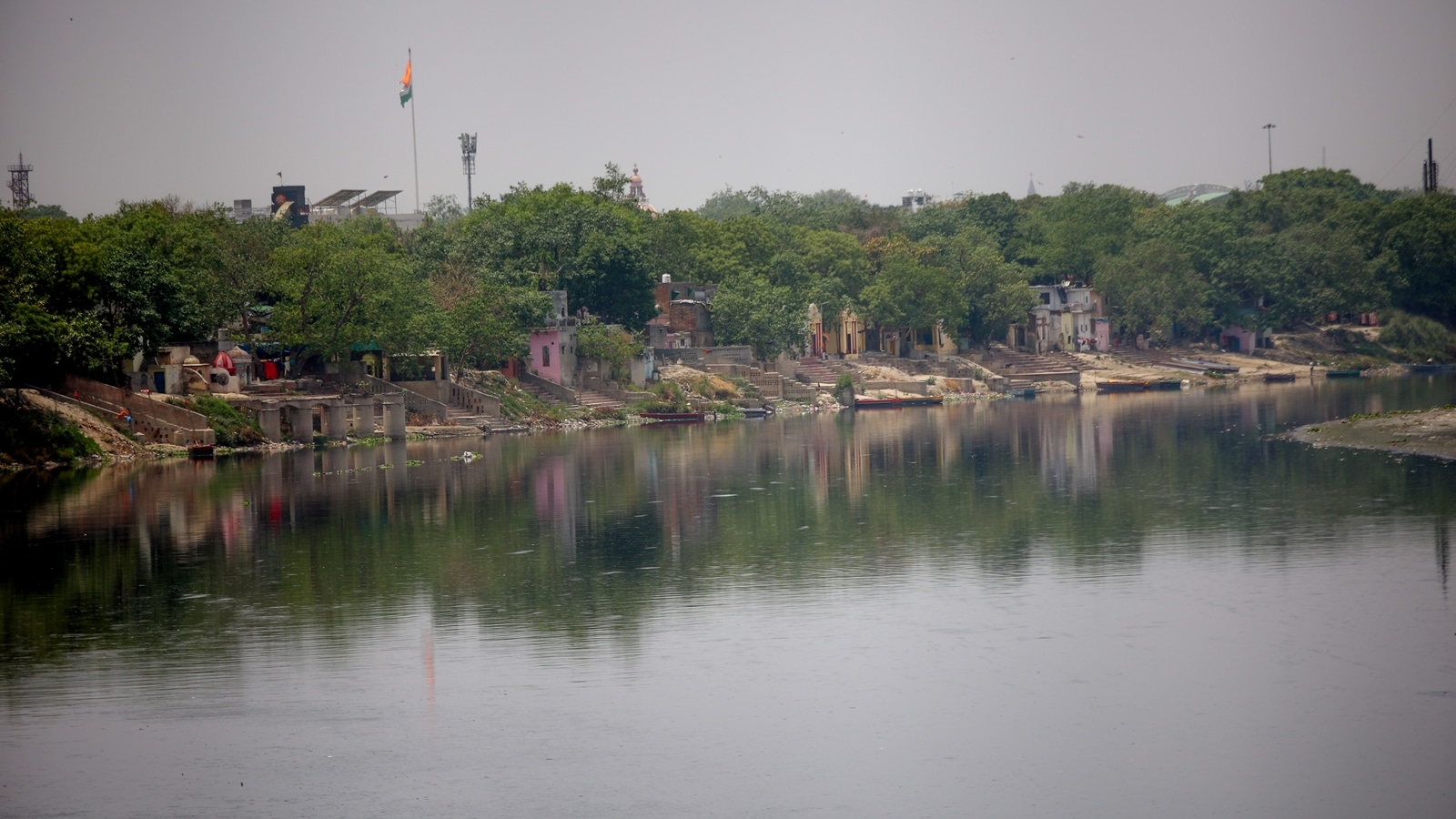 Settlement along with the River Yamuna in New Delhi on Friday. (Express Photo by Parveen Khanna)
When Taj Mohammad, a resident of Jaitpur in his early 40s, speaks of the Yamuna that flows a few hundred meters behind his house, he mentions three things — the stench from the water, the flood in which his family lost several belongings, and the wish for a bund that can keep the river at bay in case of another flood. “You can’t smell it now because the water is only ankle-deep, but when there’s more water, nobody wants to stand too close to it,” said Mohammad, a plumber.
Close to Delhi’s border with Haryana on one side and Uttar Pradesh on the other, Jaitpur is where the river exits the city. It is now mostly dry — there is just sand, garbage and a narrow pool where it usually flows.
The Capital depends on the river for water, floundering when there’s too much or too little flow — when it runs dry in the summer or when it floods. Last year, the city saw its worst recorded flood in 45 years, leaving the floodplains inundated for weeks and bringing water to areas around the Red Fort and ITO.
For the most part, the river lies forgotten until it is pulled into the middle of a political tussle over its polluted state — especially during Chhath Puja rituals every year when a blanket of foam covers its surface. To tackle the issue, both the Delhi and Union governments have been involved with projects meant to stem the flow of untreated or partially treated sewage and waste that finds its way to the river, either directly or through the 24 drains that meet the Yamuna.
Those who live near the Yamuna or on its floodplains, however, said political parties, leaders and governments alike have made many promises to ‘clean’ the river — only to break them. As Delhi votes later this month in the Lok Sabha polls, The Indian Express visited colonies situated along the 22-km stretch of the river in the city, that were flooded last year, to speak to residents about what they want from those they vote for.
Along the floodplain
At Jaitpur, thinking that the water would remain at a distance of a few 100 meters, Mohammad said he bought a house last year. “The last time the water came up till here was in 2010… we anyway heard there isn’t much water in the river now. So, we bought the house in March 2023 and celebrated Eid here — before the flood hit in July. We lost clothes, school bags, water destroyed the fridge… some got compensation of Rs 10,000, but we didn’t as the address on our IDs is the other side of the road,” said the father of four, pointing to a mark left by the water half-way up one of the walls.
Before they moved to the settlement on the floodplain, they lived in Khadda Colony on the opposite side of the Jaitpur-Kalindi Kunj Road, which is raised above the floodplain and separates the area closer to the river from the homes. “Floodwater didn’t cross the road… if there’s a bund that works like that around this settlement, our houses will be saved… neta bolte hain ki banwayenge. Gareeb rehte hain nadi ke paas… aur kahaan base? (where else can we settle?) Dilli mein toh jagah hi nahi hain,” he said, adding that a house in the colony would cost them at least Rs 13 lakh, while the house near the river was bought for around Rs 7 lakh.
The settlement, he said, has around 100 to 200 houses, and is still growing, but does not have water connections. “We have handpumps… it is difficult to draw water in the summer… the river recharges the water during the rains,” he added.
For those who live along the river in Northeast Delhi’s Old Garhi Mandu village, does the river matter when they vote this month? “It does not. Why would it? The water rises to some extent every monsoon… you vote, they win, and they anyway don’t do anything,” said Dalip Arora, 52, who runs a glass workshop and a grocery store. Lying on the floodplain, Arora’s shops, which have been around for 11-12 years, were flooded last year. “We moved some items to higher ground but lost some. It took around two months to resume business properly… there was mud all around which had to be cleaned,” he said.
Abdul Nadeem, 45, who runs a denting and painting store for cars in the village, about a km away from the river, said, “They say they will clean the river but they don’t. Kaun dekhne aata hain yahan? The one way the river is an election issue is in terms of the construction of a bund. Politicians have been talking about building one to prevent water from entering this area. But we are on the Yamuna Khadar. If we are where the river flows… galti toh humari hain.”
Nadeem moved his shop from Khajuri Khas to Garhi Mandu four years ago. “We were given Rs 10,000 as compensation during the floods, but that didn’t cover the losses — my machinery was destroyed, along with a customer’s vehicle,” he added.
For Chand Bibi, who has been living in the area with her son since 2016, having moved from Mustafabad, the question is of water and electricity connections. “There is no water connection here; we rely on tankers or submersible pumps… we are struggling to get an electricity connection as well… they are not installing new meters in such areas. We moved to a relief camp in Khajuri Khas last year when the area flooded… the Rs 10,000 we got (as compensation) didn’t cover losses. We are hoping they will build a bund along the colony (to prevent flooding),” she said.
In Old Usmanpur village in Northeast Delhi, further along the floodplain, Mukesh Gurjar, who rears cattle, also said politicians had promised to build a bund to protect the village from a flood. “We’ve been hearing about it for years, but it doesn’t happen. They spend crores saying they are cleaning the river, but it is never actually clean. In the name of cleaning the river, they plant grass and flowers in places, and that just gets washed away in the floods.”
Jeet Ram, 78, another resident, said the area also has no new electricity meters or water connections. “It is the floodplain, the ‘O zone’ (where construction is not allowed), so they talk of restrictions imposed by the National Green Tribunal and say that nothing can come up here,” he said.
Being in the ‘O zone’ meant that Kanha Ram, 63, had his house demolished by the Delhi Development Authority last year along with several others in the Bela Estate area near Rajghat, but he still lives with his family in a makeshift structure beneath a flyover in the vicinity. He had a farm on the floodplain where he grew vegetables, about a kilometre away from the river. The DDA has now taken the area for its floodplain ‘rejuvenation’ project along the river; a walking track is being laid out in the area.
“They are planting trees… dumping mud and raising land in some places, and digging up other areas for water bodies. I don’t understand what they are doing. Party logon ke saamne toh bahut hath jod liye (to prevent the demolition)… lekin kuch karte nahi hain. Vote toh dena padega…,” said Kanha Ram, who added that he was the third generation from his family living at Bela Estate.
In Palla and Jhangola villages further upstream, near where the Yamuna enters Delhi and is at its cleanest in the city, farmers with land on the floodplains, between the embankment and the river itself, said their crops were destroyed in the flood last year, the highest they had seen the water rise in years.
Sandeep, 40, whose family owns a few acres in Jhangola, said, “We don’t see netas here at all. Why would they come? It’s open land, we draw water from the ground. The river here is clean.”
River politics
The AAP and BJP have been at loggerheads over the river in the run-up to the polls.
Asked about issues in unauthorised colonies along the floodplain and efforts to ensure clean water flows through the river, Manoj Tiwari, BJP MP from Northeast Delhi and its candidate for the election, said: “Works worth Rs 1,670 crore have been done under AMRUT on the Yamuna riverfront, sewage treatment plants, and water bodies. The Yamuna area that is in my constituency gets clean water from Haryana till Wazirabad, but once the Najafgarh drain is dumped into this river, it becomes toxic. I exposed the truth in 2021 when I visited thrice. This comes under the Delhi government. I’ve been raising this issue since 2016 every year with the state, central government and in Parliament. But the Delhi CM has not made any effort from his side. I spent 40 nights in jhuggis. They face acute water problems but has the Delhi CM spent even 4 hours there? His election promise was to eradicate the tanker mafia but post becoming CM, he has become the biggest mafia. I also raised in Parliament the issue of illegal construction in the Yamuna floodplain from Okhla to Jahangirpuri.”
“The BJP is committed to improving the lives of people in all spheres. I want to improve water availability and clean Yamuna but the Delhi government has no vision other than running advertisements for schemes they have no intention to implement. I, on my part ,with the help of DDA , L-G and UD minister, am trying to make a beautiful riverfront on both sides of the river,” he added.
The AAP did not respond despite repeated attempts. The Delhi government has in the past alleged that officers are not following instructions given by ministers and funds to carry out work of the Delhi Jal Board, including that of cleaning the river, were not being released.
Earlier, the AAP-Delhi government has also pointed fingers at BJP-ruled Haryana for a range of issues — release of industrial effluents into the Yamuna that increased ammonia levels and disrupted water supply; mining-related activities along the river in Haryana resulting in it running dry last summer; and the Haryana government not releasing enough water. Haryana, in turn, has hit back, asserting that it has released the mandated quantity of water in the river.
The Hathnikund barrage is crucial as it determines the flow of the river in Delhi. Water that feeds the city’s treatment plants reaches Delhi from Haryana through two channels — Carrier Lined Channel and the Delhi Sub Branch. But around 60 MGD (million gallons per day), also reaches Delhi through the river.
Haryana releases 10 cumecs of water into the river from Hathnikund in the lean season, as per a 1994 water-sharing agreement (set to be revised in 2025) among Uttarakhand, Himachal Pradesh, Haryana, Delhi, Uttar Pradesh and Rajasthan. After a study in 2018, the National Institute of Hydrology had recommended an environmental flow of 23 cumecs.
Apart from supply woes, there is the issue of pollution.
Before the river enters Delhi at Palla, drains from Haryana — including Panipat and Sonepat — empty into the Yamuna, between the Hathnikund Barrage in Haryana and the Wazirabad Barrage in Delhi. At the Wazirabad pond, the Wazirabad and Chandrawal water treatment plants rely on Yamuna water.
In a report submitted by the Central Pollution Control Board to the NGT this February, the Board noted of the 7 locations where Yamuna water quality was monitored in January, none complied with water quality standards for ‘outdoor bathing’ for dissolved oxygen (DO), biochemical oxygen demand (BOD), and fecal coliform (FC) parameters — except for Palla. “No significant variation observed during January 2024 as compared to January 2023 w.r.t parameters DO, pH, BOD and FC,” the report noted. Fecal coliform was found to be lowest at Palla and highest at Asgarpur along the Delhi-UP border, where the river exits the city.
In February, the Delhi government told the NGT that work of providing a sewerage network was remaining in 768 unauthorised colonies out of a total of 1,799 colonies.

 12 min read