


Stay updated with the latest - Click here to follow us on Instagram
Tags:


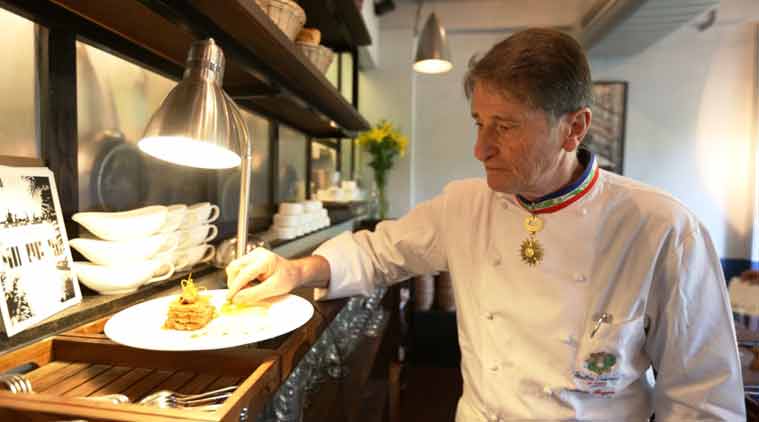
Marc Bayon’s affair with Michelin-starred kitchens began when he was just a boy. His mother was the accountant at Brasserie Georges, in Lyon, which was established in 1836 and is the largest brasserie in Europe serving between 1,500 and 2,000 patrons a day, and the boy Bayon would often accompany her to work. “There were up to 40 chefs working there at any given time and they were amused to see a young boy in the kitchen. The head chef would let me taste dishes and explain their preparation to me. I guess that’s how it started,” says Bayon. He never went to culinary school but, “started apprenticing at Michelin-starred restaurants as a teenager, first in Lyons and then in Paris”. By age 23, Bayon had won his spurs by becoming executive chef at La Giberne, a Parisian restaurant specialising in game meat, and winning his first Michelin star.

In Delhi, for a pop-up event called Palate of Provence at Le Bistro du Parc, Bayon is on his maiden trip to India, with his wife. A brief respite from cooking last weekend, afforded us a chance for a conversation with Bayon, as co-owner of the bistro Naina de Bois-Juzan was acting interpreter. “My wife has always wanted to visit India. She also collects elephant figurines. Our house in France is filled with them. I can only imagine what she’ll do here,” says Bayon.
Bayon has helmed some of the most celebrated kitchens in France, including the iconic La Tour de Argent (which claims to have been founded in 1582) and the Eiffel Tower Restaurant, among a slew of other Michelin-starred properties. He was declared a Master Chef of France in 1985 and was awarded a gold medal by a well-satiated city
of Paris.

“The pressure of running a starred kitchen is tremendous. A chef at such an establishment has no home life, and has to work at least 12-15 hours every single day. While getting your first star is arduous enough, once you get it and subsequent stars, to maintain them is another pressure-cooker situation all together,” says Bayon, referring to chef Bernard Loiseau, who committed suicide when newspapers reported his three-starred La Côte d’Or might be losing a star (this was later established to just be a rumour). It is for this reason that leading French chefs have evolved the concept of Bistronomy (which combines a casual bistro concept with haute cuisine, allowing chefs to avoid the expectations of serving up starred cuisine), currently all the rage in Paris.
Today in his seventies, Bayon runs a French food consultancy service and has visited countries as disparate as Sri Lanka, Mexico and of course Japan (“The Japanese love the complicated refinements of French cuisine and so adapted to it very easily”), all these nations eager to soak up some haute cuisine.
“I think the reason French food entered the Indian market only recently is because it is pretty intimidating. Our dishes have long complicated names and our dining minutiae is perhaps too involved, with so many courses, each with their own set of cutlery and crockery. Juxtapose that against say Italian; a pasta in red sauce is easy to translate in terms of both language and palate,” says Bayon, adding now that Indians have a wider culinary repertoire, they are more open to the idea of traditional French cuisine.
Bayon himself will be travelling the country for the next three weeks, “exploring the myriad cultures and cuisines of India.”And of course, looking for elephants.


Stay updated with the latest - Click here to follow us on Instagram


