Journalism of Courage



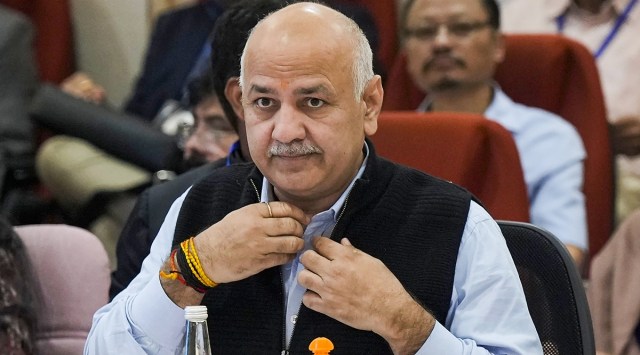 Arrested Sunday, Sisodia told by SC he should have moved the Delhi High Court.
 IN A surprise move Tuesday evening, Delhi’s Deputy Chief Minister Manish Sisodia, who is in CBI custody, and jailed minister Satyendar Jain tendered their resignations to Chief Minister Arvind Kejriwal. The resignations, which were accepted by Kejriwal, have been sent to the Office of the Lieutenant Governor, from where they will be forwarded to the President.
The development came hours after the Supreme Court refused to entertain Sisodia’s plea challenging his arrest by the CBI in the excise policy case. The agency had arrested Sisodia on Sunday after eight hours of questioning. The next day, a CBI court granted the agency five-day custody of the Deputy CM, who also holds the crucial education and finance portfolios.
In his resignation letter, addressed to Kejriwal, Sisodia wrote: “It is very sad that despite working with honesty and integrity for eight years, allegations of corruption are being levelled against me. These allegations are nothing more than a conspiracy hatched by cowardly and weak people who are scared of Kejriwal’s politics of truth.
I am not their target, you are.”
In the Supreme Court earlier, a bench of Chief Justice of India D Y Chandrachud and Justice P S Narasimha disapproved of Sisodia approaching the apex court directly under Article 32 of the Constitution, and said he could have approached the Delhi High Court first seeking similar relief.
“It will set a very wrong precedent. An incident occurs in Delhi, that does not mean we are approached,” said Justice Narasimha. CJI C Y Chandrachud, too, said that if parties start approaching the Supreme Court without exhausting other available remedies, every case will land directly in the apex court.
“Since the petitioner has efficacious alternate remedies available under the provisions of the Code of Criminal Procedure 1973, we are not inclined to entertain the petition under Article 32 of the Constitution, at this stage,” the bench said while disposing of the plea.
Senior Advocate A M Singhvi, appearing for the AAP leader, urged the Supreme Court to ask the trial court to decide the bail plea expeditiously. “Because if I go there, there is a problem of delay,” he told the bench. Solicitor General Tushar Mehta, appearing for the CBI, opposed the request.
Sisodia had cited the arrest of journalist Arnab Goswami and the case against another journalist, Vinod Dua. But the court said these cases stood on a different footing.
“Arnab travelled to this court from a judgment of the Bombay High Court. Dua’s case was a case involving freedom of speech and expression where a journalist, albeit in the electronic space, his rights to express himself in terms of handling the Covid-19 pandemic were sought to be, according to him, curtailed by recourse to the law of sedition. That’s a very different circumstance. Here you have a full remedy which is open to you either in the form of bail before the competent court, section 482 before the Delhi High Court,” said the CJI.
Section 482 of the CrPC deals with inherent powers of High Courts and says that “nothing in this Code shall be deemed to limit or affect the inherent powers of the High Court to make such orders as may be necessary to give effect to any order under this Code, or to prevent abuse of the process of any Court or otherwise to secure the ends of justice”.
Singhvi said the instant case would fall under an exception. He said that the FIR is of August 22, 2022, and that Sisodia was summoned only twice and had attended.
The senior counsel argued that “per se the arrest would be illegal for two reasons”, as in cases which carry less than seven years’ imprisonment, prior notice of appearance is required. Also as interpreted by the court in some cases, there has to be “absolute clear necessity of arrest”, he pointed out.
The triple test to satisfy the need for arrest — namely flight risk, not attending summons, interfering with documentary evidence or witnesses — has to be satisfied, he said, adding that none of the three arose in the case.
“I (Sisodia) have roots in society. I hold 18 portfolios. Flight risk is out of the question. There is no question of not responding to summons, and there is not a single proof of any kind of interfering,” he said.
“The allegation is of multi-level decision making on liquor policy. Goes from the Under Secretary, Joint Secretary, Secretary, Cabinet, Chief Minister and the Lieutenant General…,” said Singhvi.
The CJI said he was not saying the court does not have the power: “Undoubtedly we have the power…” He reiterated, however, that the case of Dua was a case of freedom of speech and expression of a journalist and added that Sisodia’s case is one involving the Prevention of Corruption Act. “Can you not tell this to the Delhi High Court. The Delhi High Court would be available for all these…,” the CJI asked.
Singhvi said the relevant roster judge in the Delhi High Court is holding charge of the tribunal looking into the ban on the Popular Front of India and that he is not sitting 60 per cent of the time. “When he comes for the few days he comes, he winds up the court shortly and says he has to continue the Tribunal…Therefore there is a problem,” he said.
The CJI responded that “for all these problems, the Chief Justice of the High Court is there. You just mention before him…”
“The allegation in the remand order is there is a policy decision taken where he was one rung out of seven rungs including the LG. No money is recovered. There is no pecuniary advantage alleged, recovered in terms of any concrete evidence,” Singhvi said.
He added that “there is also a problem of basic structure. Without a (notice under) 41A, demonstration of the necessity of arrest against political leaders of several political parties, then there is the issue of a non-level, non-democratic playing field. That will affect the basic structure”.
Singhvi said Sisodia had also attended questioning twice in the last eight months and wondered what was the need to arrest him. “Power of arrest does not mean compulsion to arrest…This is not fair,” said Singhvi. The court, however, told him to approach the Delhi High Court first. —(With ENS/Delhi)

 7 min read