Journalism of Courage



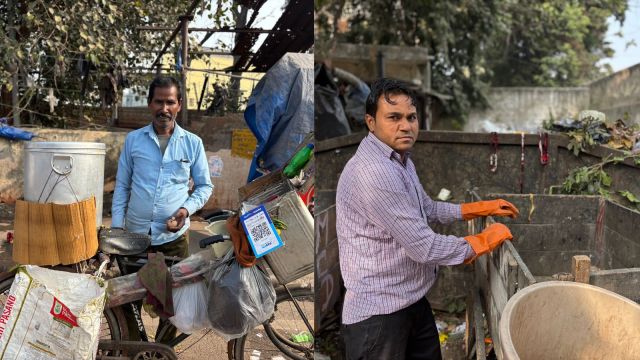 (Left) Ram Niwas, 50, sells hot snacks from a bicycle; (right) Krishan Pal, 32, pushes a handcart through Anand Vihar, collecting municipal solid waste across roughly a kilometre. Drishti Jain
At around 1 pm, the air-quality reading on the Central Pollution Control Board’s (CPCB) mobile application showed an AQI of 480 for Anand Vihar, one of Delhi’s most polluted neighbourhoods, a level classified as “Severe.” Less than a kilometre away, Monu Patel, a 24-year-old e-rickshaw driver, navigated traffic through a dense grey haze.
He wore a mask, but only intermittently. “There is a heaviness,” he said. “I cannot breathe.” When the pressure in his chest built up, the mask came off. Monu has driven an e-rickshaw in Anand Vihar for nearly nine years. He recognises the smog by sight and smell, but has little understanding of the long-term health risks of prolonged exposure.
“Some of my friends have watery eyes,” he said. What he knows more clearly is that staying home is not an option.
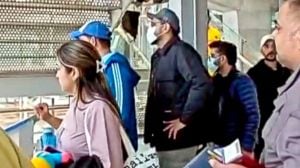
A few metres from the monitoring station, dozens of people waited for buses or crossed the flyover leading to the bus terminal and the railway station.
Traffic congestion —a near-constant presence here — is frequently cited by experts as a major contributor to vehicular emissions, the single largest source of Delhi’s hazardous air. Even at midday, the smog hung thick.
Near the curb, commuters gathered around Ram Niwas, 50, who sells hot snacks from a bicycle. He has worked at the spot for eight years. He said dust irritated his nose and chest, but he does not wear a mask.
“Koi bhi insaan apni marzi se yahan nahi aaygea jahan saans bhi aadmi ko sochke leni padhe (No sane person would willingly come to a city where you have to think before breathing),” Ram said.
The Delhi government has directed administrative and private offices to operate with no more than 50% of staff physically present, urging those who can to work from home. For informal workers like Monu and Ram —among the hundreds of thousands who earn by the day —the advisory offers little protection.
As offices thin out and schools close during peak pollution days, the city retreats indoors. Its poorest workers, however, remain outside — driving, selling and waiting — breathing air that has become both a public-health emergency and an everyday condition.
Leaving is not a realistic option. Ram said he returns to his hometown of Bareilly for brief visits during peak agricultural seasons, but a permanent move is not feasible. “Not everyone has enough land to stay home and survive,” he said. “I came to Delhi to earn.”
A few lanes away, Krishan Pal, 32, pushed a handcart through Anand Vihar, collecting municipal solid waste across roughly a kilometre. The trash is eventually transported to the Ghazipur landfill, one of the capital’s most notorious pollution hotspots.
Krishan said sanitation workers remained on duty even during the Covid-19 lockdowns. The pollution season, he added, offers no alternative. “If we sit at home, where will we get food?” he said. “I have a family of five to feed and two children to educate.”
Wearing gloves but no mask or protective gear, Krishan emptied his cart into a larger bin at a dhalao, or waste collection point. “We worked during Covid, and we have to work now,” he said. “Otherwise the city will become a mess.”
Across from the dhalao stood a cluster of jhuggi-jhopri settlements, home to domestic workers employed in nearby apartment blocks. Around 1.45 pm, Tara, 38, hurried home after finishing work at one house. Her daughter had yet to return from school.
She pulled the loose end of her sari across her face, using it as a shield against the polluted air. Masks, she said, made physical labour difficult. “I can’t bend and wipe floors wearing one — I feel breathless,” Tara said adding “my throat becomes sore and I cough a lot, but what can I do?”
If she had studied more, she added, perhaps she, too, would have found work indoors. “But we don’t have that option now,” she said.

 4 min read