Premium
This is an archive article published on December 9, 2021

In Tikri, over 365 days that brought farmers from two states closer

🔴 The protests at Red Fort and the subsequent violence which broke out during Republic Day was when the farmers from Haryana parked their tractors with the Punjabi camp for the first time.

Farm protest, Farm laws, farmers protest, farmers protest news, farmers protest Tikri border, Singhu border farmers protestAt Singhu border, Thursday. (Gajendra Yadav)

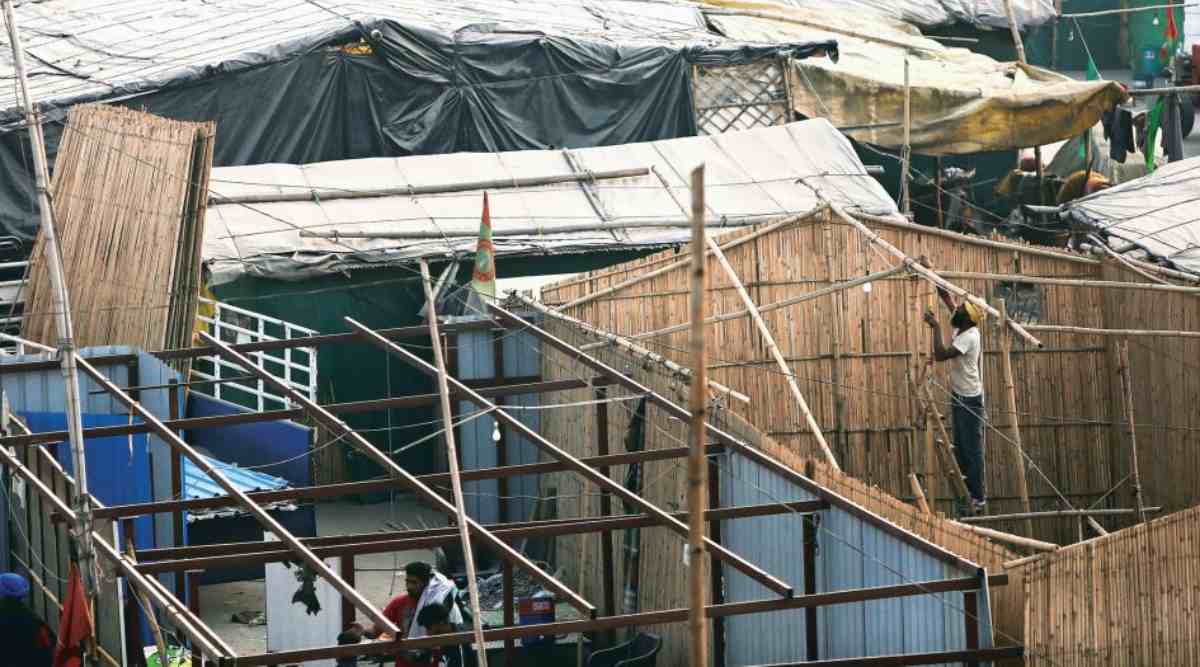
When the protest against the farm bills was at a nascent stage, farmers from Haryana’s Rohtak district had parked their tractors away from those of farmers from Punjab’s Bathinda district at the Tikri border protest site. Many of them recall barely interacting with anyone not from their state.

Slowly, though, they broke bread — and broke the ice — and began coordinating with each other to exchange strategies, oratory, and discipline to sustain the year-long protest.

“We have exchanged numbers, visited each others’ villages for weddings, shared milk and vegetables. We never have to stay at a hotel in Punjab; their home is our home now. I know we will always be welcome,” said Ramesh Sundana, a paddy farmer from Haryana’s Chiri village.

A stone’s throw away from the Haryana farmers makeshift camp, farmers from Punjab’s Mandi Kalan village had set up camp. Last year, they had to stay inside a crematorium in Bahadurgarh for over a month to protect themselves from the cold.

Recollecting the help they received at the time, Ranjit Singh (70), a farmer from Bathinda who has been protesting with his family for over 300 days, said, “Villages around us in Haryana gave us milk. We stayed at the crematorium, sometimes having to warm ourselves by a funeral pyre. Our children were traumatised. But a brotherhood with the Haryana farmers was forged in that crisis.”

Surrender Dalal, a paddy farmer from Rohtak, added: “The Haryana farmer is made for the field. We saw our Punjabi brothers cook rotis and clean their protest site — that was a learning for us. We learned how to put forth arguments and not get offended during heated debates and they learned tricks of instilling discipline in a protest like our khap system.”

Amandeep (37), a paddy farmer from Bathinda, said: “We learnt how to do household work which we, for generations, thought was done by women. The men learned how to cook rotis while our women protested. This was significant.”

Story continues below this ad

Gurdeep Kaur (71) broke into a smile as she remembered sharing firewood and vegetables with farmers from Haryana: “Our culture is similar, but we barely interacted. Just like the generation of the Partition has that experience in their bones, similarly we have this experience.”

The protests at Red Fort and the subsequent violence which broke out during Republic Day was when the farmers from Haryana parked their tractors with the Punjabi camp for the first time. “We all barricaded the protest site with our tractors. Our Punjabi brothers were branded as terrorists. We stood with them. Now we are one family,” Dalal said.

Anand Mohan J is an award-winning Senior Correspondent for The Indian Express, currently leading the bureau’s coverage of Madhya Pradesh. With a career spanning over eight years, he has established himself as a trusted voice at the intersection of law, internal security, and public policy. Based in Bhopal, Anand is widely recognized for his authoritative reporting on Maoist insurgency in Central India. In late 2025, he provided exclusive, ground-level coverage of the historic surrender of the final Maoist cadres in Madhya Pradesh, detailing the backchannel negotiations and the "vacuum of command" that led to the state being declared Maoist-free. Expertise and Reporting Beats Anand’s investigative work is characterized by a "Journalism of Courage" approach, holding institutions accountable through deep-dive analysis of several key sectors: National Security & Counter-Insurgency: He is a primary chronicler of the decline of Naxalism in the Central Indian corridor, documenting the tactical shifts of security forces and the rehabilitation of surrendered cadres. Judiciary & Legal Accountability: Drawing on over four years of experience covering Delhi’s trial courts and the Madhya Pradesh High Court, Anand deconstructs complex legal rulings. He has exposed critical institutional lapses, including custodial safety violations and the misuse of the National Security Act (NSA). Wildlife Conservation (Project Cheetah): Anand is a leading reporter on Project Cheetah at Kuno National Park. He has provided extensive coverage of the biological and administrative hurdles of rewilding Namibian and South African cheetahs, as well as high-profile cases of wildlife trafficking. Public Health & Social Safety: His recent investigative work has uncovered systemic negligence in public services, such as contaminated blood transfusions causing HIV infections in thalassemia patients and the human cost of the fertilizer crisis affecting rural farmers. Professional Background Tenure: Joined The Indian Express in 2017. Locations: Transitioned from the high-pressure Delhi City beat (covering courts, police, and labor issues) to his current role as a regional lead in Madhya Pradesh. Notable Investigations: * Exposed the "digital arrest" scams targeting entrepreneurs. Investigated the Bandhavgarh elephant deaths and the impact of kodo millet fungus on local wildlife. Documented the transition of power and welfare schemes (like Ladli Behna) in Madhya Pradesh governance. Digital & Professional Presence Author Profile: Anand Mohan J at Indian Express Twitter handle: @mohanreports ... Read More

Stay updated with the latest - Click here to follow us on Instagram

Latest Comment
Post Comment
Read Comments
Advertisement
Loading Taboola...
Advertisement