Journalism of Courage
 5 min read


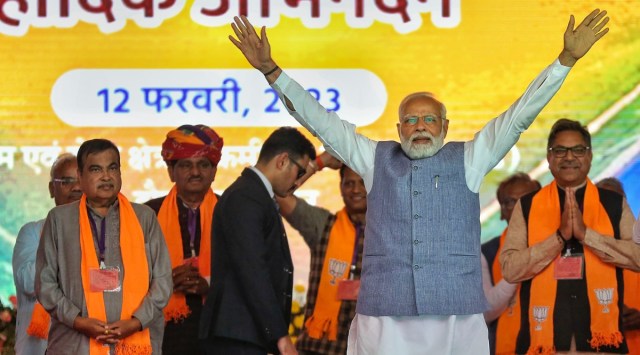 Dausa: Prime Minister Narendra Modi during the inauguration of the Delhi-Dausa-Lalsot section of Delhi Mumbai Expressway, in Dausa, Sunday, Feb. 12, 2023. (PTI Photo)
 Prime Minister Narendra Modi dedicated the completed 246-km Delhi-Dausa-Lalsot section of the Delhi-Mumbai Expressway to the nation on Sunday. Speaking at an event in Dausa, the Prime Minister said that the expressway, one of the most advanced in the world, presented a grand picture of India’s progress.
“When such modern roads, railway tracks, Metros and airports are constructed, it gives momentum to the nation’s progress. Several studies show that the money spent on developing infrastructure has wide and farreaching impact on the ground,” the Prime Minister said. He said that investment in infrastructure ultimately attracts greater investment than what had been made initially.
“Over the last nine years, the central government has invested a lot in infrastructure. Over the last few years, more than Rs 50,000 crore have been given to Rajasthan for roads. In this year’s Union Budget, we have allotted Rs 10 lakh crore [on infrastructure]. This is five times more than in 2014. Rajasthan will benefit to a great extent from this investment,” the PM said.
When investments are made in highways, railways, ports, airports, optical fibre cables, digital connectivity, construction of pucca houses and colleges, etc., every section of society is empowered, he said.
The 246-km section of the expressway inaugurated by the Prime Minister on Sunday has been developed at a cost of more than Rs 12,150 crore. An NHAI official said this stretch is likely to be opened for traffic in the next few days. The Sohna-Dausa stretch is expected to cut travel time between Delhi and Jaipur to about three hours, reduce traffic congestion on the Delhi-Jaipur highway, and improve connectivity between Gurgaon, Nuh, Palwal and adjoining areas, NHAI officials said.
The development of infrastructure boosts economic activities, the PM said. Grameen Haats are being developed along the expressway, which would help local farmers and artisans. “Tourism spots like Sariska, Keoladeo National Park, Ranthambhore, Jaipur, and Ajmer will draw huge benefits from the highway,” the PM said. Apart from Rajasthan, several parts of Delhi, Haryana, Gujarat, and Maharashtra would benefit as well, he said.
The expressway project is under the Gati Shakti Master Plan, under which arrangements have been made to lay optical fibre cables, electricity lines, and gas pipelines, and to use the leftover land for warehousing and producing solar energy. “All these efforts will save the nation crores of rupees and a lot of time in the future”, Modi said.
The PM also laid the foundation stone for another 247 km of National Highway projects that will be developed at a cost of more than Rs 5,940 crore.
One of these projects will connect Jaipur with the expressway; another will link the Ambala-Kotputli corridor with the expressway near Alwar and help connect Haryana, Punjab, Himachal Pradesh and Jammu and Kashmir with Gujarat, Madhya Pradesh, and Maharashtra; and a third, the Lalsot-Karoli road, will connect the region with the expressway.
Earlier in the day, Union Minister of Road Transport and Highways Nitin Gadkari and Haryana Chief Minister Manohar Lal Khattar inspected the traffic management control room of the Delhi-Mumbai Expressway at Sohna and Hilalpur toll plaza in Nuh in Haryana. Haryana Deputy Chief Minister Dushyant Chautala, Union Minister for Jal Shakti Gajendra Singh Shekhawat, Union Minister of State for Civil Aviation, Road Transport and Highways Gen V K Singh (Retd), and Union Minister of State for Statistics and Programme Implementation Rao Inderjit Singh — who is also the MP from Gurgaon — were also present.
At Hilalpur toll plaza, Chief Minister Khattar said the expressway will set a new paradigm for progress in the country.
“Besides connecting Delhi and Mumbai, this expressway project will provide thrust to the economic development of the country. Over 129 km of this expressway will be in Haryana, and will connect Gurgaon to Jaipur. Nuh is an aspirational district and quite backward…the expressway passing through Nuh will help in its industrial development and offer employment opportunities to the people of this region,” Khattar said.
Deputy Chief Minister Chautala hailed the “historic day” for Haryana: “With the inauguration of this stretch of the expressway, the NCR region’s connectivity with Mumbai will improve and it will emerge as the hub for logistics transport in the region and accelerate the pace of industrial development across Haryana.”
Being developed at an estimated cost of over Rs 1 lakh crore, the 1,386-km-long Delhi-Mumbai Expressway will be India’s longest expressway and one of the fastest to be built anywhere in the world. Expected to be operational by 2024, the expressway will pass through Delhi, Haryana, Rajasthan, Madhya Pradesh, Gujarat and Maharashtra. It will enhance connectivity between Delhi and Mumbai, and reduce travel time between the two cities to 12 hours from 24 hours, and also cut the journey by 180 km (from 1,424 km to 1,242 km).
The eight-lane access-controlled greenfield expressway has scope for expansion to a 12-lane expressway with a 21-metre median depending on the volume of traffic. The expressway will have a state-of-the-art automated traffic management system, and 94 wayside amenities to improve the commuter experience, including resorts, restaurants, food courts, dormitories, fuel stations, facilities for truckers, and logistics parks. A helicopter ambulance service will be available for accident victims. Animal overpasses have been planned to facilitate unrestricted movement of wildlife.