Journalism of Courage



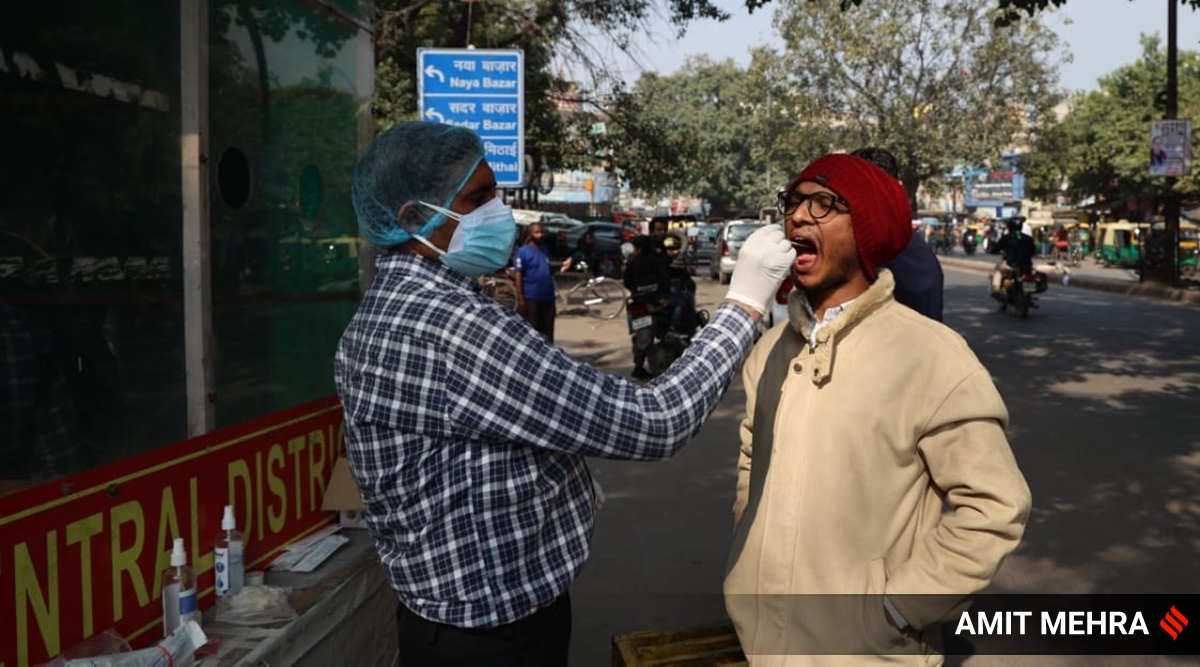 A health worker collects swab sample of a man in New Delhi. (Express Photo By Amit Mehra)
Delhi has been recording a consistent decline in the number of Covid cases, with fewer than 2,000 fresh infections reported for the first time this year. As per Saturday’s health bulletin, the city saw 1,604 new cases while the positivity rate stood at 2.87%.
A Covid-19 outbreak is thought to be under control when a positivity rate below 5% is maintained for over two weeks, according to the World Health Organisation.
With the lower positivity rate, the Delhi Disaster Management Authority said schools, colleges, and gyms can reopen from Monday.
The current surge — the fifth for Delhi and third for the country — waxed and waned quickly in the national capital. The number of fresh cases reported each day remained over 2,000 for 35 days during the current surge of infections. In comparison, it remained over the 2,000-mark for 52 days during the previous surge in April-May last year.
The surge was largely driven by the highly mutated omicron variant and resulted either in no symptoms or mild symptoms such as fever, chills, body ache, and sore throat in most of the people it infected. And, although the number of cases was similar at the peak of the current and previous wave, there were fewer hospitalisations and deaths.
There were 28,395 cases reported in a single day on April 20 last year at the peak of the previous surge and a comparable 28,867 cases on January 13 at the peak of the current surge in cases. However, hospitalisations peaked at 2,734 on January 19 for the current wave as compared to 20,142 on May 3 during the previous wave.
The highest number of deaths recorded in a day during the current wave was 45 as reported on January 22. The highest single day toll during the previous surge was 448 reported on May 3, as per data shared by the Delhi government.
Fewer hospitalisations and deaths have been attributed to not only the likelihood of milder disease with the omicron variant, but also high levels of previous exposure to the virus and high vaccination rates.
“We previously reported a sero-prevalence of 97%, which means that almost the entire population of Delhi was exposed to the virus either during the first or second wave. This, coupled with everyone having received at least one dose of the vaccine and 80% receiving even the second dose in Delhi, we had thought that the course of the infection wouldn’t be too bad. With the omicron variant having silently infected most of Delhi residents, this immune response must have been boosted without many deaths or severe disease. This will offer protection from further infection,” said Dr Pragya Sharma, professor of community medicine at Maulana Azad Medical College. Her team conducts the sero-surveillance studies in Delhi.
Dr Jayaprakash Muliyil, chairperson of the Scientific Advisory Committee of the National Institute of Epidemiology, said, “A natural infection always offers better protection than a vaccine. Because of the previous exposure to the Wuhan variant and then the delta variant among the Indian population — and also vaccine coverage — omicron resulted in mild disease but offered protection against future infection.”
Data from the National Clinical Registry shows that only 10.2% people who were completely vaccinated but needed hospitalisation died during the current wave as compared to 21.8% of unvaccinated individuals.

 3 min read