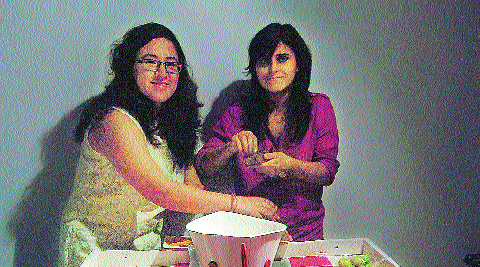
The thela embodies the first point of interaction that consumers have with their food in a typical Indian context, says Suvani Suri.
In a small courtyard, surrounded by white walls that glowed in the evening darkness, people stood huddled under a tree and played a strange game. A thela or vegetable vendor’s cart had been painted with red and white squares like a chessboard, with heaps of food acting as chess pieces. Two women played referees, repeatedly telling players, “If you don’t eat, you can’t play.” The name of the board game, fittingly, was Appetite.
Each player would make a move and then eat a slice of cake or a piece of nachos or drink a shot of soft drink. As they played, food — baby corn, cherry tomatoes, packaged apples, cucumber, soya sticks — was removed from the board and piled on a weighing machine that contained a white and red bowl. Only when the last player had finished the last round, did the referees explain the meaning of the game — the red squares represent the corporations who dominate the food industry, while the whites are the farmers.
“The thela embodies the first point of interaction that consumers have with their food in a typical Indian context. The cake, nachos and soft drink represent food miles and carbon footprints that the players consume to move ahead in the game,” says Suvani Suri, one of the referees, who conceptualised the game with Simran Chopra. The two interactive designers from National Institute of Design were part of a residency titled “InContext: public.art.ecology — Food Edition III” at KHOJ Studios, Khirkee Extension that has, over the years, championed unconventional art. On April 17, Suri and Chopra joined four other artistes to reveal that food, an essential ingredient of life, also has a cutting edge behind it.
A few days before, two Pakistani artistes, Rabbya Naseer and Hurmat Ul Ain had presented Tea Party and Crow Effect Project. The former used chai to address the shared history of India and Pakistan. For the latter — the name is inspired by the belief that a crow cawing in one’s house indicates that one should expect a guest — the duo invited strangers for a meal and conversation.
A meal and conversation also explained Mona Gandhi’s Eat Future Tense, in which guests sat around a table slurping bowls of Burmese Khao Suey. Mumbai-based Gandhi promotes natural, plant-based, food and the Burmese Khao Suey was packed with flavours — steamed moong sprout, pumpkin, potato, peas, carrot and cauliflower with raw toppings pomegranates, celery, spring onion and lemon in a cashew-based curry. It won over diners, ranging from an elderly housewife who asked for the recipe to a former hippy, who called it “food with integrity”. Gandhi did better than give a talk; she brought issues of grain subsidies, biodiversity and politics of food into a dining table conversation. “People talk a lot about fresh and local nowadays. This, for me, is a classic example of a glocal experience. I deliberately chose a Burmese khao suey but I gave it my own fresh and local twist,” said Gandhi.
In a gallery next to Gandhi’s, Srishti Lakhera sat before a mound of pork ribs, tearing off a shred and eating it disinterestedly. She nibbled constantly through the evening, looking deliberately bored, except when she chatted with guests about the link between fat on the plate and fat in the body. During her research, Lakhera had also spoken to people about which body part they were most ashamed of — and photographs of these limbs and bellies animated a wall to her left. Against the opposite wall, guests sat with headphones, listening to people talk about their struggle with fat. But it was Rishikesh-based Lakhera, a filmmaker, basket weaver and farmer, who grows her own food, that made a viewer comment that he would not eat pork for a long time. “I didn’t know where the pork has come from, beyond the restaurant. We no longer know our food, just as we don’t listen to our bodies while binging,” said Lakhera.
Italian Leone Contini, on the other hand, travelled from the ruins of Satpula to Majnu ka Tilla, crossing sewers, drains, the polluted Yamuna and the nearby farmlands. At Khoj, he invited guests to join in for a meal “that may be poisoned”. Titled Bottlegourd Bokchoy Ballet, the piece juxtaposed the common kaddu with the more exotic bok choy — but the suspense was an envelop with a question mark hanging from the wall. “The envelop contains test results showing if there are any metals in our food,” he said, as guests keenly tucked into the kaddu, cooked Silcilian style, and Tuscan-Chinese Bok choy dish. “I had thought people would be afraid of eating because the kaddu and bok choy might be contaminated,” he said.
Story continues below this ad
Delhi-based Ravi Agarwal served up food for thought in the form of video installations titled A Feast of Sorts. In it, a sadhu talks about non-dependence on food, Mona Gandhi talks about her passion for raw food and a linguist-cum-poet analyses behavioural aspects of food. A photograph of Mahatma Gandhi during a hunger strike hung in a corner, with the Gandhi’s quote: God comes to the hungry in the form of food juxtaposed with the slogan “I’m Loving It” in a fast food brand’s font and colour.
Dipanita Nath is a Senior Assistant Editor at The Indian Express, based in Pune. She is a versatile journalist with a deep interest in the intersection of culture, sustainability, and urban life.
Professional Background
Experience: Before joining The Indian Express, she worked with other major news organizations including Hindustan Times, The Times of India, and Mint.
Core Specializations: She is widely recognized for her coverage of the climate crisis, theatre and performing arts, heritage conservation, and the startup ecosystem (often through her "Pune Inc" series).
Storytelling Focus: Her work often unearths "hidden stories" of Pune—focusing on historical institutes, local traditions, and the personal journeys of social innovators.
Recent Notable Articles (December 2025)
Her recent reporting highlights Pune’s cultural pulse and the environmental challenges facing the city during the winter season:
1. Climate & Environment
"Pune shivers on coldest morning of the season; minimum temperature plunges to 6.9°C" (Dec 20, 2025): Reporting on the record-breaking cold wave in Pune and the IMD's forecast for the week.
"How a heritage tree-mapping event at Ganeshkhind Garden highlights rising interest in Pune’s green legacy" (Dec 20, 2025): Covering a citizen-led initiative where Gen Z and millennials gathered to document and protect ancient trees at a Biodiversity Heritage Site.
"Right to breathe: Landmark NGT order directs PMC to frame norms for pollution from construction sites" (Dec 8, 2025): Reporting on a significant legal victory for residents fighting dust and air pollution in urban neighborhoods like Baner.
2. "Hidden Stories" & Heritage
"Inside Pune library that’s nourished minds of entrepreneurs for 17 years" (Dec 21, 2025): A feature on the Venture Center Library, detailing how a collection of 3,500 specialized books helps tech startups navigate the product life cycle.
"Before he died, Ram Sutar gave Pune a lasting gift" (Dec 18, 2025): A tribute to the legendary sculptor Ram Sutar (creator of the Statue of Unity), focusing on his local works like the Chhatrapati Shivaji statue at Pune airport.
"The Pune institute where MA Jinnah was once chief guest" (Dec 6, 2025): An archival exploration of the College of Agriculture, established in 1907, and its historical role in India's freedom struggle.
3. Arts, Theatre & "Pune Inc"
"Satyajit Ray, Ritwik Ghatak were not rivals but close friends, says veteran filmmaker" (Dec 17, 2025): A deep-dive interview ahead of the Pune International Film Festival (PIFF) exploring the camaraderie between legends of Indian cinema.
"Meet the Pune entrepreneur helping women build and scale businesses" (Dec 16, 2025): Part of her "Pune Inc" series, profiling Nikita Vora’s efforts to empower female-led startups.
"How women drone pilots in rural Maharashtra are cultivating a green habit" (Dec 12, 2025): Exploring how technology is being used by women in agriculture to reduce chemical use and labor.
Signature Style
Dipanita Nath is known for intellectual curiosity and a narrative-driven approach. Whether she is writing about a 110-year-old eatery or the intricacies of the climate crisis, she focuses on the human element and the historical context. Her columns are often a blend of reportage and cultural commentary, making them a staple for readers interested in the "soul" of Pune.
X (Twitter): @dipanitanath ... Read More


 6 min read


 The thela embodies the first point of interaction that consumers have with their food in a typical Indian context, says Suvani Suri.