


Stay updated with the latest - Click here to follow us on Instagram
Tags:


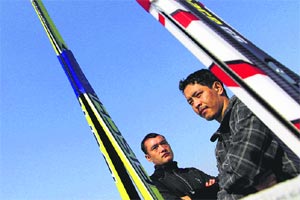
Two skiers from Leh,Tashi Lundup and Jamyang Namgial,head to Vancouver next week for their first brush with the big,white Winter Olympics an event which holds more thrill than expectation for them By aabha Rathee
Red and green mingle as two pairs of snow skis advertise their newness on a sunlit rooftop hidden in Delhis bustling Darya Ganj. Ten minutes earlier,a floor below,Tashi Lundup and Jamyang Namgial had zipped open their long,narrow carry packs,eager to show off their gleaming Atomic blades and unsoiled ski boots. The sense of new is hard to miss in the lives of the two havaldars of the Indian Armys Ladakh Scouts regiment after all,theyre going to the big,white Winter Olympics.


Before 2002,the closest Lundup and Namgial had come to skiing even in their cold Himalayan villages,was upturning metal box lids and trying to balance both feet on them on frozen ponds and streams in the winter months. Its a childhood playtime activity in the village, Namgial says. Snow isnt very frequent,but we get a lot of frozen,ice-covered water bodies and kids love to slide down those.
In 2002,both having joined the Army recently as sepoys were asked to report to a sports camp meant to get a bunch of new recruits to train as skiers. They showed natural skill,got noticed early and quickly moved to representing the Army in national tournaments. Staying and travelling together,they found acquaintances common to each other to talk about,but they had never expected to find themselves taking off to the Big O.
Unusual choice
With a lama and a post-office worker for older brothers,Lundup had not found much encouragement from his farmer father to move out of the house at 17 years of age. Staying in the family village of Achinathang,near Leh,was the more preferred option. I was done with school,and my friends insisted I come along,so I went and got enlisted, Lundup says. Once there,Lundup found there was much he could do with ready facilities and opportunity. He had only played a bit of volleyball before,but the prospect of training as a sportsperson appealed. He had worked in the field,and just seemed to have natural stamina too, Namgial pitches in as his friend breaks the conversation thread.
The 2002 camp was the determining factor. Lundup is now a permanent resident of the High Altitude Warfare School (HAWS) in Gulmarg,which is the Armys nodal centre for mountain and snow warfare,but where Lundup says,he is part of a select bunch who practice and train for their chosen alpine sport. The coaches thought his natural stamina suited the cross-country version,and so his specialisation was picked. He now has a boxful of national-level medals the first coming in March 2003,just four months after he started skiing. The latest was a gold at the National Winter Games in Gulmarg last year that qualified him to take the spot at the Vancouver Games for the country.
I hadnt really gone out much before that,but joining the Army was good for me because I got a lot of chances,plus it meant steady money back home, Lundup says. His skills on snow got him an early promotion too he was elevated to the post of havaldar just two years into his job,a task that usually takes at least 10. His oldest daughter,five,is already in school,but the travails of travelling do show up: Lundup takes a moment to recall his youngest daughters name. We stay out too much! he says.
In 2007,he got himself his only international medal when he finished third at the FIS race in Iran. That was the kind of thing that makes you believe in yourself. Competing at the world level takes a lot of will too, Lundup says. He will be part of a similar big stage in Vancouver,but there is one small thing that Lundup says he is specially looking forward to seeing Lukas Bauer in the flesh. The Czech Republics Bauer became the first man to win two Tour de Ski titles just last month. When we go abroad for competitions,we see people like Bauer and Norways Petter Northug on television. It will be nice to see them in action, Lundup says. They are like Sachin Tendulkar, Namgial elaborates,when they move across the venue,there are always people looking at them.
A new beginning
The ebullient Namgial was at a loss of wits when he made his way to the Army,also on the insistence of friends. I had won myself a scholarship to the Vishesh Kendriya Vidyalaya in Ghaziabad in Class VII. But after Class X,most of my friends left,so I didnt want to stay there any more. I made my way to Jammu to look for something to do, he says. But that was short-lived,mothers orders were to come back home to the village of Saboo near Leh right away.
Once there,he,too,was whisked along in the group of friends enlisting in the Army. There,at the same camp in Gulmarg in 2002,Namgial was found capable of skiing between sets of poles,or gates,and Indias next alpine skier was born. He is also part of the HAWS now.
The strict rigours of the Army help in his sport,but every little chance he gets,Namgial likes to indulge himself by stealing a peek at the latest Hindi movie. I really liked 3 Idiots, he says of the latest hit. But they deleted so many portions they had shot in my village,that was disappointing, Namgial says. His younger brother,who quit the Army because it was too disciplined for him now works as a taxi driver in Leh,an older brother is employed with the district treasury,and his mother,a handicrafts artist,and grandmother,have begun talking about his marriage. I tell them,there is a lot to do right now.
Back recently from a three-month pre-Olympic training stint in Italy,Namgial also has horror tales of food mishaps to tell from his travels. I cant eat beef and you get beef in everything in Europe. Taking out meat pieces from the soup on a shared dining table is not a great idea! There was also the experience with cat meat sandwich while returning from the Asian Winter Games in China. I scare my friends by saying I have to live on snakes and insects when I go abroad, Namgial laughs.
Off the dinner plate,the biggest challenge in his sport,he says,is getting used to different tracks. The difficulty levels vary drastically,and you really need to race on a lot of tracks and get used to the differences, he says. Still,Vancouver calls,an achievement Namgial says was noted in Leh on the local radio,but one that he hopes helps in getting snow sports the necessary popularity in the country. Sometimes I think I couldve studied further,I wouldve liked to, Namgial says,but this isnt too bad either you know.
Forced stopover
The Winter Games Federation of India office was forced into the premises of a publishing house in Darya Ganj,when the earlier one caught fire last month. The passports of the two were luckily at the house of one of the officials. The good luck,and that brand new equipment the sports ministry helped them get just about 15 days ago,the two hope,will help them get a ride theyre proud of on the cottony slopes of Vancouver.
Its great when you have a team to count on,rather than being the only one
Despite having won an Asian championship silver at the end of last year,the scheduled run-up to his fourth Winter Olympic Games didnt quite go as planned for Shiva Keshavan,with the luge rider missing out on all the tournaments he had lined up before Vancouver because of a stress fracture in his back. Indias best bet in the Games,however,is healed and rested,and with a one-week stint in France,also track-ready again. He talks about the injury,his preparations and the comfort of not being a solo participant in a big event. Excerpts:
How has the run-up to the Vancouver Games panned out for you?
My preparations had a bit of a setback because of the stress fracture in a vertebra right after I returned to Delhi post the Asian championships. I had to take three weeks off,including one week of physiotherapy. It meant that I missed out on all the tournaments I had lined up,including the World Cups,but Im fine now. I have spent a week in France on the field with my coach and I feel confident.
How did you get the injury? Are there any lingering effects?
It was because of accumulated pressure,I think. I dont travel with a physiotherapist so I didnt realise it in time. But I got it checked in December when I was in Delhi and was told that I would have to take immediate rest. There is no discomfort at the moment.
Does the lack of track time make you nervous before the big Games then?
It is an unfortunate thing,obviously,but I think I had had sufficient competition time through the season prior to it. I had had enough runs. The week in France was productive as I got time with my coach and we got the chance to try out some small changes in terms of angles. Ill also have five days of practice in Vancouver. Plus,my last race was at the Asian meet,so I just have to stick to the positive feeling from there. Im ready to go.
Have you raced at the Olympic venue before?
This is a new track,so there hasnt been a race here yet. But we were all given some time in November on the track and that helped. The good thing is that for everyone in the world,except of course the Canadians,it will be new. But this is one of the fastest tracks in the world,so the reaction times will have to be top-notch.
What will be the key at the Games?
In an Olympics,it is extremely important to be consistent. In a world championship there are just two heats,but here there are four. Even one mistake in any of them can cost you.
How does it help to go as part of a contingent,even if small,rather than the only competitor from the country?
Its great because you have a team to count on. When youre moving around in the Games Village,you do it as a team. There is the familiarity of language too,its much more comfortable.
Have you been speaking to Tashi and Namgial,giving them tips as the experienced one?
I havent met them yet,but we have common friends. My event is the first,on the 13th and the 14th,so Ill have the chance to give them time and inputs. They will be nervous,but Im sure my experience will help.
Are you looking forward to the opening ceremony,being the most senior member of the squad?
My federation chief has recommended my name to be the flag-bearer,but I havent yet received a word. Lets see how it works out.


Stay updated with the latest - Click here to follow us on Instagram


