Journalism of Courage



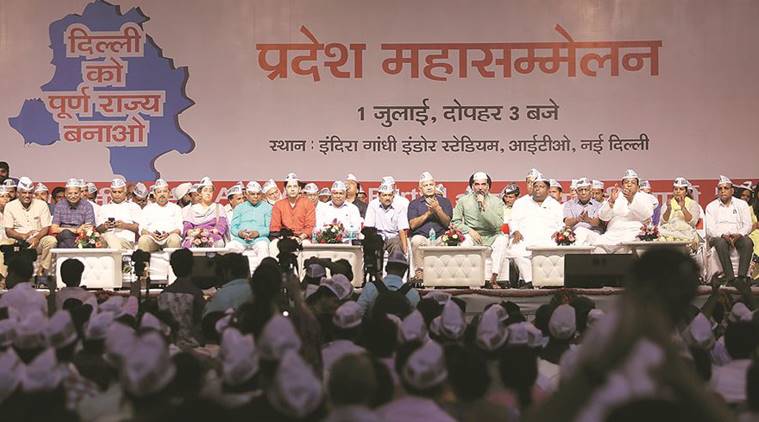 During the AAP meet at Indira Gandhi Indoor Stadium on Sunday. (Photo by Gajendra Yadav)
On Sunday, Chief Minister Arvind Kejriwal announced the launch of a signature campaign to demand separate statehood for Delhi, at a state conference of the Aam Aadmi Party (AAP). The CM suggested that until the demand for statehood is met, the Lieutenant Governor of Delhi should be chosen by the people.
The conference, attended by around 5,000 party workers and leaders, marked the launch of a full-fledged movement for separate statehood. Gopal Rai, national executive convener of AAP, told the gathering that “3,000 purna rajya kendras (separate state centres) would have to be opened across Delhi”.
“On July 3, we will begin the first leg of our movement from these centres. We will launch a signature campaign with the aim of gathering 10 lakh signatures, which we will place at PM Modi’s feet,” said Rai. Kejriwal added that this would be the first phase of a more sustained movement, and once the signatures are submitted to PM Modi, the campaign would continue “until we have signatures from 100 per cent of the city residents”.
Deputy Chief Minister Manish Sisodia likened the gathering at Indira Gandhi Indoor Stadium to the one at Jantar Mantar in 2011. Kejriwal further said that the day would be remembered as “the day the people of Delhi have the same rights as the people of Maharashtra or Andhra Pradesh”. Stating that the central government should keep the New Delhi Municipal Council (NDMC) area as its capital region and “give the rest of Delhi its freedom”, the CM reiterated the promises on which AAP’s campaign for separate statehood is hinged.
His primary focus was on the Delhi government retaining 30% of the income tax generated from the city to enable building houses for every resident within a period of five years, and on reserving 85% of government jobs for the people of the city.
Kejriwal also claimed that with separate statehood, the Delhi government would be able to create more new universities to ensure higher education seats for the city’s youth, regularise unauthorised colonies within the span of a month, and make the city “crime-free” by taking charge of the Delhi Police.
“We are a popularly elected government, but the public interest projects we tried to launch, which also have popular backing like mohalla clinics, doorstep ration delivery and CCTV cameras, are regularly blocked by the L-G… Delhi has, historically, always been enslaved — first under the Mughals, then under the British and now under the L-G,” said Kejriwal.
“If the L-G is to wield so much power over an elected government, it is the right of the people that until separate statehood is achieved, the L-G should be chosen by them, or their will shall always be over-ruled,” he added.

 3 min read