Journalism of Courage



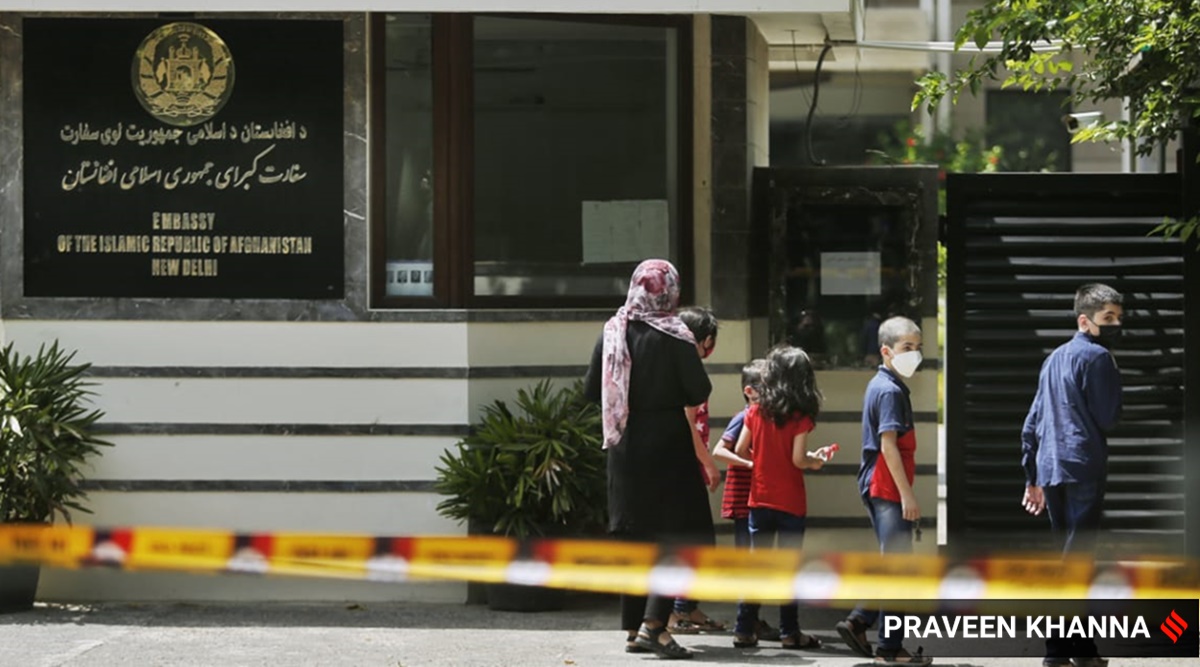 People outside Afghanistan Embassy in New Delhi on Monday. (Express photo by Praveen Khanna)
With the Taliban takeover of Afghanistan complete, Afghan students of Delhi’s universities are hoping that being here might offer them some stability and security from the turmoil at home.
A second semester Masters in Sociology student in JNU, a recipient of a scholarship from the Indian Council for Cultural Relations, had been attending classes and college work remotely from Afghanistan so far, but fears that if she does not come to the university immediately now, her education might come to an end.
“I want my visa to come to India and to join my university immediately because I’m sure that very soon, it will be impossible for me to leave the country by saying that I need to go study. If I stay here, I won’t be able to study and I fear that even studying online will not be possible, that electricity and internet connections might be snapped… My father wants to shift us all elsewhere outside Afghanistan and going to India and completing my education is my best hope… I had contacted the university administration but didn’t get a proper response. I have contacted ICCR (Indian Council for Cultural Relations: Home) and am now waiting to hear from them, I have been told that it will take around 15 days for the visa procedure,” she said over the phone, requesting not to be named.
 While JNU registrar Ravikesh did not respond to calls and messages from The Indian Express, he had issued a circular on Saturday stating: “Some Afghan students of JNU have requested the administration to facilitate their return to the campus. As the university has remained closed as directed by the DDMA, government of NCT of Delhi, this matter is being looked into.”
Some Afghan students who are already in India and are nearing the end of their programmes fear that it is not possible to return to their country and said they hope to extend their study and stay in India.
“I am an ICCR scholar and I have just completed my M.A. in International Relations from JNU and am awaiting my degree. The previous government had offered me to join a two-year job with them on return to Afghanistan but I’m afraid that I’ll face persecution there now. I haven’t even been able to contact my family for two weeks; they are not reachable. My visa will expire in a month. I hope that our scholarships can be extended; I am willing to study in any Indian university and do my PhD. The Indian government gives 1,000 Afghan students scholarships every year. No one will be able to come now with this situation, the government should just extend the scholarships to those who are already there,” said Shafiq Sultan from Wardak province.
In Delhi University, the administration has in the last month facilitated the arrival of a number of its Afghan students but is worried about whether its new students from the country will be able to join. The university’s Deputy Dean (Foreign Students) Dr Amarjiva Lochan said that around 40 Afghan students, mostly those on scholarship, have returned to Delhi since July.
“We facilitated the return of these enrolled students even though studies are happening remotely because they were finding it difficult to manage their studies, with time zone and internet problems… But we are worried about the next batch for whom admissions are ongoing. We have given seats to 80 ICCR scholars and we have received applications from another 79 Afghan nationals. Their classes will only begin earliest in October, and I wonder if it’ll even be possible for them to join us,” he said.
Jamia Millia Islamia also has a large number of Afghan students but university administrators said their students have not reached out to them for support “because our campus has been fully closed and everything has been happening remotely”.

 4 min read