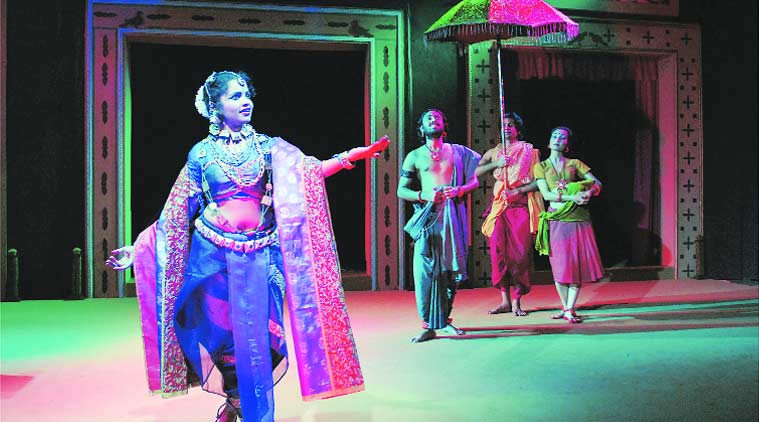
In Mrichakatikam, a love story is underlined with political intrigue; K S Rajendran is exploring the ‘dimensions of a woman’s curse’ Photos: (Source: Express photo by S Thyagarajan)
By 1978, Emergency had lifted but not the anger. On Marina Beach in Chennai, Leftist intellectuals would gather to make their voices heard through street theatre. A young man would join in every Saturday. Here, among the crashing and frothing waves, KS Rajendran made his first play. “It was called Swayamvaram, in which all political parties try to woo Bharat Mata and she refuses to garland any of them,” says the director, “I played Bharat Mata, wearing a sari.” On the 40th anniversary of the Emergency, Rajendran — his politics glinting with humour — is staging a protest over another national issue, the marginalisation of women.
Mahabharata of Women draws from a Tamil myth in which a young girl is killed by her brothers who suspect her of having a lover. “She was fond of talking to flowers in the garden but her brothers thought that she was with a man.
There are myths prevailing in some parts of Tamil Nadu that, as she burnt to death, the girl set a curse on all the males of her vansha. Playwright K Madavane has expanded this story to include incidents from the Mahabharata in which characters set a curse or became victims of a curse,” says Rajendran, 62, who is working with the Shri Ram Centre’s Repertory Company in Delhi. The play will be staged in the second week of September.
The heroes of the Mahabharata who uttered or fell to words of disaster walk around the stage. Satyavati, who was born to the cursed apsara Adrika. Amba, the princess of Kashi, who calls misfortune upon the patriarch Bhishma.
Curses entwine Kunti, the mother of the Pandavas, and Draupadi, their queen. Karna, the warrior, does not escape and neither does the godhead Krishna. “The play is a collage of the different dimensions of a woman’s curse. I play it in a non-directional manner, in which an action does not lead to another in a straight corollary but branches into a number of angles,” says the veteran director.
Like the plot, the stage is busy. Rajendran, in his signature style “opens windows on stage, as if it were a computer”. A mother starts the action in Mahabharata of Women, by telling a story to her children, and different corners, alcoves and levels of the stage light up in tune with her narrative. “I want to break the picture frame of the proscenium. If I have 20 actors, I would have each one doing something different in different parts of the space. I like to have interconnected scenes playing out simultaneously at various levels and places so that the audience has to follow the play actively,” says the director.
In classics and mythology, Rajendran has sought, and found, mirror images to contemporary realities. Mrichakatikam is as much about the love of the impoverished Charudutta for the rich courtesan Vasantasena as about a plot to overthrow a tyrannical king. Mudrarakshasa traces the rise of Chandragupta Maurya but also the intrigues of Chanakya. In Uttararamacharita, the protagonists Rama and Sita become commoners who go to office and are burdened by daily chores. Rajendran’s views on welding religion with governance was evident in Richard III, staged a few weeks ago by students of Delhi’s National School of Drama. When his 2006 play, Aurangzeb, was held at Shri Ram Centre last month, a houseful crowd turned up at 11 am for the ticketed show that told the story of ruthless ambition.
Story continues below this ad
One reason for the immediate, even visceral, relationship that audiences develop with Rajendran’s plays is that his actors physically possess the text. After long workshops and discussions, every actor is made to supplement the dialogues with their body. “The spoken word is only 10-15 per cent of a performance,” says the director, who has made around 50 plays in Hindi, Tamil, Kannada, Malayalam and Sanskrit. His long collaboration with dancer-choreographer Anjana Rajan as well as Thang Ta gurus has “opened up new ways of devising theatre performances”.
Mahabharata for Women follows Richard III, in which the beleaguered king is haunted by dreams of swaying ghosts of those he has killed. In Mrichakatikam, the uncontrolled desires of Vasantasena emerge as a berserk dance of a mad elephant. “I try to match the spoken word with performance,” says Rajendran, with the quiet confidence of somebody who has scaled an epic before.
Dipanita Nath is a Senior Assistant Editor at The Indian Express, based in Pune. She is a versatile journalist with a deep interest in the intersection of culture, sustainability, and urban life.
Professional Background
Experience: Before joining The Indian Express, she worked with other major news organizations including Hindustan Times, The Times of India, and Mint.
Core Specializations: She is widely recognized for her coverage of the climate crisis, theatre and performing arts, heritage conservation, and the startup ecosystem (often through her "Pune Inc" series).
Storytelling Focus: Her work often unearths "hidden stories" of Pune—focusing on historical institutes, local traditions, and the personal journeys of social innovators.
Recent Notable Articles (December 2025)
Her recent reporting highlights Pune’s cultural pulse and the environmental challenges facing the city during the winter season:
1. Climate & Environment
"Pune shivers on coldest morning of the season; minimum temperature plunges to 6.9°C" (Dec 20, 2025): Reporting on the record-breaking cold wave in Pune and the IMD's forecast for the week.
"How a heritage tree-mapping event at Ganeshkhind Garden highlights rising interest in Pune’s green legacy" (Dec 20, 2025): Covering a citizen-led initiative where Gen Z and millennials gathered to document and protect ancient trees at a Biodiversity Heritage Site.
"Right to breathe: Landmark NGT order directs PMC to frame norms for pollution from construction sites" (Dec 8, 2025): Reporting on a significant legal victory for residents fighting dust and air pollution in urban neighborhoods like Baner.
2. "Hidden Stories" & Heritage
"Inside Pune library that’s nourished minds of entrepreneurs for 17 years" (Dec 21, 2025): A feature on the Venture Center Library, detailing how a collection of 3,500 specialized books helps tech startups navigate the product life cycle.
"Before he died, Ram Sutar gave Pune a lasting gift" (Dec 18, 2025): A tribute to the legendary sculptor Ram Sutar (creator of the Statue of Unity), focusing on his local works like the Chhatrapati Shivaji statue at Pune airport.
"The Pune institute where MA Jinnah was once chief guest" (Dec 6, 2025): An archival exploration of the College of Agriculture, established in 1907, and its historical role in India's freedom struggle.
3. Arts, Theatre & "Pune Inc"
"Satyajit Ray, Ritwik Ghatak were not rivals but close friends, says veteran filmmaker" (Dec 17, 2025): A deep-dive interview ahead of the Pune International Film Festival (PIFF) exploring the camaraderie between legends of Indian cinema.
"Meet the Pune entrepreneur helping women build and scale businesses" (Dec 16, 2025): Part of her "Pune Inc" series, profiling Nikita Vora’s efforts to empower female-led startups.
"How women drone pilots in rural Maharashtra are cultivating a green habit" (Dec 12, 2025): Exploring how technology is being used by women in agriculture to reduce chemical use and labor.
Signature Style
Dipanita Nath is known for intellectual curiosity and a narrative-driven approach. Whether she is writing about a 110-year-old eatery or the intricacies of the climate crisis, she focuses on the human element and the historical context. Her columns are often a blend of reportage and cultural commentary, making them a staple for readers interested in the "soul" of Pune.
X (Twitter): @dipanitanath ... Read More


 5 min read


 In Mrichakatikam, a love story is underlined with political intrigue; K S Rajendran is exploring the ‘dimensions of a woman’s curse’ Photos: (Source: Express photo by S Thyagarajan)