Journalism of Courage



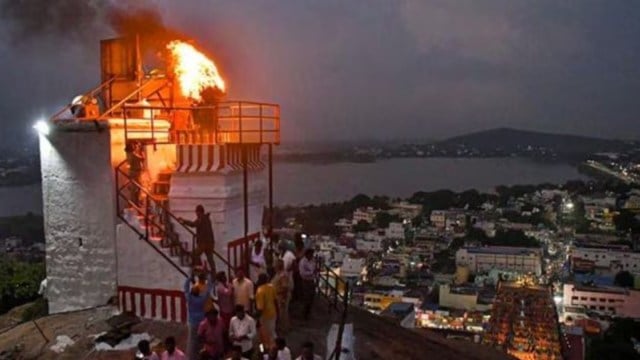 A lamp lit at Thiruparankundram temple as part of ‘Karthigai Deepam’ festival celebrations, in Madurai district. (PTI/File)
Thiruparankundram Karthigai Deepam row: Even as the Madras High Court grappled with appeals and contempt proceedings over the lighting of the Karthigai Deepam at the Deepathoon atop Thiruparankundram hill, Justice S Srimathy of the Madurai Bench Thursday permitted a tightly regulated hunger strike by local residents pressing for the ritual, while officials from the Tamil Nadu Archaeology Department quietly surveyed the disputed stone pillar — a move that immediately drew objections from petitioners who argued that the state was attempting to generate fresh evidence in a matter still under judicial consideration.
Justice Srimathy allowed a petition filed by advocate R Prabhu of Thiruparankundram, seeking permission for what he described as “peaceful fasting” by the public on December 13 near the Mayil Mandapam on Sannathi Street. The protest is aimed at pressing for the lighting of the Deepam at the Deepathoon, located close to a dargah on the hill — the same site at the centre of a series of contentious orders, appeals and contempt actions over the past ten days.
The judge imposed strict conditions: no more than 50 participants, fasting permitted only between 9 am and 5 pm, no slogans of any kind, and only the chanting of mantras. The entire event must be videographed, only one microphone may be used, and neither the petitioner nor the authorities may give the protest any political colour.
While the state strongly opposed the plea, arguing that the core dispute was pending before appellate courts, Justice Srimathy held that a hunger strike constituted a form of expression protected under the Constitution and could not be denied outright. Authorities, she said, may regulate protests but cannot impose a blanket bar.
The order came on a day when the state’s administrative actions added a fresh layer of controversy. On December 10, a seven-member team from the Tamil Nadu Archaeology Department, led by Deputy Director Yatish Kumar and Assistant Director Loganathan, conducted a survey of the Deepathoon and surrounding area atop the hill. Officials said the exercise was intended to study the physical characteristics of the pillar – claimed by some parties as a survey stone — through a detailed technical analysis.
The timing of the survey, however, raised immediate legal concerns. Niranjan S Kumar, counsel for one of the petitioners, questioned how the state could undertake such an exercise when the matter was sub judice. Any new material generated through the survey, he argued, could alter the very nature of the dispute if placed before the court. The episode underscored the fraught relationship between judicial proceedings and executive action in a case already marked by accusations of defiance, overreach and institutional conflict.
Hovering over these developments is a broader political and judicial backdrop that has sharpened scrutiny on Justice G R Swaminathan, whose orders triggered the present chain of events. Four months before the Thiruparankundram row erupted, Members of Parliament from the INDIA bloc wrote separately to President Droupadi Murmu and then Chief Justice of India B R Gavai, alleging that Justice Swaminathan had displayed ideological bias and caste-based preference during his tenure on the Madurai Bench.
The identical letters, dated August 11, 2025, accused the judge of favouring advocates from the Brahmin community and those associated with right-wing ideologies, and described his conduct as amounting to “proved misbehaviour and gross misconduct.” According to the MPs, such conduct undermined the secular and impartial functioning of the judiciary and warranted parliamentary action. Trichy Siva, one of the signatories, later said an impeachment motion citing 13 charges had been submitted.
The letters pointed to several rulings as illustrative, including an order permitting ‘Annathanam’ and ‘Angapradakshinam’ at a temple in Karur – practices that, the MPs noted, had earlier been barred by a Division Bench as inhuman. More recently, Justice Swaminathan’s directions in the Thiruparankundram case — including orders invoking contempt, quashing prohibitory measures and directing police protection — have placed him once again at the centre of a political and constitutional storm.

 4 min read