3 min read
Stay updated with the latest - Click here to follow us on Instagram

Journalism of Courage



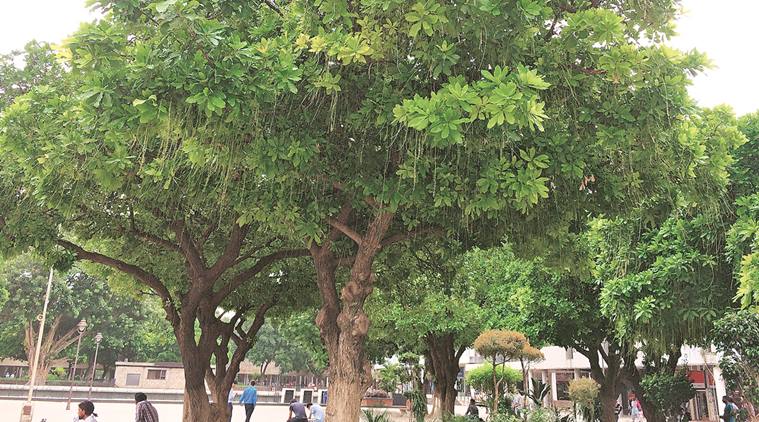 Barringtonia Acutangula in Sector 17 plaza. Jaskiran kapoor
In the heart of the Sector 17 Plaza, one can find a cluster of dense trees providing shade for the visitors taking rest or sitting on the benches placed under them.
In one corner, sits a sketch artist, ready with his pencil to capture the human expressions, but unaware of the many moods of the tree above him.
Flaunting a lovely after-rain green, the Barringtonia Acutangula forms a large part of the plaza landscape; it’s thin and ribbon-like extensions dangling from the bunches of leaves like a million little bow-ties.
Although the rains have washed away most of it, tiny pink and red coloured blooms still dotted the long slender pendulous racemes.
WATCH: Monsoon Session: BJP Reaches Out To Congress To End GST Stalemate
[related-post]
This is Samundar-phal and Indian Oak as it is commonly referred to as. Not found in huge numbers in the city, this evergreen tree grows to a moderate height and size and is also known as ‘Dhatriphala’ or ‘nurse’s fruit’, as a domestic remedy.
Its root is said to be useful in place of quinine according to The Tree Directory of Chandigarh and its bark is often used for stupefying fish and used as a tan.
Although in these parts it is cultivated as an ornamental tree, Barringtonia is usually found of the banks of streams, in moist places and wetlands.
No wonder it is also popular as Freshwater Mangrove and forms part of largest wetlands in the Northeast, Sonbeel in Assam’s Barak Valley.
From the Lecythidaceae family, Barringtonia in Sanskrit is called Hijja or Hijjala, and also as Pichul, Nichul, Abja, Adal, Neora, Injar, Jujar, Panniari. Interestingly, according to Flowers of India, Barringtonia has earned the reputation of being the Itchy Tree, ‘after a caterpillar with irritant haris that colonises the base of its leaves’.
With tree plantation drives on in full swing, one can propagate Barringtonia by seed and while it is quite tolerant of heavy clay soils with poor drainage, it can adapt fast to variety of soils too.
The tree can be spotted in Sector 9 market, in sectors 14, 21, 40, and in the Chandigarh Botanical Garden.
Stay updated with the latest - Click here to follow us on Instagram