Journalism of Courage



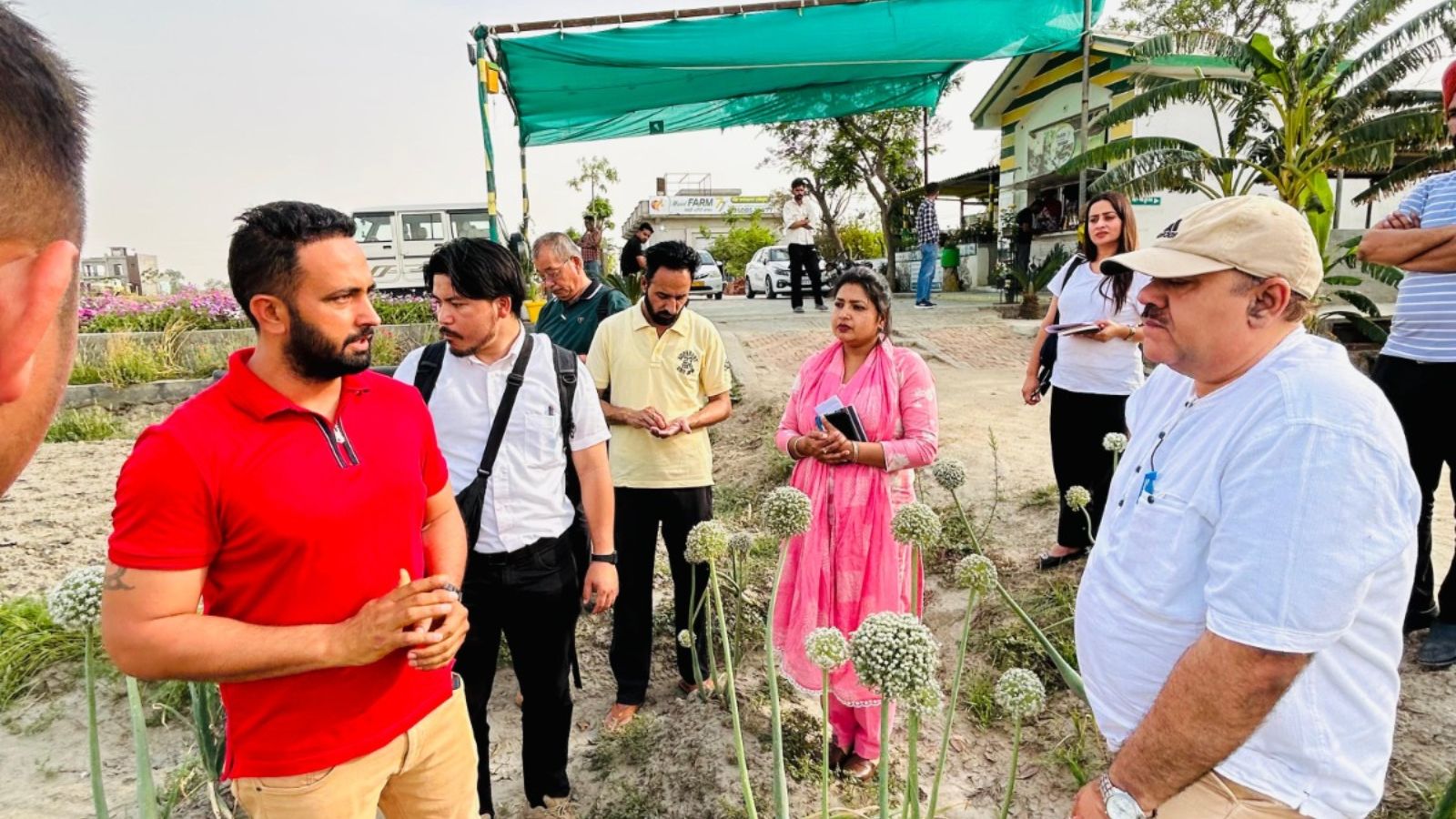 Farmer Mani Kaler in his onion seed field with visitors (Express Photo)
In a quiet village of Raidharana in Lehragaga tehsil of Sangrur district — a region infamous for its high farmer suicide rate — 36-year-old Mani Kaler is rewriting the narrative of despair into one of hope and prosperity.
Despite leaving more than half of his 24-acre farm fallow for four months each year to rejuvenate the soil, Kaler earns an impressive profit of around Rs 70 lakh annually depending on the market after covering all input and labour costs. His farm is not just a source of personal income, but also a significant contributor to rural employment — around 100 labourers are engaged for eight months of the year, while 15 workers are employed full-time throughout the year.
Kaler’s farming journey began in 2013, when he was just 24. He decided to move away from his family’s practice of leasing out land and not cultivating it by themelves. He started by cultivating 2.5 acres for flower seed production under contract with a private company. Encouraged by early results, he expanded to vegetable farming on 5 acres, and by 2018 had established nursery cultivation on 10 acres. By 2024, he had reclaimed all 24 acres and converted the entire holding into a model of diversified and profitable farming.
 Farmer Mani Kaler showing his onions Nursery fields (Express Photo)
Today, 14 of Mani Kaler’s 24 acres are dedicated exclusively to growing vegetable nurseries — covering a wide range of both summer and winter crops, including cauliflower, tomato, capsicum (in all colors), chillies, onions, multiple brinjal varieties and types of flowers. The nursery cycle runs from August to March, during which Kaler raises multiple rounds of saplings on every single acre. Owing to the rotation, he cultivates the equivalent of 3–4 acres from just a single acre over a season, as most nurseries are ready for sale within 30 to 40 days.
“After each batch is sold, the land is replanted to grow new nursery stock,” Kaler explains, adding “I begin sowing cauliflower and onion nursery crops in August, and this continues till December end. These fields are typically vacated by January end or early February. The same process applies to other vegetable nurseries. I then allow the nursery fields to rest from April to July — a practice I believe is essential for maintaining long-term soil health and sustainability.”
The remaining 10 acres are devoted to a well-planned mix of high-value crops: 2 acres under turmeric, 1 acre for strawberries, 2 acres for onions, and 5 acres for seed production of onion and cauliflower. After harvesting the seed crop, this 5-acre block is rotated with Basmati rice from July to October.
 Farmer Mani Kaler at his outlet in his field where farmers from four states come to purchase nursery (Express Photo)
Kaler, who runs his venture under the name ‘Mani Farm77’, sells his nursery saplings directly from an outlet on his farm to farmers from Punjab, Haryana, Rajasthan, and Uttar Pradesh. “I don’t take my produce to the market — the market comes to me,” he says.
In addition to vegetables and nursery plants, he also grows seasonal fruits such as watermelon and muskmelon on around couple of acres, and has planted a variety of fruit trees on some portion of his farm land.
“From nursery sowing I earn about Rs 3 lakh per acre per batch after all expenses and if I take more than one batch of nursery from the same fields during the eight-month nursery sowing then it can be multiplied accordingly,” says Kaler, adding that beyond the nursery fields, he also earns around Rs 2.5 lakh per acre annually from his other crops, including onion crop, onion and cauliflower seed production, Basmati rice, and other seasonal crops.
“I have a sanctioned crop loan limit from the bank, but I rarely need to use it. If I build a new structure or facility, I may use it briefly — and repay it within months.”
 Farmer Mani Kaler with Chief Minister’s Award
Kaler’s scientific and forward-thinking approach to farming includes regularly attending training sessions at Punjab Agricultural University. His efforts and innovations in sustainable farming were recently recognized with the Chief Minister’s Award presented to him in March 2025.
“My focus is on continuous improvement — from expanding the nursery to developing my own marketing channels. I believe land should not only be cultivated but also cared for,” he says, adding “When I take multiple nursery batches from the same fields, it becomes essential to let the soil rest for 4–5 months a year to rejuvenate. I’ve seen firsthand how this improves both productivity and soil health.”

 5 min read