Journalism of Courage



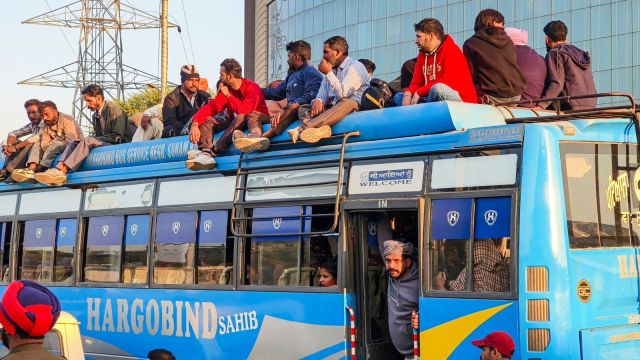 Commuters board a private bus, a day after a strike by PRTC contractual workers over detainment of their leaders by police, at a bus stand, in Patiala. (PTI Photo)
Bus services across Punjab remain partially halted as employees of Punjab Roadways, PUNBUS and PRTC continue their indefinite strike against the government’s kilometre scheme from November 28 onwards. The standoff intensified after the state terminated the employment of 152 employees and issued notices to several others following clashes during protests. As the confrontation deepens, here is a look at what the kilometre scheme is, why it was introduced, and why employees are vehemently opposing it.
The kilometre scheme is a model under which the state transport undertakings (Pepsu Road Transport Corporation — (PRTC), Punjab Roadways and PUNBUS contract out bus operations to private operators. Under this scheme, a private person supplies (or buys) the bus and hires the driver and handles maintenance; the state issues the route permit, assigns the route, provides (in many cases) the conductor and fuel, and pays the private operator a fixed amount per kilometre travelled.
In effect, the bus remains under a state-run permit/route, but the bus ownership and primary operations are with the private operator. The government avoids the upfront cost of buying new buses, the maintenance burden, and the driver-salary liability.
According to previous reports, the kilometre scheme in Punjab was first introduced around 1998. The main reason is to ease the financial and capital burden on the state. The state transport department often lacks sufficient funds to buy new buses; through the kilometre scheme, buses can be added quickly without requiring a large capital investment from the government.
So far, around 217 buses are already running under the kilometre scheme in PRTC by signing a six-year contract. Of these, the contract for 140 buses is about to expire.
In PUNBUS, the scheme was introduced in 2007-2008 during the SAD-BJP government. Still, after persistent employee protests, in 2013, the government decided not to procure any more buses for PUNBUS under the kilometre scheme. Still, now the AAP government is again all set to hire around buses under the kilometre scheme in PUNBUS as well as PRTC due to which we went on strike from November 28 onwards,” said Yudh Singh, state general secretary of Punjab roadways, PUNBUS and PRTC contract staff union.
In Punjab, as of now, nearly 2300 buses are under the state government, and not more than 1600 employees are on regular rolls, while nearly 7500 employees are on contract and outsourced collectively, revealed union members. The number of regular employees has been declining over the years, as new hires are mostly contract staff, he added.
According to Bikram Singh Shergill, MD, PRTC, the kilometre scheme is being run in other states as well, and Punjab is not the lone state. Rather, in Punjab, not more than 18 per cent of the fleet is under the kilometre scheme, while in many states, it ranges from 24-27 per cent as well.”
Employees (contractual or outsourced staff) and their unions have several grievances against the scheme and how it is being implemented. They claim the kilometre scheme undermines job security: by outsourcing buses to private operators, the number of state-run buses (and thus state-employed staff) is reduced. Many longstanding contractual/outsourced workers feel their chances of regularisation (permanent employment) are being bypassed.
“The bus operator under the kilometre scheme gets a regular payout from the government based on the kilometres he runs through buses on the routes given by the government.” The government is thus paying lakhs to these bus operators only to save employees’ salaries, and after 5 or 6 years, when his contract ends, the bus is retained by the private owner. So this is a loss-making venture,” said Yudh Singh.
Employees have been protesting against the kilometre scheme for months. However, on November 1, Contract staff staged a protest in Ludhiana against the planned induction of 142 AC buses and 19 Volvo buses under the kilometre scheme by Punjab Roadways. And over 100 PRTC buses as well. Union representatives warned this would further threaten jobs. The government postponed the tender for hiring these buses at that time to November 17 following the protest. However, on November 17, workers held another one-day strike.
On November 28, a statewide indefinite strike began after police reportedly detained several union leaders early in the morning. Over 3,000 buses stayed off roads; major depots were locked down; bus stands were blocked, sit-ins and protests occurred in various cities (including Ludhiana, Patiala, Sangrur, Jalandhar, Amritsar, Ferozepur), causing severe commuter disruption. On the same day at a depot in Sangrur, the protest escalated — one of the protesters set himself on fire, and while controlling the situation, a police officer also got minor burns. This triggered a police crackdown and arrests.
On November 29, the government responded by sacking 152 employees, including ten employees involved in burn injuries to a police officer in Sangrur. As on November 30, a meeting between union members and Punjab transport minister Laljit Singh Bhullar is underway at Tarn Taran.

 5 min read